


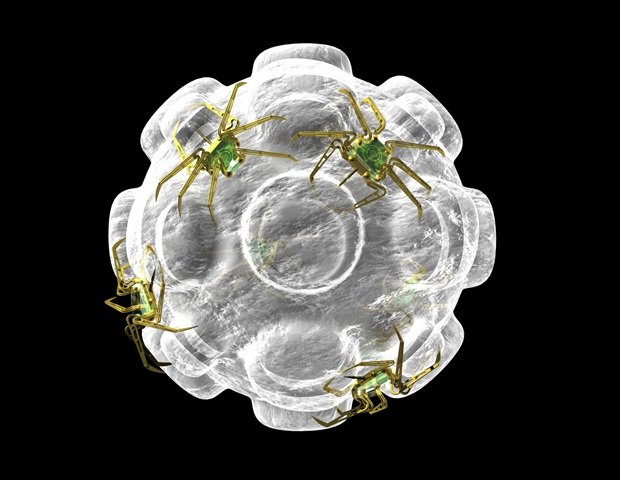
Just as the human body relies on organs like the heart or liver for essential functions, cells depend on their own tiny organs, or organelles, to perform vital tasks, including transporting nutrients, removing waste, and regulating genetic activity.
Now, a team of UCLA researchers has developed a new method for making programmable artificial organelles inside living cells using RNA as both the material and the blueprint. The approach allows researchers to design droplet-like cellular compartments that assemble in predictable ways and can be controlled in terms of how and where they form, as well as which molecules they recruit. A study describing the new approach was published on April 29 Nature Nanotechnology.
Some organelles are enclosed by membranes, but others are membrane-less, droplet-like clusters of proteins and RNA known as biomolecular condensates. These structures form as needed and act as temporary workspaces where molecules gather to perform specific functions more efficiently. Artificial condensates have emerged as a promising tool in synthetic biology, offering a way to reorganize the cell’s internal environment and direct chemical reactions and gene activity.
Unlike previous approaches based on naturally aggregating proteins, this method encodes assembly instructions directly into the RNA sequence and structure, allowing condensates to be designed with precise interaction rules and tunable properties.
This research is a step towards architectural engineering of the cell interior. By using RNA as a building material, we can create customizable compartments inside cells while using fewer cellular resources than protein-based approaches.”
Elisa Franco, study leader, professor of mechanical and aerospace engineering and industrial engineering, UCLA Samueli School of Engineering
To drive the formation of condensates, the researchers designed small strands of RNA that fold into structures they call “nanostars,” each with three or more arms. At the ends of these arms are complementary sequences known as “kissing loops”, which link together and allow the nanostars to assemble into larger networks. Because RNA follows predictable base-pairing rules, the structures can be programmed to form in specific ways.
The team also demonstrated the ability to tune the size, composition and location of the condensates. By modifying the number and length of the nanostar arms or the strength of their interactions, the researchers could shift where condensates form inside the cell, including between the cytoplasm and the nucleus, where they perform different functions.
“We can control how and where these RNA droplets form and what they attract, effectively creating new, temporary rooms inside the cell equipped with select molecular tools,” said study first author Shiyi Li, a bioengineering PhD candidate and member of Franco’s Dynamic Nucleic Acid Systems lab.
As the technology develops, these programmable concentrates could enable the creation of synthetic organelles inside living cells with specialized biological functions, opening up new possibilities in nanomedicine, genetics and cellular engineering.
Other authors of the paper include Neil Lin, UCLA Samueli associate professor of mechanical and aerospace engineering and bioengineering. Kathryn Plath, professor at UCLA’s Broad Stem Cell Research Center. and Associate Professor Melody Li and Professor Douglas Black, both from UCLA’s Department of Microbiology, Immunology and Molecular Genetics. They are joined by Dino Osmanovich, a project scientist on Franco’s team. postdoctoral researchers Anli Tang and Wen Xiao; graduate students Eric Payson, Alexandra Bermudex, and Maria Nieto. and undergraduates Yuna Kim, Kevin Wang, Madison Yang, and Diego Dilao.
The research was funded by the National Science Foundation, the Alfred P. Sloan Foundation and the National Institutes of Health. The UCLA Technology Development Group has filed for a patent related to the technology.
Source:
Journal Reference:
