


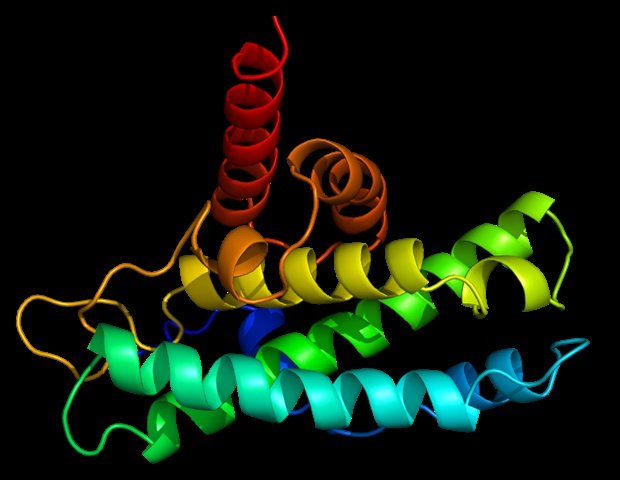
University of Cincinnati structural biologists are the first in the world to visualize a key cellular protein as part of newly published research from the College of Medicine.
The Seegar lab became the first to visualize the structure of a regulatory protein, iRhom1, bound to the enzyme ADAM17, using cryogenic electron microscopy housed at UC’s Center for Advanced Structural Biology. This follows the lab’s work published last year that visualized the structure of ADAM17 bound to iRhom2.
ADAM17 enzyme activity is essential in humans for proper tissue growth and immune response, and modulation of its activity is a drug target for the treatment of chronic inflammatory diseases. Ectodomain shedding is the fundamental biological process in which enzymes, such as ADAM17, rapidly cleave and release other protein targets from the cell surface, altering cell-to-cell communication.
Thus, this latest research, published in Cell Reports, identified structural elements in both iRhom1 and iRhom2 that act as a molecular relay, relaying information to the cell surface and linking intracellular signaling to the activation of ADAM17 enzymes at the cell surface.
ADAM17 is rapidly activated in response to changes in intracellular signaling networks, yet how these signals are transmitted across the cell membrane to where ADAM17 is located remains a long-standing question in the field.”
Tom Seegar, PhD, corresponding author, assistant professor, Department of Molecular and Cellular Biosciences, and Ohio Distinguished Scholar
The first authors of the study are Joe Maciag, PhD, a researcher in the Seegar lab, and Joe Ungvary, a third-year graduate student in cancer and cell biology.
The Seegar lab also revealed new insights into why the iRhom1 and iRhom2 proteins are thought to be key regulators of ADAM17, which exists only in a complex with iRhom1 and iRhom2. They found that the structures of both iRhom1 and iRhom2 are identical, as are their responses to intracellular signals, leading to a unified model for enzyme activation.
“While the structures are strikingly similar, their functions are divergent. The ability to maintain distinct roles despite overall structural similarities can likely be attributed to their sequence nuance, which helps preferentially recognize and cleave substrates,” said Maciag.
How they know which function or job to do is unknown, and why they make different decisions is expected to be studied more closely in the future. “It’s what’s been missing in our field for 30 years,” Seegar said.
In addition, iRhom proteins, particularly iRhom2, will further serve as a new drug target for the treatment of chronic inflammatory diseases, as they appear to be the drivers of ADAM17 specificity.
The researchers also looked at an iRhom1 mutation identified in a patient with cardiomyopathy.
They found that the variant was completely defective in supporting iRhom1-ADAM17 function. “We were able to see that the iRhom1 proteins were probably not able to fold properly,” Ungvary said. “The structure of the protein is not correct, therefore, its function is null.”
In this case, ADAM17 could neither function properly nor reach its target near the cell surface. Dysregulated ADAM17 activity has been implicated in a wide range of diseases such as chronic inflammation, cancer and neurodegenerative disorders.
“Notably, this phenotype differs from those observed in animal models and may more accurately reflect the consequences of iRhom1 dysfunction in humans,” said Seegar. “This is one of the first insights into how this biology is different in human and animal models.”
