


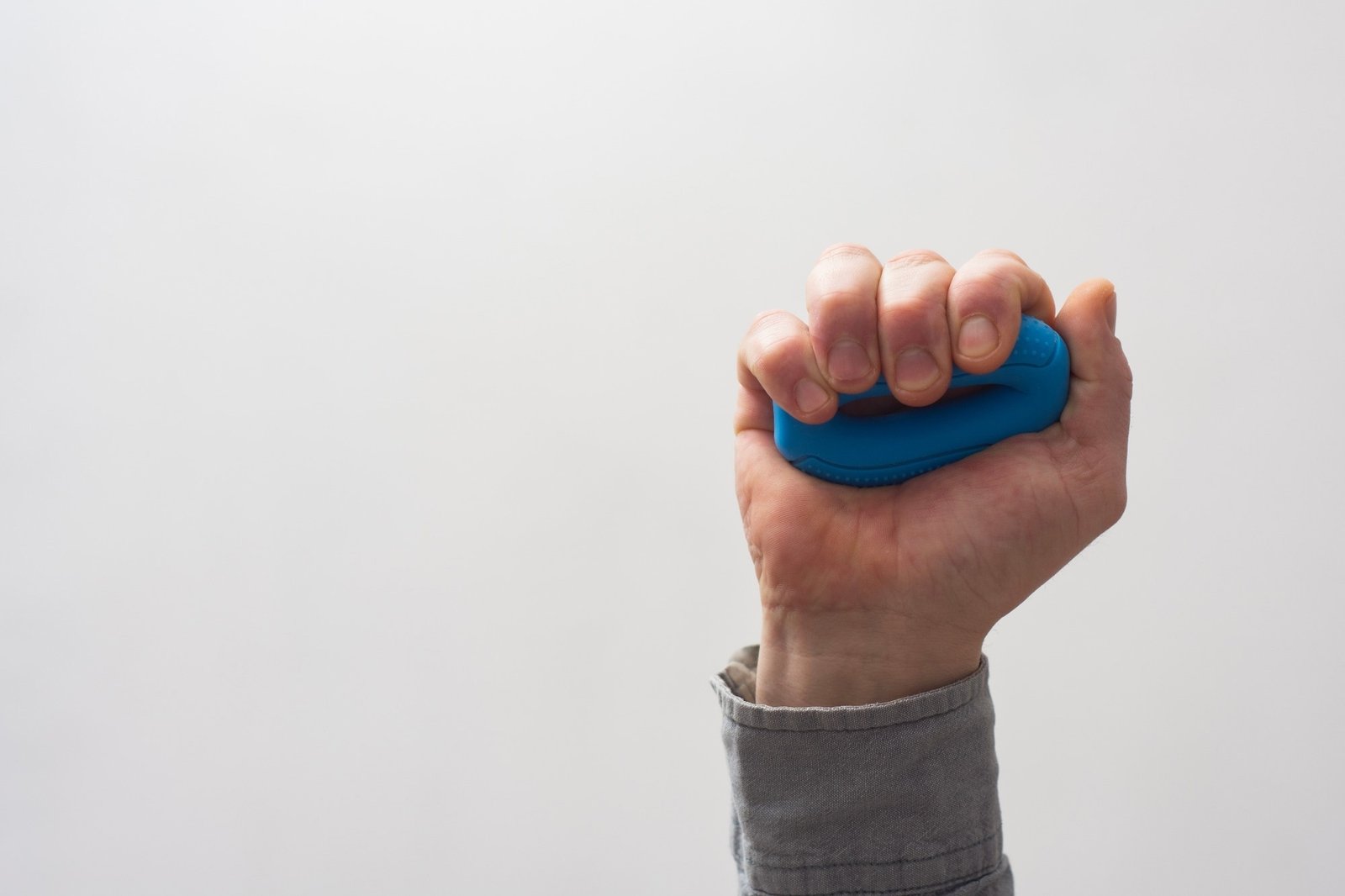
Struggling to remain stable under pressure may not just be ‘in your head’. The researchers found that mental stress can directly affect muscle blood flow and fine motor control during simple physical tasks.
Study: The effect of cognitive stress on vascular response and force stability during a handgrip task in men and women. Image credit: VADZIM SHUBICH/Shutterstock.com
Force stability during very low-intensity contractions and vascular responses involved in the performance of motor tasks may be reduced under cognitive stress, according to a new study published in Journal of Applied Physiology.
Cognitive stress affects physical performance
Adequate blood flow to the working muscles is essential to meet the energy demands of the muscles during tasks involving sustained force, such as the handgrip test. In these tasks, known as isometric contractions, the muscles produce force without appreciably changing length or moving the joint. This prolonged contraction increases the pressure within the muscle, which can restrict blood flow to the active tissue.
Many daily activities, workplace tasks, and military operations require people to perform physical and mental tasks simultaneously. For example, a person may need to maintain steady muscle control while also concentrating under pressure or performing a mentally demanding task. However, researchers still know relatively little about whether cognitive stress affects blood flow and vascular control in working muscles during these types of motor activities.
This study was designed by researchers at the University of Oklahoma, USA, to investigate changes in muscle blood flow, force stability and muscle activation during isometric grip tasks at various intensities, with or without a stressful cognitive task.
The research group included both male and female participants, as gender differences may influence the effect of intramuscular pressure on blood flow.
Control of blood flow during stressful motor challenges
The study population included 15 male and 15 female participants who attended two randomized experimental sessions three days apart. In one session, both cognitive and motor tasks were performed simultaneously, while in the second session, only the motor task was performed individually.
The cognitive task involved difficult mental math, a widely used technique to increase biomarkers of stress. The isometric handgrip task was chosen as a motor task in which participants performed isometric contractions at 5%, 10%, and 20% of maximal voluntary contraction.
Forearm vascular conductance, which is a measure of the ease of blood flow through blood vessels relative to pressure, was measured during each isometric contraction. Force constancy was measured as the amplitude of force fluctuations after muscle contractions. Acute changes in anxiety during the experimental protocol were assessed using a visual analog scale.
Mental stress reduced blood vessel function during contractions
Analysis of the study revealed that the cognitive stress induced during the mental math test significantly reduced forearm vascular conductance in both men and women. The reduction was greater at lower contraction intensities.
For contractions performed at very low and low intensities (5% and 10%), participants with greater maximal voluntary contraction (stronger participants) showed smaller decreases in forearm vascular conductance. In sessions involving cognitive tasks, mean arterial pressure increased to a greater extent at lower contraction intensities, and the induction was stronger in women.
Regarding strength stability, the study found a significant reduction in the cognitive stress response only in very low-intensity contractions. The reduction was comparable between male and female participants.
The researchers observed no significant changes in muscle activation patterns measured by electromyography (EMG) during cognitive stress.
Stress can disrupt muscle control and blood regulation
The findings suggest that cognitive stress may impair both muscle control and vascular function during low-intensity handgrip tasks in men and women. The effects were most noticeable during very low force contractions, where participants showed reduced handgrip stability along with lower forearm vascular conductance.
While the reduction in force constancy was similar between participants, reductions in vascular conductance were greater in subjects with lower maximal voluntary contraction (MVC) values. In this study, these participants were more often women, who, on average, had lower levels of strength than men.
Previous research has shown that intramuscular pressure plays an important role in regulating blood flow during isometric contractions performed without cognitive stress. In stronger individuals, the higher pressure within the muscle can restrict blood flow even at relatively low contraction intensities, sometimes below 20% of maximal effort. Consistent with this, female participants in the current study, who had approximately 43 % lower MVC values than males, showed greater vascular conductance only during motor work, particularly at very low contraction intensities.
However, when the motor task was combined with a mentally stressful task, women tended to show greater decreases in vascular conductance at lower contraction intensities. The authors suggest that the greater intramuscular pressure generated by stronger men may partially offset the effects of cognitive stress on blood flow regulation. However, the researchers stress that the mechanisms involved are not yet fully understood.
Previous studies have reported that cognitive stress can affect sympathetic nerve activity and vascular conductance under resting conditions, although findings varied by muscle group and population studied. The current findings extend this work by showing that cognitive stress can also alter vascular regulation during active muscle contractions.
Overall, the study highlights the important contribution of cognitive stress to altering vascular responses and force control in both men and women during motor activities.
