

Close Menu
Healthtost
  • News
  • Mental Health
  • Men’s Health
  • Women’s Health
  • Skin Care
  • Sexual Health
  • Pregnancy
  • Nutrition
  • Fitness
  • Recommended Essentials
What's Hot

Global childhood immunization rates stagnate despite slight recovery from pandemic

July 15, 2026

Is it okay to be imperfect and still be happy? 6 Challenges

July 15, 2026

Sexual evolution: What 500 million years of life tell us about sex, gender and mating

July 15, 2026
Facebook X (Twitter) Instagram
  • About Us
  • Contact Us
  • Privacy Policy
  • Terms and Conditions
  • Disclaimer
Facebook X (Twitter) Instagram
Healthtost
SUBSCRIBE
  • News

    Global childhood immunization rates stagnate despite slight recovery from pandemic

    July 15, 2026

    Weight loss and anti-inflammatory drugs combine to fight leukemia

    July 14, 2026

    Unreliable datasets shape clinical prediction models

    July 14, 2026

    Bariatric surgery is safe, effective for obese teenagers and young adults

    July 13, 2026

    Engineered ribozyme repairs broken RNA to explain origin of life

    July 13, 2026
  • Mental Health

    Is it okay to be imperfect and still be happy? 6 Challenges

    July 15, 2026

    How can you be tired but wired? Blame it on your stone age brain

    July 12, 2026

    Almost 20% of new mums have anxiety or depression, but a promising psychedelic treatment is on the horizon

    July 7, 2026

    How can ART help us improve our mental health? With 3 Ways

    July 5, 2026

    How much do friends affect the mental health of teenagers? What a new study can (and can’t) tell us

    July 3, 2026
  • Men’s Health

    Sexual evolution: What 500 million years of life tell us about sex, gender and mating

    July 15, 2026

    Low testosterone or just stress? How to tell the difference

    July 11, 2026

    Gut-friendly diet linked to lower risk of coronary heart disease mortality

    July 9, 2026

    Men don’t just avoid their health. Many lose themselves.

    July 8, 2026

    The Crazy Hard Standards of the Hardest PE Program in History

    July 8, 2026
  • Women’s Health

    I tried to hide my hemiparesis

    July 15, 2026

    Kyoto recap, bamboo forest and monkey park

    July 13, 2026

    Menopause and Your Microbiome: How Gut Health Shapes Weight, Mood, and Hormones

    July 11, 2026

    They heard us. Now will they listen?

    July 11, 2026

    Taite Heller on Why Barre Became a Top-5 Fitness Trend

    July 8, 2026
  • Skin Care

    How to use nature’s retinol: Bakuchiol in your beauty routine

    July 13, 2026

    How our natural hair care achieves salon-level results without silicones

    July 11, 2026

    Coconut Allergy and Skin Care: 20 Questions Finally Answered by a Pharmacist

    July 11, 2026

    New Sunscreen Ingredient: Is This The SPF Upgrade We’ve Been Waiting For?

    July 9, 2026

    How to achieve the perfect tan

    July 8, 2026
  • Sexual Health

    Celebrating 30 years of Sex Sense

    July 15, 2026

    STDs in older adults are on the rise—up to seven times higher than in 2012

    July 13, 2026

    Fildena 150 Benefits | Effective ED & Sexual Performance Treatment

    July 11, 2026

    Painful sex after menopause: When is it time to seek treatment?

    July 11, 2026

    Emotional capitalism and artificial intimacy

    July 10, 2026
  • Pregnancy

    Exercise Wall Angels During Pregnancy: A Step-by-Step Guide

    July 15, 2026

    Breech VBAC (Vaginal Birth after Caesarean Section) Birth Story

    July 13, 2026

    How baby showers have changed throughout history

    July 13, 2026

    Calf Raises During Pregnancy: Step-by-Step Guide and Benefits

    July 8, 2026

    Tri-Tri Triplet Pregnancy with Vaginal Birth Story – The Birth Hour Triplet Pregnancy and Vaginal Birth Story with Ashlie Holladay

    July 7, 2026
  • Nutrition

    Chocolate Cherry Chia Pudding: Easy Vegan Recovery Snack

    July 14, 2026

    The Cholesterol Question: A Breakthrough Victory for Keto and Cognitive Health

    July 14, 2026

    15 No-Cook Dinners for Kids (Because It’s Too Hot to Turn on the Oven)

    July 12, 2026

    30 Minute Chicken Pesto Pasta (Dietist Approved)

    July 11, 2026

    5 Easy High Fiber Bowl Recipes

    July 8, 2026
  • Fitness

    How to Choose a Fitness Certification on a Budget

    July 14, 2026

    Meet the Belle Vitale™ Supplement System: Two Formulas. A comprehensive approach to hormone health.

    July 11, 2026

    where we ate in Tokyo (and gluten-free options!)

    July 9, 2026

    Using External Signaling to Improve Linear Acceleration – Tony Gentilcore

    July 8, 2026

    5 Simple Screen Changes That Can Improve Sleep and Focus

    July 7, 2026
  • Recommended Essentials
Healthtost
Home»Mental Health»New hope for fast-acting depression treatment
Mental Health

New hope for fast-acting depression treatment

healthtostBy healthtostOctober 29, 2024No Comments6 Mins Read
Facebook Twitter Pinterest LinkedIn Tumblr Reddit WhatsApp Email
New Hope For Fast Acting Depression Treatment
Share
Facebook Twitter LinkedIn Pinterest WhatsApp Email

October 24, 2024
• Research Highlights

Depression symptoms can be difficult to manage, especially for people with treatment-resistant depression, a persistent and severe form of the disorder. Fortunately, new treatments are emerging for such difficult conditions. One of these is the drug ketamine, which numerous NIMH-funded studies have shown to have real action and lasting effects in people with mood disorders such as depression.

Realization: Jennifer Fontan.

The discovery of ketamine was a game-changer for people with severe depression, who often need rapid relief from life-threatening symptoms. While most antidepressants take weeks or months to work, ketamine works within hours to significantly reduce symptoms of depression in people for whom other treatments have not worked.

Despite ketamine’s effectiveness as an antidepressant, serious concerns limit its use, including problematic side effects and a high risk of misuse. To address these concerns, the National Institutes of Health (NIH) is investing in finding drugs that capitalize on ketamine’s therapeutic effects while avoiding its negatives.

What did the researchers look at in the study?

New research funded through NIH Blueprint Neurotherapeutics Network for Small Molecules Program tested a new drug related to ketamine known as RR– HNK. RR-HNK is a metabolite or byproduct, of ketamine that remains as the body breaks it down. RR-HNK showed antidepressant effects in preclinical animal studies but it had not yet been tested on humans.

The study involved a broad collaboration of researchers in the intramural programs of the NIH’s National Institute of Mental Health, the National Center for Advancing Translational Sciences, and the National Institute on Aging. Duke University and the University of Maryland School of Medicine. and other national and international bodies.

What did the researchers do in the study?

This study looked at safety, tolerability, pharmacokinetics (how the drug moves through the body) and pharmacodynamics (how the drug affects the body) RR-HNK for the first time in humans.

Participants were healthy adults between 18-65 years of age. A total of 74 people participated in three randomized trials: 55 received RR-HNK and 19 received an inactive placebo. Both the drug and the placebo were given intravenously, with participants and researchers unaware of which group the participants belonged to.

  • In Trial 1, participants received one of six dose levels RR-HNK only once.
  • In Trial 2, participants received one of two dose levels RR-HNK four times in 2 weeks.
  • In Trial 3, participants received a single dose RR-HNK, and their cerebrospinal fluid (a fluid that surrounds the brain and spinal cord) was collected.

The primary goal of the study was to determine whether the drug is safe by first testing it in healthy adults without a diagnosed mental health condition. Throughout the study, the researchers watched closely for adverse effects, such as negative side effects. The comprehensive safety profile included physical examinations. lab results; vital signs; electrocardiograms of cardiac activity. and assessments of mood, suicidal risk, and dissociative and depressive symptoms. In addition, participants were asked to inform study staff if they experienced any concerns or side effects at any point.

The researchers also collected blood and urine samples from all participants before, during and after taking the drug. These samples and the cerebrospinal fluid collected in Trial 3 were used to test whether the drug entered the body and brain.

As a final exploratory step, the researchers used brain imaging to examine the participants’ gamma oscillations (a type of brain wave) before and after taking the drug. This measure of the brain’s response to stimuli is one of the few available biomarkers of a drug’s effects on the brain.

What did the study find?

RR-HNK has proven to be extremely safe, with no serious side effects and only mild side effects that resolve quickly without care. Participants also reported no symptoms of depression or dissociation. The positive safety profile was maintained at all doses tested and after multiple doses. Together, the results show it RR-HNK is safe and tolerable, with limited potential for abuse or misuse.

The cerebrospinal fluid confirmed it RR-HNK entered the brain and remained at detectable levels several hours after administration. The results further showed a dose-dependent response to the drug, meaning that at higher levels RR-HNK, the amount of the substance in the body also increased at the same rate. A predictable relationship between the amount of RR-HNK is given and the amount of RR-HNK in the bloodstream is important to the drug’s clinical effectiveness, allowing doctors and researchers to precisely calibrate doses to a person’s specific level and type of symptoms.
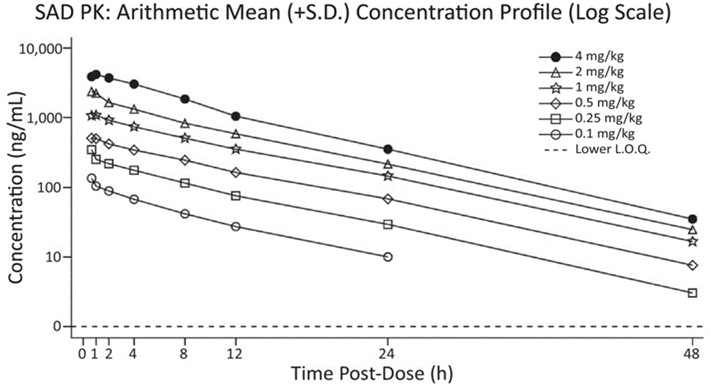
Plasma concentration-time profiles for the six dose levels of RR-HNK tested in Trial 1.

RR-HNK plasma concentration-time profiles from Trial 1. Reprinted from “A Phase 1 Assessment of the Safety, Tolerability, Pharmacokinetics and Pharmacodynamics of (2R,6R)-Hydroxynorketamine in Healthy Volunteers,” by SM Raja et al. , 2024, Clinical Pharmacology & Therapeutics, 116(5), pp. 1314–1324 (https://www.doi.org/10.1002/cpt.3391). Copyright 2024 by the authors.

In the brain activity test, some participants who received low to moderate doses RR-HNK, but not those given high doses or the placebo, showed an increase in the power of gamma oscillations. Preliminary evidence that RR-HNK causing a change in brain activity strengthens the case for its use as an antidepressant and provides a clinical biomarker to measure if it works in future research. However, there was a lot of variability in the results, and given the small number of participants, the researchers caution against drawing firm conclusions from these findings.

What do the results mean?

This study offers critical insight into its safety, tolerability, and effects RR-HNK in a diverse population of healthy adults. Findings from this early-stage study show that the ketamine metabolite does not cause the negative side effects of ketamine and is safe for use in humans. The results also help define dosing parameters for its use in future research and therapy.

These data, particularly a strong safety profile, support progress to the next phase of research aimed at developing new treatments for people with difficult-to-treat mental disorders. Despite the small size of each trial, making some of the results difficult to interpret, the findings hold promise for the future of mental health treatment. This study is a critical early step in NIMH’s mission to improve the treatment of mental illness through research, setting the stage for clinical trials testing whether RR-HNK effectively treats depression and other disorders.

Reference

Raja, SM, Guptill, JT, Mack, M., Peterson, M., Byard, S., Twieg, R., Jordan, L., Rich, N., Castledine, R., Bourne, S., Wilmshurst, M., Oxendine, S., Avula, SGC, Zuleta, H., Quigley, P., Lawson, S., McQuaker, SJ, Ahmadkhaniha, R., Appelbaum, LG … & Thomas, CJ (2024). Phase 1 evaluation of the safety, tolerability, pharmacokinetics and pharmacodynamics of (2R,6R)-hydroxynorketamine in healthy volunteers. Clinical Pharmacology & Therapeutics, 116(5), 1314–1324. https://www.doi.org/10.1002/cpt.3391

Grants

R01MH107615 , ZIAMH002857 , ZIATR000042 , ZIAAG000297

Clinical trial

NCT04711005

depression fastacting hope Treatment
bhanuprakash.cg
healthtost
  • Website

Related Posts

Is it okay to be imperfect and still be happy? 6 Challenges

July 15, 2026

How can you be tired but wired? Blame it on your stone age brain

July 12, 2026

Fildena 150 Benefits | Effective ED & Sexual Performance Treatment

July 11, 2026

Leave A Reply Cancel Reply

Don't Miss
News

Global childhood immunization rates stagnate despite slight recovery from pandemic

By healthtostJuly 15, 20260

In 2025, 90% of infants worldwide – or nearly 116 million – received at least…

Is it okay to be imperfect and still be happy? 6 Challenges

July 15, 2026

Sexual evolution: What 500 million years of life tell us about sex, gender and mating

July 15, 2026

I tried to hide my hemiparesis

July 15, 2026
Stay In Touch
  • Facebook
  • Twitter
  • Pinterest
  • Instagram
  • YouTube
  • Vimeo
TAGS
Baby benefits body brain cancer care Day Diet disease exercise finds Fitness food Guide health healthy heart Improve Life Loss Men mental Natural Nutrition Patients People Pregnancy research reveals risk routine sex sexual Skin Skincare study Therapy Tips Top Training Treatment ways weight women Workout
About Us
About Us

Welcome to HealthTost, your trusted source for breaking health news, expert insights, and wellness inspiration. At HealthTost, we are committed to delivering accurate, timely, and empowering information to help you make informed decisions about your health and well-being.

Latest Articles

Global childhood immunization rates stagnate despite slight recovery from pandemic

July 15, 2026

Is it okay to be imperfect and still be happy? 6 Challenges

July 15, 2026

Sexual evolution: What 500 million years of life tell us about sex, gender and mating

July 15, 2026
New Comments
    Facebook X (Twitter) Instagram Pinterest
    • About Us
    • Contact Us
    • Privacy Policy
    • Terms and Conditions
    • Disclaimer
    © 2026 HealthTost. All Rights Reserved.

    Type above and press Enter to search. Press Esc to cancel.