

Close Menu
Healthtost
  • News
  • Mental Health
  • Men’s Health
  • Women’s Health
  • Skin Care
  • Sexual Health
  • Pregnancy
  • Nutrition
  • Fitness
  • Recommended Essentials
What's Hot

If you can still do these 7 things at 60, your body is aging better than most

May 2, 2026

AI scribes save doctors time, but fail to reduce overtime

May 2, 2026

Every mental health journey starts with being seen

May 2, 2026
Facebook X (Twitter) Instagram
  • About Us
  • Contact Us
  • Privacy Policy
  • Terms and Conditions
  • Disclaimer
Facebook X (Twitter) Instagram
Healthtost
SUBSCRIBE
  • News

    AI scribes save doctors time, but fail to reduce overtime

    May 2, 2026

    Identifying the ages at which Alzheimer’s biomarkers change sharply

    May 1, 2026

    Timing of food may shape how T cells respond to infection and therapy

    May 1, 2026

    UCLA researchers build programmable artificial organs using RNA

    April 30, 2026

    Sapio Sciences brings Claude Cowork to the lab

    April 30, 2026
  • Mental Health

    Every mental health journey starts with being seen

    May 2, 2026

    What animal studies teach us about toxic work environments

    April 27, 2026

    I hate hope: How to manage hope when you have treatment-resistant bipolar disorder

    April 19, 2026

    Rose Byrne is raw, magnetic and unfiltered as a woman in crisis

    April 18, 2026

    Can a single mother change her child’s surname in India?

    April 16, 2026
  • Men’s Health

    3 Day Home Workout Plan: Build Muscle and Burn Fat

    April 30, 2026

    GLP-1 drugs promise broader health benefits, but experts advise caution on use

    April 28, 2026

    Trauma patients recover faster when medical teams know each other well, new study finds

    April 28, 2026

    I did red light therapy for 3 months so I shouldn’t have

    April 27, 2026

    Sex Secrets for Men Over 40: Surviving Male Menopause

    April 27, 2026
  • Women’s Health

    What is the difference between UVA and UVB rays?

    May 1, 2026

    Are you a fungus fanatic? We unpack the nutritional trend of mushroom mania

    April 29, 2026

    What the Patients’ Bill of Rights Could Mean for Black Women

    April 29, 2026

    Navigating sexual health during and after cancer

    April 28, 2026

    Do tampons break the hymen? Facts, Myths and What You Need to Know – Vuvatech

    April 27, 2026
  • Skin Care

    The truth about waterless care: What your skin really needs

    May 2, 2026

    What happens to your skin while you sleep? (the science of “Beauty Sle

    May 1, 2026

    Face Peeling Mask Guide: Shine Without Irritation

    April 28, 2026

    Is your moisturizing face mist really drying out your skin?

    April 28, 2026

    Uses and Benefits of TNW Natural Aloe Vera Face Gel – The Natural Wash

    April 27, 2026
  • Sexual Health

    Boost erectile health and confidence

    May 1, 2026

    Judicial Restrictions on Abortion COVID-19 < SRHM

    April 30, 2026

    Can herpes affect fertility?

    April 29, 2026

    The Importance of Personalized Care in Medication Assisted Therapy (MAT) Programs I Novus

    April 28, 2026

    Your favorite mold is lying to you (a little) — Sexual Health Alliance

    April 28, 2026
  • Pregnancy

    5 things you need for the third trimester

    May 1, 2026

    Eating disorders in pregnancy and breastfeeding: Why “healthy eating” is not always easy

    May 1, 2026

    Comprehensive yoga for pregnancy, birth and beyond

    April 29, 2026

    Midwifery and Life – The postnatal health check New mums don’t know they can ask for

    April 28, 2026

    Epidural and unmedicated delivery with two different deliveries

    April 26, 2026
  • Nutrition

    How to create a self-care plan when you’re stressed

    May 1, 2026

    I answer the most HOT Questions about Fatty Liver

    April 29, 2026

    Why You’re Not Losing Weight After 35 (Even When You Eat Less)

    April 28, 2026

    Where to eat in London

    April 27, 2026

    Dr. Will Cole on Why Hire FDN Professionals

    April 26, 2026
  • Fitness

    If you can still do these 7 things at 60, your body is aging better than most

    May 2, 2026

    A Hike Leader’s Must-Have Kit

    April 30, 2026

    Menopausal Hair Loss Solutions: 10 Expert Tips

    April 29, 2026

    Identity Inversion: Part 1 – Ben Greenfield Life

    April 29, 2026

    How to improve accessibility in your gym

    April 28, 2026
  • Recommended Essentials
Healthtost
Home»Mental Health»Magnetic seizure therapy as effective as electroconvulsive therapy for treating depression
Mental Health

Magnetic seizure therapy as effective as electroconvulsive therapy for treating depression

healthtostBy healthtostDecember 20, 2023No Comments4 Mins Read
Facebook Twitter Pinterest LinkedIn Tumblr Reddit WhatsApp Email
Magnetic Seizure Therapy As Effective As Electroconvulsive Therapy For Treating
Share
Facebook Twitter LinkedIn Pinterest WhatsApp Email

December 18, 2023
• Research Highlights

Major depression is one of the most common mental disorders in the United States, with an estimated 21 million US adults experiencing a depressive episode in 2021. Medication and therapy are often used to treat depression, but they don’t work for everyone.

Electroconvulsive therapy (ECT) is a treatment used when people have not found relief from depression symptoms through other treatments. In ECT, an electric current is used to induce widespread seizure activity in the brain. The crisis leads to chemical changes in the brain that relieve the symptoms of depression. Although ECT is effective in reducing symptoms of depression, some people experience memory loss after treatment, especially loss of memories about their personal history (called autobiographical memories). Sometimes, these memory problems can be severe.

Magnetic seizure therapy (MST) is a newer treatment being studied for depression. It is designed to have all the benefits—and fewer of the memory and cognitive side effects—seen with ECT. In MST, a magnetic coil is held on the scalp. The magnetic coil produces seizures in the brain that are much more localized and milder than those produced during ECT.

What did the researchers do?

Sarah H. Lisanby, MD, Director of the Noninvasive Neuromodulation Unit in the Division of Experimental Therapeutics and Pathophysiology at the National Institute of Mental Health, and colleagues examined the effectiveness of MST compared with ECT for the treatment of depressive symptoms.

The study included 73 participants between the ages of 18 and 90 who had experienced a major depressive episode and were referred for ECT treatment. Participants were randomly assigned to receive ECT (38 participants) or MST (35 participants) three times per week until they achieved remission or until their treatment response normalized.

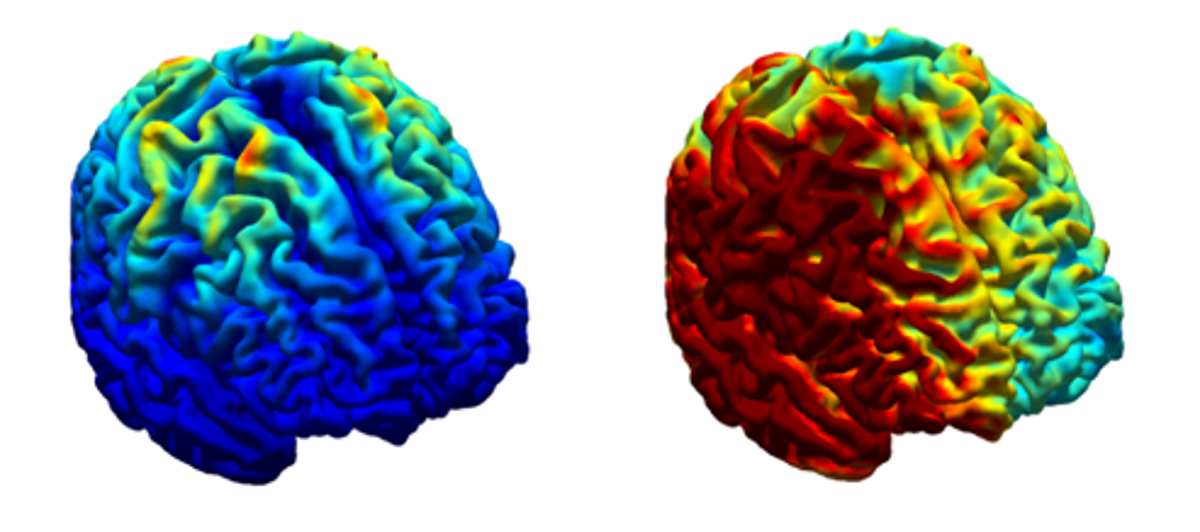
Electric field model induced in the brain by MST and ECT. Credit: This is an open access article distributed under the terms of the CC-BY license. 2023 Deng ZD et al. JAMA Psychiatry.

Clinicians assessed participants for depressive symptoms at baseline (before treatment), on the morning of each treatment session, 24 to 72 hours after each treatment session, and twice monthly for 2 months after the end of treatment, and once once a month thereafter for the duration of the study.

Clinicians also measured patients’ cognitive abilities at the start of the study and 72 hours after the last treatment session. After each treatment session, participants were asked to rate the presence and severity of potential side effects, including headache, nausea, dry mouth, muscle pain, confusion, and memory problems.

What were the results of the clinical trial?

Among participants who completed the full course of treatment (24 for ECT and 29 for MST), 60.4% experienced a significant reduction in depressive symptoms and 43.4% achieved depression remission. When researchers looked at the impact of MST and ECT treatment on all study participants—those who completed some treatment in combination with those who completed full treatment—they found that 46.6 percent experienced a significant reduction in depressive symptoms and 31.5% achieved complete depression remission.
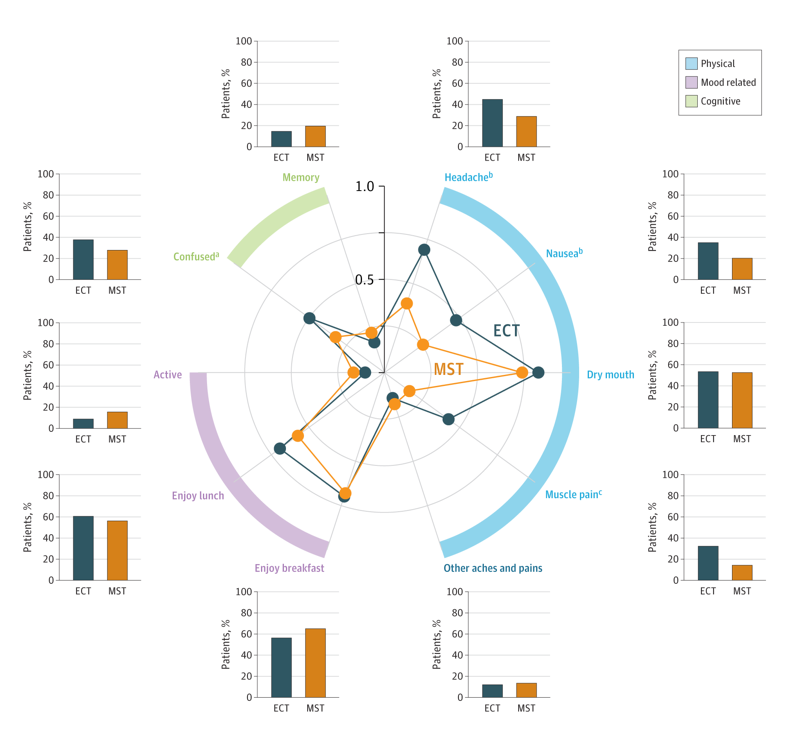
Mean severity of subjective adverse events and percentages of participants experiencing them for ECT and MST.  Credit: This is an open access article distributed under the terms of the CC-BY License.  2023 Deng ZD et al.  JAMA Psychiatry.

Mean severity of subjective adverse events and percentages of participants experiencing them for ECT and MST. Credit: This is an open access article distributed under the terms of the CC-BY License. 2023 Deng ZD et al. JAMA Psychiatry.

The researchers found no significant differences in symptom reduction or remission between the ECT and MST groups, indicating that the treatments were equally effective in alleviating depressive symptoms. Participants in the ECT group achieved depression remission slightly earlier (between 6 and 7 sessions) than the MST group (9 sessions). The antidepressant benefit of both treatments lasted up to 6 months after the last treatment session.

Patients who received ECT reported more severe headaches, nausea, muscle pain, confusion, and disorientation than participants who received MST. While global cognition remained intact for participants who received either treatment, patients who received MST showed greater recall and specificity of autobiographical memories and regained cognitive orientation after treatment more quickly than participants who received ECT.

What do these findings mean?

The clinical trial found MST to be just as effective in reducing depressive symptoms as ultra-brief right unilateral ECT—the safest form of ECT currently available. MST reduced depressive symptoms for up to 6 months and had fewer side effects than ECT. The improved autobiographical memory performance and faster cognitive orientation observed after MST treatment suggest that it provides a high level of cognitive security to participants.

The findings demonstrate the promise of MST. Larger trials are currently underway to better understand the comparison between MST and ECT and to learn how to better optimize the delivery and dosing of MST.

Report

Deng, Z.-D., Luber, B., McClintock, SM, Weiner, RD, Husain, MN, Lisanby, SH (2023). Clinical outcomes of magnetic resonance therapy versus electroconvulsive therapy for major depressive episode: A randomized clinical trial. JAMA Psychiatry. https://doi.org/10.1001/jamapsychiatry.2023.4599

Grants

MH087739 , MH002955 , TR001115

Clinical trial

NCT00488748

depression effective electroconvulsive Magnetic seizure Therapy treating
bhanuprakash.cg
healthtost
  • Website

Related Posts

Every mental health journey starts with being seen

May 2, 2026

Timing of food may shape how T cells respond to infection and therapy

May 1, 2026

The Importance of Personalized Care in Medication Assisted Therapy (MAT) Programs I Novus

April 28, 2026

Leave A Reply Cancel Reply

Don't Miss
Fitness

If you can still do these 7 things at 60, your body is aging better than most

By healthtostMay 2, 20260

Aging has a way of slowing down your body. It can affect your muscles, strength…

AI scribes save doctors time, but fail to reduce overtime

May 2, 2026

Every mental health journey starts with being seen

May 2, 2026

The truth about waterless care: What your skin really needs

May 2, 2026
Stay In Touch
  • Facebook
  • Twitter
  • Pinterest
  • Instagram
  • YouTube
  • Vimeo
TAGS
Baby benefits body brain cancer care Day Diet disease exercise finds Fitness food Guide health healthy heart Improve Life Loss Men mental Natural Nutrition Patients Pregnancy protein research reveals risk routine sex sexual Skin Skincare study Therapy Tips Top Training Treatment ways weight women Workout
About Us
About Us

Welcome to HealthTost, your trusted source for breaking health news, expert insights, and wellness inspiration. At HealthTost, we are committed to delivering accurate, timely, and empowering information to help you make informed decisions about your health and well-being.

Latest Articles

If you can still do these 7 things at 60, your body is aging better than most

May 2, 2026

AI scribes save doctors time, but fail to reduce overtime

May 2, 2026

Every mental health journey starts with being seen

May 2, 2026
New Comments
    Facebook X (Twitter) Instagram Pinterest
    • About Us
    • Contact Us
    • Privacy Policy
    • Terms and Conditions
    • Disclaimer
    © 2026 HealthTost. All Rights Reserved.

    Type above and press Enter to search. Press Esc to cancel.