


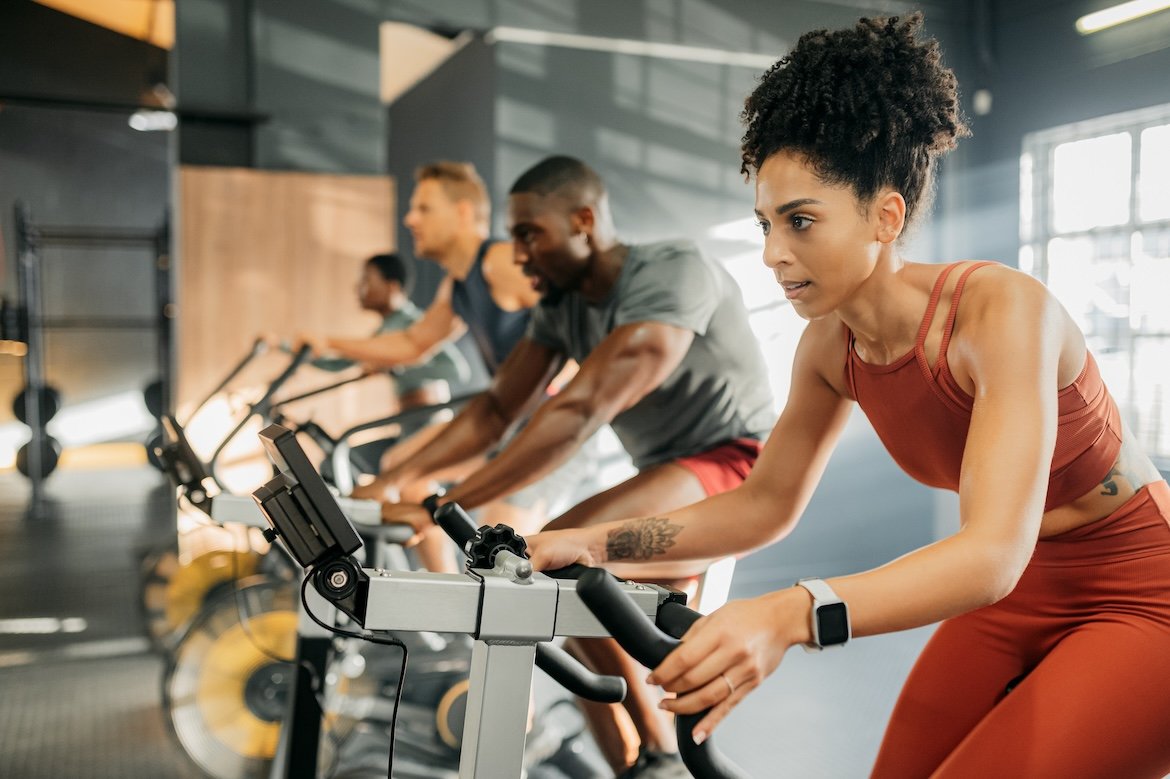
In a space where music by Black and Brown artists and Black and Brown bodies (ie big behinds) are loved and sought after, it becomes challenging when we ourselves are not welcome.
Boutique gyms, in particular, are filled with mostly white faces. Whenever I take a fitness class, the first thing I do is look for other people with black or brown skin. About seven times out of ten, I’m the only one. When you spend so much time in a place where you are another, you adopt certain behaviors—like looking for faces in the crowd that look like you—to feel safe.
Recently, I read the book Who is wellness for? An examination of wellness culture and who it leaves behind by Fariha Róisín. There was a passage in it that got me thinking about the role I play in the wellness space.
Róisín writes: “I am deeply concerned that whiteness and capitalism have co-opted wellness, relegating self-care to a privilege when wellness should be for everyone. Instead, gear, gadgets, and clothing (mostly created by whites for other whites while completely stealing other people’s culture) have maintained inequality for the masses.”
With that in mind, let’s take a look at how and why wellness excludes Black and Brown communities, and what the fitness industry can do to change that.
1. Lack of representation
Check out the Instagram account of any major boutique gym as well as the classes they take. What faces do you see looking at you? They are probably mostly white.
Now imagine being a member of the BIPOC community and looking for a place to start your fitness journey. You don’t see anyone who looks like you, so you don’t think it’s for you and you don’t join. Ultimately, this could derail you from achieving your goals.
Why does this matter? Because conditions like diabetes, obesity and hypertension are higher in our communities.
“The lack of diverse representation in the fitness space affects the health and well-being of black and brown people,” she says. Jonelle Lewis, E-RYT 500yoga teacher and co-owner of Empowered Yoga. “This group has documented worse health outcomes, and if we don’t see ourselves represented in health, fitness and wellness spaces, we’re less inclined to believe those spaces are for us. If we don’t feel welcome or belong, poor health outcomes will continue to be perpetuated in Black and Brown communities.”
This has been proven to me as I have been told specifically by clients that they left a studio because when the coaches of color left at their preferred time, they no longer felt like they belonged. It was no longer a safe space for them.
2. Colonization of practices
When you think of yoga, what’s the first thing that comes to mind? If you’re like me, it’s not the Native American cultural practice, but a thin white woman striking poses in matching workout gear in a 100-degree room. Yes, it’s a stereotype, but it’s also the image we’ve been conditioned to see.
Yoga is a practice that has been colonized by whites and Indian culture has been completely removed. In fact, according to a 2021 survey by Pew Research Centermost Indians, including Hindus, do not practice yoga.
“We see these communities being exploited,” says Lewis. “Black and brown spiritual healing, movement and awareness practices have been appropriated time and time again – and practitioners are very rarely paid monetarily for their creativity and innovation.”
“If we don’t take the time to get out of our comfort zones and ask the hard questions, we won’t be able to have an industry that is diverse and truly invites everyone to be healthy and well.” —Jonelle Lewis, E-RYT 500
3. High cost of entry
Let’s be honest, the cost of fitness is high—especially at boutique fitness.
“Fitness is an expensive endeavor,” he says Suzie Sang, PhDresearch associate at Max De Pree Leadership Center. “It takes real cash to invest in a gym membership or a personal trainer. When people have to choose between eating and going to the gym, they choose the former.”
What I often hear in fitness spaces, and admittedly have even said when selling memberships, is that fitness is a long-term investment, and even though the cost is high up front, it will save you doctor bills down the road.
While in some cases this may be true, it is an extremely elitist way of looking at things. When basic household needs aren’t met, things like a gym membership aren’t a priority.
4. Little access to gyms
If you look for fitness studios in the Black and Brown communities, you usually don’t find as many as in the affluent areas.
“There aren’t many opportunities for exercise in marginalized communities, for example gyms and fitness classes,” says Sang. “If there are, they may not be well equipped or they may close because it may not be profitable. You’ll find more liquor stores in Black communities than grocery stores and gyms.”
Louis agrees.
“Black and brown people have been systematically excluded and disenfranchised in society at large, and this spills over into every industry, including fitness, health and wellness,” she says. “It’s harder for us to raise capital and investment for their businesses, and we’re not as easily supported or resourced as easily or often as our white counterparts.”
There are not only gyms and fitness studios, but also other free spaces for activity, such as public parks.
A 2016 study in Journal of Urban Health found that in low-income communities, although there were parks, there was very little access to organized activities, which could be due to a lack of staff or resources. In higher-income communities, the researchers observed much more activity, which may have been partly because the costs could be covered by participant fees.
What can we do to change things?
We can’t change the fitness and wellness space without having the necessary dialogue around inclusion and diversity—and the people participating in those conversations need to be part of the BIPOC community. What do they lack and what do they need to feel seen and safe?
Sang believes it will take established fitness brands to make a move for others to follow.
“Big fitness companies have to take risks to invest in communities that have zero resources and limited access,” he says. “To do that, there may need to be some subsidy as an investment, not a token one, so that the overall well-being of more communities can be realized.”
Although Empowered Yoga is currently on a smaller scale, Lewis is not waiting and is making the change the industry needs.
“We celebrate and reinforce the work of our teachers—meaningful representation matters,” says Lewis. “We also invest in staff training to make sure everyone in our venue understands what it takes for all participants to feel represented and valued. If we don’t take the time to step out of our comfort zones and ask the hard questions, we won’t be able to have an industry that is diverse and truly invites everyone to be healthy and well.”
Well+Good articles refer to scientific, credible, recent, robust studies to support the information we share. You can trust us on your wellness journey.
- Cohen DA, Hunter G, Williamson S, Dubowitz T. Are food deserts also play desert? J Urban Health. 2016 Apr;93(2):235-43. doi: 10.1007/s11524-015-0024-7. PMID: 27033184; PMCID: PMC4835352.
Our editors independently select these products. Making a purchase through our links may earn you a Well+Good commission.
