


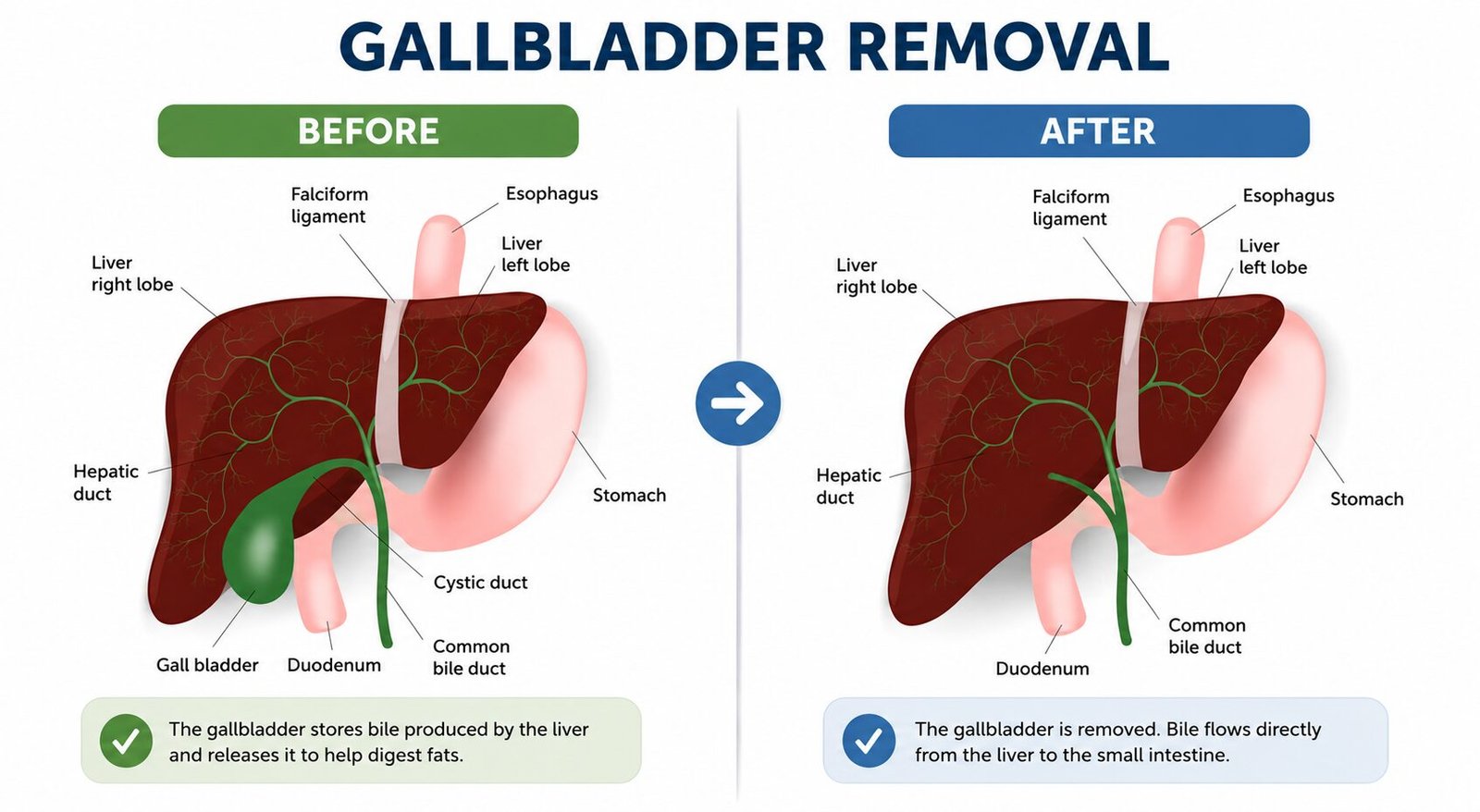
If you’ve had your gallbladder removed, you’ve probably been told one of two things:
“You don’t need it” or: “just avoid fatty foods”.
None of them are good enough.
Your gall bladder was not optional equipment. It was a critical part of how your body digests fat, absorbs nutrients, clears hormones, and removes waste. Removing it solved an immediate problem – but didn’t fix what created this problem in the first place.
If you’re still experiencing digestive issues, fatigue, skin issues, hormonal chaos, or persistent weight after gallbladder removal – keep reading.
→ Do you think your liver and bile flow may be behind your symptoms? [Take the quiz here]
Why did you lose your gallbladder?
Your gallbladder didn’t fail by accident. It was the end result of a system that was struggling well before removal was deemed necessary.
Your liver produces bile – a liquid that breaks down fat, carries toxins out of your body, acts as an antimicrobial and keeps your digestive system moving. Your gallbladder stored and condensed this bile, releasing it in a coordinated wave when you ate.
When bile becomes too thick, too sluggish, or too saturated—from nutrient deficiencies, chronic stress, medications, or hormonal imbalance—it crystallizes. These crystals become stones. And very often, symptoms and surgery conflict.
Most common contributors:
- Bile is too thick to flow – from taurine, magnesium or selenium deficiency
- Excess estrogen – which thickens bile and slows the flow through the bile ducts
- Chronic stress – which disrupts digestive function including the release of bile
- Long-term medicines – especially statins, HRT and oral contraceptives
- Too much nutrients – especially an overload of iron, vitamin A or copper, which stress the liver
- Chronic constipation – which prevents the proper excretion of bile acids
Understanding why it happened is important—because if these underlying conditions aren’t addressed, the liver continues to struggle long after the gallbladder is gone.
What changes when the gallbladder is gone?
Before removal, bile was stored, condensed and released in a precise surge when the fat hit the small intestine. Without the gallbladder, this changes completely.
Bile is now constantly dripping from your liver – in low concentration, regardless of whether you eat. Here’s what this means in practice:
- Fat digestion becomes unreliable – Without concentrated bile during meals, fat goes through poor absorption, causing bloating, nausea and loose stools
- Fat-soluble vitamins A, D, E and K become more difficult to absorb – deficiencies can accumulate quietly even when nutrition is excellent
- Bile acid recycling is interrupted – your liver works harder to produce new bile acids from scratch, increasing demand for nutrients
- Bowel movements slow down or become irregular – bile stimulates peristalsis. without concentrated pulsatile release, constipation or bile acid diarrhea are both common
- Estrogen stops clearing properly – Bile carries used estrogen out of the body. when flow is insufficient, estrogen recirculates, leading to PMS, weight gain, breast tenderness and mood swings
- The nervous system becomes an obstacle – the release of bile was coordinated by the vagus nerve. Chronic stress suppresses vagal tone, slows down bile production, and keeps the entire system sluggish, no matter what else you do
How to support your body forward
1. Give your liver less work
The more you reduce what your liver has to process, the more ability it has to efficiently produce bile and clear waste. The most common things that overload the liver after removal:
- Alcohol – impairs bile production and the liver’s ability to detoxify
- Unnecessary supplements and drugs – both are processed by the liver
- Excess fat-soluble vitamins in supplement form – particularly vitamin A and D, which build up when bile flow is compromised
- Copper overload – from cookware, supplements, nuts, dark chocolate and copper IUDs
- Iron overload – common and underdiagnosed, especially in postmenopausal women
- High exposure to pesticides and environmental toxins – processed through the same liver pathways as hormones
- Heavy metals – lead, mercury, cadmium and arsenic are processed through the same liver detoxification pathways as hormones and metabolic wastes. After removal, when bile flow is already compromised, the heavy metal build-up creates an additional burden that your liver must work with before it can do anything else.
This doesn’t mean you need an elimination diet. It means you have to be strategic about the load—doing less of certain things consistently so your liver isn’t always working at capacity.
2. Balance minerals that drive bile production
Bile production and flow are mineral dependent. Without the right nutrients, your liver can’t produce bile efficiently—and what it does produce can be too thick to move. Here are the six that matter most after subtraction:
Taurine
It conjugates bile acids so they are water soluble and able to do their job. Without it, bile becomes less efficient and the recycling loop breaks down. It is mainly found in animal proteins.
Magnesium
It relaxes the bile ducts and supports the function of liver enzymes. It is quickly depleted by chronic stress—the same stress that contributed to your gallbladder problems in the first place.
Zinc
Essential for liver detoxification pathways and main copper antagonist. Low zinc allows copper to build up – one of the most common and overlooked liver stressors in women.
Selenium
It protects liver cells from oxidative damage and supports the conversion of thyroid hormone, which directly affects the amount of bile your liver produces.
Molybdenum
Clears sulfite build-up from gut bacterial metabolism – a silent but significant burden on the liver, especially common post-surgery when bile flow is disrupted and gut dysbiosis ensues.
Potassium
It keeps the intestinal motility moving, so the bile has somewhere to go. Low potassium directly contributes to constipation which supports the entire system.
The critical point: you can’t guess which one you need. Mineral relationships are not linear – one large part affects the others. The only way to know what your body really needs is to test at the tissue level.
3. Don’t skip the nervous system
Bile production is regulated by the vagus nerve. Chronic sympathetic dominance—the state in which women live with the most stress and malaise—suppresses vagal tone, slows bile synthesis, and keeps digestion in a low-grade state of dysfunction. No supplement protocol fully compensates for a nervous system stuck in fight-or-flight. Mineral deficiency, poor bile flow and nervous system dysregulation are not separate problems. It’s the same problem in three different ways – all three need to be tackled together.
Start with facts, not guesswork
The test I use to support clients after gallbladder removal looks at:
- Hair Mineral Tissue Analysis (HTMA) – tissue levels of minerals that support bile, heavy metal accumulation and stress and metabolic patterns that stress the liver. Available worldwide, no needles, no clinic.
- Plasma zinc and serum (blood) copper – to directly assess the zinc-copper ratio
- Iron studies (blood) – because iron overload is often overlooked and directly reduces detoxification capacity
- Vitamin A (blood) – because accumulation of fat-soluble vitamins is a real risk when bile flow is compromised
This combination shows what your liver is deficient in, what it’s overloaded with, and where to focus first. A map – not another protocol to guess your way around.
Are you ready to find out what’s really going on?
Not sure if your liver is behind your symptoms?
Take the quiz. Two minutes. Instant answers.
→ [Take the Quiz]
Ready to get started with data?
Hair mineral tissue analysis shows exactly what your liver is missing, what it’s overloaded with, and where to start.
→ [Learn About Testing] or [Request a Free Consultation]
Are you ready to do something about it?
The DRAIN method is the opposite of a detox – a strategic, sustainable approach to giving your liver less work while giving it exactly what it needs.
→ [Learn About DRAIN]
Recommended reading
References
- Lammert F, et al. Cholelithiasis. Nature Reviews Disease Primers2016.
- Hofmann AF. The continuing importance of bile acids in liver and intestinal disease. Archives of Pathology1999.
- Schaffer SW, et al. Physiological roles of taurine in heart and muscle. Journal of Biomedical Science2010.
- Rayman MP. The importance of selenium for human health. The Lancet2000.
- Prasad AS. Zinc: role in immunity, oxidative stress and chronic inflammation. Current Opinion in Clinical Nutrition & Metabolic Care2009.
