


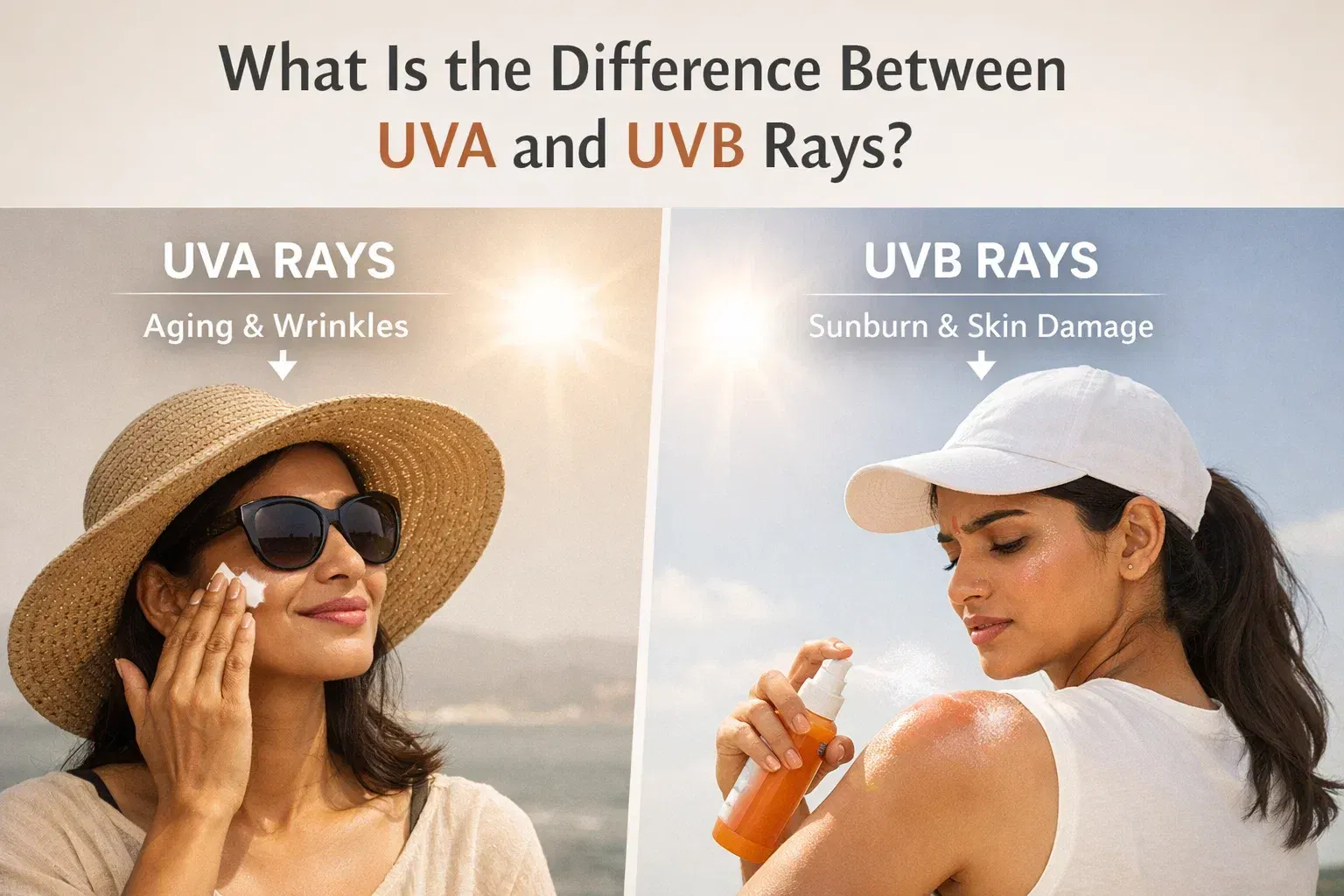
Sunscreen labels list both – broad spectrum, UVA, UVB, PA rating. Most people nod without fully understanding what each type of radiation actually does to the skin.
Here is the honest, straightforward analysis.
The UV spectrum: What are you really being protected from?
The sun emits UV radiation in three wavelength ranges:
- UVA — long wavelength (315–400 nm)
- UVB — medium wavelength (280–315 nm)
- UVC — short wavelength (100–280 nm) – absorbed by the atmosphere, does not reach the skin
You need protection from UVA and UVB rays. Here’s what each one does.
What UVB rays do to your skin
UVB stands for ultraviolet B. These are the rays responsible for sunburn.
They affect the outer layer of the skin (epidermis) and are the main cause of:
- Redness and sunburn after sun exposure
- Damage to the DNA of skin cells
- Contribution to the risk of skin cancer
UVB intensity varies by time of day and season. It peaks between 10 a.m. and 4 p.m. On cloudy days, UVB levels drop more than UVA.
The SPF in your sunscreen specifically measures UVB protection.
What UVA rays do to your skin
UVA stands for Ultraviolet A. These are longer wavelength rays that penetrate deeper into the skin – the dermis layer, where collagen and elastin live.
UVA rays are responsible for:
- Aging of the skin — breakdown of collagen causes fine lines and loss of firmness
- Hyperpigmentation and black spots — UVA stimulates melanin production
- The tan — the immediate tan you see after exposure to the sun is largely due to UVA
- Contribution to skin cancer after long-term cumulative exposure
The critical difference: UVA levels remain relatively constant throughout the day and year. They also penetrate glass. Sitting near a window, driving or working in a room with natural light means your skin is exposed to UVA – even on cloudy days.
That’s why dermatologists recommend daily sunscreen even when you don’t plan to go outside.
Why you need broad spectrum protection
"Wide spectrum" means that the sunscreen protects against both UVA and UVB. A sunscreen that only states SPF (no broad spectrum) technically only measures UVB protection.
For Indian skin, which is prone to hyperpigmentation, UVA protection is especially important. Melanin-rich skin may not burn as visibly from UVB – but UVA-induced pigmentation and uneven skin tone are very real concerns.
What the PA rating tells you about UVA protection
SPF measures UVB blocking. THE PA rating UVA protection measures:
| PA rating | Level |
|---|---|
| PA+ | Minimal UVA protection |
| PA++ | Moderate |
| PA+++ | High |
| PA++++ | Current highest score |
For Indian climate and skin concerned with pigmentation and ageing: PA++++ with SPF 50 is the practical goal for daily use.
Does Indian skin need more UVA protection?
In a word: yes.
India lies within the tropical zone and receives high intensity UV radiation throughout the year. The UV index in cities like Mumbai, Delhi, Chennai and Bangalore regularly reaches 8–11 – classified as very high to extreme.
UVA radiation is responsible for a large percentage of the pigmentation concerns women raise: dark spots, uneven skin tone, and worsening of existing hyperpigmentation from conditions such as PCOS or post-pregnancy skin changes.
Broad spectrum protection combining high SPF with PA++++ covers both bases.
What to look for in a broad spectrum sunscreen
- SPF 50 or above + PA++++ — adequately covers both UVA and UVB rays
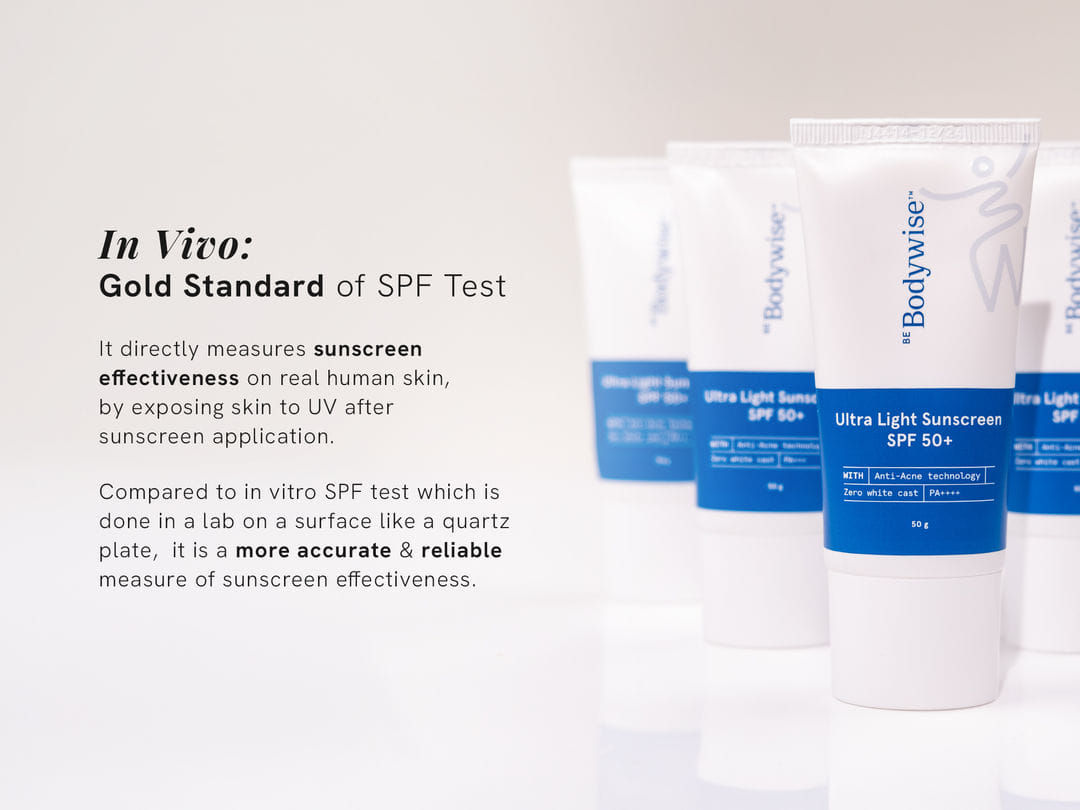
- Tested on Vivo — performance measured on real human skin, not just a lab dish
- Chemical or mineral filters — each works differently (covered in detail separately)
- Non-greasy, lightweight formula — so you’ll actually use it every day
A sunscreen made with next-generation broad-spectrum filters, In Vivo and In Vitro tested and certified free of endocrine disruptors is the most complete choice. Be Bodywise’s Ultra Light Sunscreen SPF50+ is PA++++ rated, In Vivo tested with SPF 50.17, fragrance-free and acne-safe – factors worth checking in any sunscreen you’re considering. Compare filter type, test certifications and PA rating before choosing.
FAQ
Q: Is UVA or UVB more dangerous?
Both cause harm, but in different ways. UVB ultraviolet radiation causes immediate visible damage (sunburn). UVA causes slower, deeper damage (aging, pigmentation, cancer risk) that builds up invisibly over the years.
Q: Does the glass block UVA rays? Standard glass blocks most UVB, but blocks very little UVA. Car windows, office windows and home windows let in UVA radiation. Daily sunscreen is important even indoors.
Q: Can UVA rays cause tanning?
Yes – the immediate darkening you see after exposure to the sun is mainly due to UVA, while delayed tanning includes UVB. Both contribute.
Q: Why doesn’t SPF alone tell you about UVA protection?
Because SPF only measures UVB blocking. You need the PA rating (or broad spectrum label) to know that a sunscreen also protects against UVA.
Q: What time of day are UVA rays strongest?
Unlike UVB, UVA remains relatively constant throughout the day. There is no safe time to skip UVA protection.
Q: Does cloudy weather reduce UVA exposure?
At least. Clouds block about 20% of total UV radiation – UVA penetrates the cloud much more effectively than UVB.
For sun protection that covers both UVA and UVB rays with PA++++ and certified broad-spectrum protection, explore options designed for Indian skin at bebodywise.com.
