

Close Menu
Healthtost
  • News
  • Mental Health
  • Men’s Health
  • Women’s Health
  • Skin Care
  • Sexual Health
  • Pregnancy
  • Nutrition
  • Fitness
  • Recommended Essentials
What's Hot

Waters debuts industry’s first extended-range MALS detector for UHPLC/UPLC, powering rapid characterization of large molecules

April 16, 2026

35-minute bodyweight chest workout routine at home

April 16, 2026

How the CEO of Cadence OTC Made Sex Talk

April 16, 2026
Facebook X (Twitter) Instagram
  • About Us
  • Contact Us
  • Privacy Policy
  • Terms and Conditions
  • Disclaimer
Facebook X (Twitter) Instagram
Healthtost
SUBSCRIBE
  • News

    Waters debuts industry’s first extended-range MALS detector for UHPLC/UPLC, powering rapid characterization of large molecules

    April 16, 2026

    The use of electric bicycles and scooters causes an increase in brain injuries

    April 15, 2026

    ORGAPRED Selects CYTOQUBE® from Hamamatsu Photonics for Personalized Oncology Research and Therapeutic Discovery

    April 15, 2026

    States change custody laws to keep children of immigrant detainees out of foster care

    April 14, 2026

    Study Warns of Teens’ Growing Dependence on AI Companions

    April 14, 2026
  • Mental Health

    Is it anxiety or OCD? 2 psychology experts explain the difference

    April 14, 2026

    Understanding the different types of treatment: C…

    April 10, 2026

    How does Medicare’s new Mental Health Check In work? Is this low-intensity CBT likely to help?

    April 10, 2026

    the surprisingly common condition with a scary name

    April 6, 2026

    How yoga helps heal emotional wounds

    April 4, 2026
  • Men’s Health

    35-minute bodyweight chest workout routine at home

    April 16, 2026

    Vaping may increase risk of cognitive decline in young adults, study finds

    April 14, 2026

    Opinion: Prediction markets are betting against public health

    April 14, 2026

    A monk’s method for falling asleep fast

    April 13, 2026

    The Future of MenAlive: From Men’s Health to Relational Healing and Transformation

    April 13, 2026
  • Women’s Health

    How the CEO of Cadence OTC Made Sex Talk

    April 16, 2026

    New developments in screening for osteoporosis and osteopenia

    April 15, 2026

    Are you drinking enough water? 5 simple tips to stay hydrated

    April 15, 2026

    What is urea for dry skin?

    April 13, 2026

    Beyond fitness: Why exercise is vital to improving cardiovascular health

    April 12, 2026
  • Skin Care

    Fact or Fiction? 12 skincare myths, busted

    April 15, 2026

    Wait – can makeup really cause a reaction to gluten?

    April 14, 2026

    CoolSculpting Elite – SkinCare Physicians

    April 13, 2026

    Why Your Skin Barrier Is The Most Important Thing You’re Ignoring – Lifeline Skin Care

    April 12, 2026

    Spa Los Angeles: Best Services to Book for Real Results

    April 12, 2026
  • Sexual Health

    Judicial reform is the only real way out of today’s political hell

    April 15, 2026

    Personal and Professional considerations between generations

    April 15, 2026

    Can you get tested for herpes without an outbreak?

    April 14, 2026

    At the Intersection of Autism, LGBTQIA+ Identity and Kink — Sexual Health Alliance

    April 13, 2026

    Endometriosis procedures are reimbursed at lower rates, doctors say

    April 8, 2026
  • Pregnancy

    Serious maternal complications affect nearly 3 per cent of pregnancies, Ontario study finds

    April 11, 2026

    Third Trimester Nutrition Guide for Indian Moms

    April 10, 2026

    How your partner can support a happier pregnancy

    April 9, 2026

    Exposure to plastic during pregnancy may be linked to more premature births than expected

    April 4, 2026

    How to relieve numbness and tingling in the legs in the third trimester?

    April 3, 2026
  • Nutrition

    Sweet rhubarb butter & strawberry rhubarb

    April 15, 2026

    High protein comfort food for women who are tired of salads

    April 14, 2026

    Blueberry Chia Pudding (Easy Breakfast!) • Kath Eats

    April 13, 2026

    Because cooling potatoes reduces their glycemic load

    April 12, 2026

    The mind-body connection of fertility

    April 12, 2026
  • Fitness

    Training Strategies to Build Your Own Terminator Army – Tony Gentilcore

    April 15, 2026

    10 Mental Health Tips for Those Who Work From Home

    April 14, 2026

    7 shoulder exercises that keep your arms strong and pain-free after 40

    April 14, 2026

    Inside The OPEX Method Mentorship: A Coach’s POV with Dr David Skolnik (Week 1)

    April 12, 2026

    Active summer camps that build healthy lifelong habits in 6 US states

    April 12, 2026
  • Recommended Essentials
Healthtost
Home»News»Gut bacteria have been found to produce serotonin and enhance intestinal motility
News

Gut bacteria have been found to produce serotonin and enhance intestinal motility

healthtostBy healthtostOctober 22, 2025No Comments6 Mins Read
Facebook Twitter Pinterest LinkedIn Tumblr Reddit WhatsApp Email
Gut Bacteria Have Been Found To Produce Serotonin And Enhance
Share
Facebook Twitter LinkedIn Pinterest WhatsApp Email

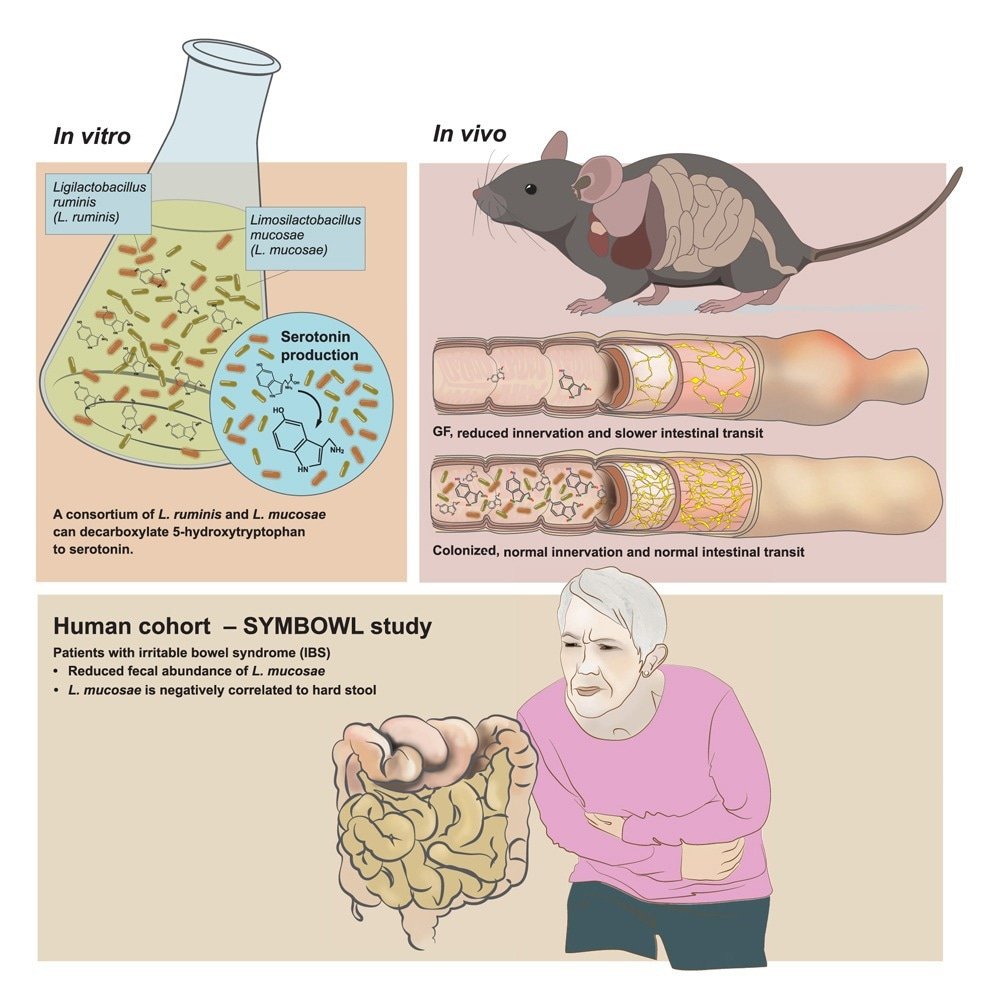
Scientists have discovered two human gut microbes that produce serotonin, revealing how microbial chemistry can shape gut motility and nerve connectivity and opening up new possibilities for treating gut disorders like IBS.

Study: Identification of human gut bacteria that produce bioactive serotonin and promote colonic innervation.

In a recent study published in the journal Cell referencesresearchers identified human intestinal substances that decarboxylate 5-hydroxytryptophan (5-HTP) to produce serotonin.

Serotonin is an important signaling molecule in the gut, mediating gastrointestinal functions such as vasodilation, visceral sensitivity, and peristalsis. Abnormal serotonin signaling is involved IBS pathogenesis. The gut accounts for about 95% of the body’s serotonin pool. Mammalian enterochromaffin cells produce serotonin from tryptophan (Trp).

Studies have shown that the gut microbiota up-regulates the host’s production of serotonin Tph1 expression. Disrupting the gut microbiota with the use of antibiotics has been shown to shrink the colon Tph1 expression and serotonin levels. While serotonin has been detected in culture media of facultative anaerobes, incl Escherichia colithere is no evidence for microbial production of serotonin in the gut. However, in this study, microbial serotonin was derived from decarboxylation of 5-HTP and not from hydroxylation of Trp to 5-HTP.

The study and findings

The present study identified human gut bacteria that produce serotonin. First, the researchers compared serum and fecal serotonin levels Tph1– incomplete (Tph1-/-) and wild type (Tph1+/+) raised conventionally (CONV-R) and germ-free (GF) mice. Both serum and faecal serotonin levels were lower Tph1-/- relative to Tph1+/+ CONV-R mice. Tph1+/+ GF mice had lower serotonin levels than Tph1+/+ CONV-R mice.

While serum serotonin levels were not different from each other Tph1–/- CONV-R and GF mice, fecal serotonin levels were higher in Tph1–/- CONV-R mice than media GF counterparts. Further, Tph1–/- GF mice were conventionalized with caecal contents from Tph1+/+ CONV-R mice. This significantly increased faecal serotonin levels in conventional mice compared to Tph1–/- GF mice, indicating that the gut microbiota produces serotonin.

Microbial feces from six individuals were then cultured anaerobically and serotonin was quantified. Serotonin was produced in the growth medium, reaching maximum levels within the first 12 hours of inoculation. In addition, the researchers isolated bacteria from the feces of healthy people to identify the serotonin-producing strains. Several consortia containing at least one metabolizable species Trp were isolated and cultured.

Only two consortia (Ls and h1L12h) synthesized detectable serotonin. Genomic analysis identified two species in Ls and seven in h1L12h. Limosilactobacillus mucosae and Ligilatobacillus ruminis were present in both Ls and h1L12h. Other consortia lacked one or both species. The team then investigated whether these two species produced serotonin in monocultures. These species were isolated as pure cultures in nutrient-rich broth.

However, no serotonin production was detected under aerobic or anaerobic conditions, suggesting that interactions between the two species may be required for serotonin synthesis. Consistent with this, serotonin and tryptamine production occurred in the co-isolated community and not in monocultures or simple cocultures in vitroalthough the reconstituted pair increased fecal serotonin in vivo. The study further confirmed that the L. mucosae strain encoded a tryptophan decarboxylase gene, which was cloned and functionally validated as capable of producing tryptamine from Trp and serotonin from 5-HTP.

Further experiments revealed that the two co-isolated lactobacilli produced tryptamine and serotonin in vitro by its decarboxylation Trp and 5-hydroxytryptophan (5-HTP), respectively. Serotonin was not produced by Trp; 5-HTP was required. It was decarboxylated in vitro in microbial communities rather than monocultures.

The group was then colonized Tph1–/- GF mice with Ls, which increased faecal levels of tryptamine and serotonin and serotonin immunoreactivity in colonic tissue, but did not change serum serotonin levels, indicating a local rather than a systemic effect.

Monocolonization with L. mucosae or L. ruminis did not increase faecal serotonin, but colonization of reconstituted Ls increased faecal serotonin levels. Further, the researchers assessed whether Ls colonization affects colonic innervation and stained proximal colonic sections from GF and Ls-colonization Tph1-/- mice with Tuj1, a pan-neural marker. This showed an increased Tuj1-immunoreactive area in the Ls group relative to GF controls and increased serotonin immunoreactivity within the isolated myenteric plexus.

Further, the colonic myenteric plexus of the enteric nervous system was isolated and stained to visualize serotonin immunoreactive areas. This showed increased serotonin immunoreactivity in the myenteric plexus of Ls colonized Tph1-/- mice. The reconstituted Ls also increased the area of ​​serotonin in the myenteric plexus, whereas the single strains did not. Next, the team investigated whether Ls colonization affects gut transit time.

Wild type GF Mice showed slower transit than wild-types CONV-R mice. However, wild-type Ls colonization GF mice normalized transit time to that of the wild type CONV-R mice. Colonization significantly increased faecal serotonin levels, which were positively correlated with intestinal transit rate. This association was significant overall and in women, but not in men, when analyzed separately. Notably, Ls colonization was not increased Tph1 expression in the proximal colon, suggesting Ls as a source of serotonin, and Mao expression was not reduced.

The researchers then determined the abundance of feces L. ruminis and L. mucosaefecal and serum serotonin levels, total oral transit time, and stool composition and form in 147 IBS patients and 27 healthy controls. They found no significant differences in serum and fecal serotonin levels between groups. IBS patients showed significantly lower abundance only L. mucosae rather than controls. Besides, L. mucosae abundance was negatively associated with hard stools IBS patients, reflecting a weak correlation (Spearman ρ ≈ -0.23, FDR = 0.044) according to the paper’s reported effect size.

conclusions

Overall, the findings showed that members of the human gut microbiota produce serotonin in cultures and in vivo. Co-isolated man L. ruminis and L. mucosae strains produce serotonin from 5-HTP in vitro and regulate intestinal serotonin levels, intestinal transit time, and enteric innervation in vivo. These results were obtained in germ-free mice. The mechanisms of microbial regulation of serotonin and the clinical implications in humans remain to be determined.

Restrictions: The mechanistic regulators of microbial serotonin synthesis have not been resolved. Effects were demonstrated in germ-free mice, but human serotonin levels did not differ by IBS situation. The study reports industry relations and a patent application.

bacteria enhance gut intestinal motility Produce serotonin
bhanuprakash.cg
healthtost
  • Website

Related Posts

Waters debuts industry’s first extended-range MALS detector for UHPLC/UPLC, powering rapid characterization of large molecules

April 16, 2026

The use of electric bicycles and scooters causes an increase in brain injuries

April 15, 2026

ORGAPRED Selects CYTOQUBE® from Hamamatsu Photonics for Personalized Oncology Research and Therapeutic Discovery

April 15, 2026

Leave A Reply Cancel Reply

Don't Miss
News

Waters debuts industry’s first extended-range MALS detector for UHPLC/UPLC, powering rapid characterization of large molecules

By healthtostApril 16, 20260

Waters Corporation today announced the launch of Waters omniDAWN™ Multi-Angle Light Scattering (MALS) Photometer, part…

35-minute bodyweight chest workout routine at home

April 16, 2026

How the CEO of Cadence OTC Made Sex Talk

April 16, 2026

The use of electric bicycles and scooters causes an increase in brain injuries

April 15, 2026
Stay In Touch
  • Facebook
  • Twitter
  • Pinterest
  • Instagram
  • YouTube
  • Vimeo
TAGS
Baby benefits body brain cancer care Day Diet disease exercise finds Fitness food Guide health healthy heart Improve Life Loss Men mental Natural Nutrition Patients People Pregnancy research reveals risk routine sex sexual Skin Skincare study Therapy Tips Top Training Treatment ways weight women Workout
About Us
About Us

Welcome to HealthTost, your trusted source for breaking health news, expert insights, and wellness inspiration. At HealthTost, we are committed to delivering accurate, timely, and empowering information to help you make informed decisions about your health and well-being.

Latest Articles

Waters debuts industry’s first extended-range MALS detector for UHPLC/UPLC, powering rapid characterization of large molecules

April 16, 2026

35-minute bodyweight chest workout routine at home

April 16, 2026

How the CEO of Cadence OTC Made Sex Talk

April 16, 2026
New Comments
    Facebook X (Twitter) Instagram Pinterest
    • About Us
    • Contact Us
    • Privacy Policy
    • Terms and Conditions
    • Disclaimer
    © 2026 HealthTost. All Rights Reserved.

    Type above and press Enter to search. Press Esc to cancel.