

Close Menu
Healthtost
  • News
  • Mental Health
  • Men’s Health
  • Women’s Health
  • Skin Care
  • Sexual Health
  • Pregnancy
  • Nutrition
  • Fitness
  • Recommended Essentials
What's Hot

UCSF and Samsung launch remote study of aging brain health

July 9, 2026

Why report e-6929 matters in Canada — Sexual Health Research Lab

July 9, 2026

where we ate in Tokyo (and gluten-free options!)

July 9, 2026
Facebook X (Twitter) Instagram
  • About Us
  • Contact Us
  • Privacy Policy
  • Terms and Conditions
  • Disclaimer
Facebook X (Twitter) Instagram
Healthtost
SUBSCRIBE
  • News

    UCSF and Samsung launch remote study of aging brain health

    July 9, 2026

    Active birth control pills may increase emotional eating

    July 9, 2026

    Socioeconomic status confers unequal reductions in metabolic disease among racial, ethnic groups

    July 8, 2026

    Only one in 10 Australians know the Black Triangle safety symbol

    July 8, 2026

    Study reveals why patients with rare leukemia develop resistance to tagraxofusp

    July 7, 2026
  • Mental Health

    Almost 20% of new mums have anxiety or depression, but a promising psychedelic treatment is on the horizon

    July 7, 2026

    How can ART help us improve our mental health? With 3 Ways

    July 5, 2026

    How much do friends affect the mental health of teenagers? What a new study can (and can’t) tell us

    July 3, 2026

    What happens in your blood when you are stressed? We put it to the test

    June 28, 2026

    Why negative news grabs our attention and what it means for our mental health

    June 25, 2026
  • Men’s Health

    Gut-friendly diet linked to lower risk of coronary heart disease mortality

    July 9, 2026

    Men don’t just avoid their health. Many lose themselves.

    July 8, 2026

    The Crazy Hard Standards of the Hardest PE Program in History

    July 8, 2026

    Why our relationships are becoming more dishonest and what we can do about it

    July 7, 2026

    Definitive Guide: The Primal Blueprint

    July 7, 2026
  • Women’s Health

    Taite Heller on Why Barre Became a Top-5 Fitness Trend

    July 8, 2026

    Sunscreen TikTok convinces young people

    July 7, 2026

    Biology, Myths and Real Care

    July 7, 2026

    The shape of the strong black woman

    July 6, 2026

    208: What Mold Really Does to Your Health and How to Find It with Brian Karr

    July 5, 2026
  • Skin Care

    New Sunscreen Ingredient: Is This The SPF Upgrade We’ve Been Waiting For?

    July 9, 2026

    How to achieve the perfect tan

    July 8, 2026

    How I did it: I plump the skin without fillers

    July 6, 2026

    Natural bug bite relief with herbal remedies

    July 4, 2026

    Why Jojoba Beads Beat Coconut Shell Pow

    July 3, 2026
  • Sexual Health

    Why report e-6929 matters in Canada — Sexual Health Research Lab

    July 9, 2026

    Complete Career Guide — Sexual Health Alliance

    July 8, 2026

    Because your sexual health matters more than you think

    July 5, 2026

    Fildena 150 How It Works: Mechanism & Benefits

    July 4, 2026

    Climate justice is reproductive justice

    July 2, 2026
  • Pregnancy

    Calf Raises During Pregnancy: Step-by-Step Guide and Benefits

    July 8, 2026

    Tri-Tri Triplet Pregnancy with Vaginal Birth Story – The Birth Hour Triplet Pregnancy and Vaginal Birth Story with Ashlie Holladay

    July 7, 2026

    Common pregnancy drugs linked to higher rates of autism diagnosis in large study

    July 6, 2026

    Monsoon Infections During Pregnancy: Safety Tips for Expectant Moms

    July 5, 2026

    How to be the support she really needs

    July 4, 2026
  • Nutrition

    5 Easy High Fiber Bowl Recipes

    July 8, 2026

    Salmon Teriyaki Recipe (Ridiculously Easy!) • Kath Eats

    July 8, 2026

    Can exercise counteract a high-fat meal?

    July 6, 2026

    Natural ways to boost energy throughout the day

    July 6, 2026

    My story with iron deficiency as a plant-based nutritionist and runner

    July 4, 2026
  • Fitness

    where we ate in Tokyo (and gluten-free options!)

    July 9, 2026

    Using External Signaling to Improve Linear Acceleration – Tony Gentilcore

    July 8, 2026

    5 Simple Screen Changes That Can Improve Sleep and Focus

    July 7, 2026

    How to prevent muscle loss while losing weight

    July 5, 2026

    The role of nutrition in maintaining energy during regular exercise

    July 5, 2026
  • Recommended Essentials
Healthtost
Home»News»Mediterranean and MIND diets boost memory retention in middle age
News

Mediterranean and MIND diets boost memory retention in middle age

healthtostBy healthtostFebruary 6, 2024No Comments4 Mins Read
Facebook Twitter Pinterest LinkedIn Tumblr Reddit WhatsApp Email
Mediterranean And Mind Diets Boost Memory Retention In Middle Age
Share
Facebook Twitter LinkedIn Pinterest WhatsApp Email

A study published in the journal Alzheimer’s Research & Treatment describes that the Mediterranean and MIND diets could effectively preserve episodic and visuospatial working memory in middle age.

Study: Dietary patterns and cognitive performance in a UK twin women’s registry (TwinsUK). Image credit: DiViArt / Shutterstock

Record

Age-related cognitive decline is a public health concern as it can affect morbidity and mortality. Although most people experience cognitive decline in middle age, the rate of cognitive decline can vary greatly among individuals depending on their cardiovascular health and lifestyle behaviors. A faster-than-usual rate of cognitive decline with age may be a risk factor for Alzheimer’s disease.

Nutrient-rich dietary patterns, such as the Mediterranean (MED) and the Mediterranean Dietary Approach to Stop Hypertension Intervention for Neurodegenerative Delay (MIND) diets, are known to have neuroprotective and cognitive abilities. In this context, evidence suggests that the MED diet can improve cognitive functions by positively affecting the gut microbiota.

In this study, scientists investigated the impact of the MED and MIND diets on cognitive function and 10-year change in cognitive performance in cognitively healthy female twins.

Study design

The study analyzed data obtained from the UK Adult Twin Registry that enrolled healthy female twins between 1992 and 2004. A total of 509 twins who had complete baseline data on diet and cognitive performance between 1998 and 2000 were included in the analysis. of twins, 34% were monozygotic (genetically identical) and 66% were dizygotic (50% identical genes).

Baseline dietary intake was assessed using a food frequency questionnaire. Dietary intake data were used to calculate diet scores for the MED and MIND dietary patterns. A higher nutritional score is indicative of higher adherence to the respective diets.

Participants’ cognitive performance was assessed at baseline and after ten years (2008 – 2010). Six types of cognitive functions were examined, including reaction speed, spatial working memory, episodic memory, visual episodic memory, decision time, and visuospatial working memory.

Fecal samples were collected from the participants at the 10-year follow-up to analyze the gut microbiota.
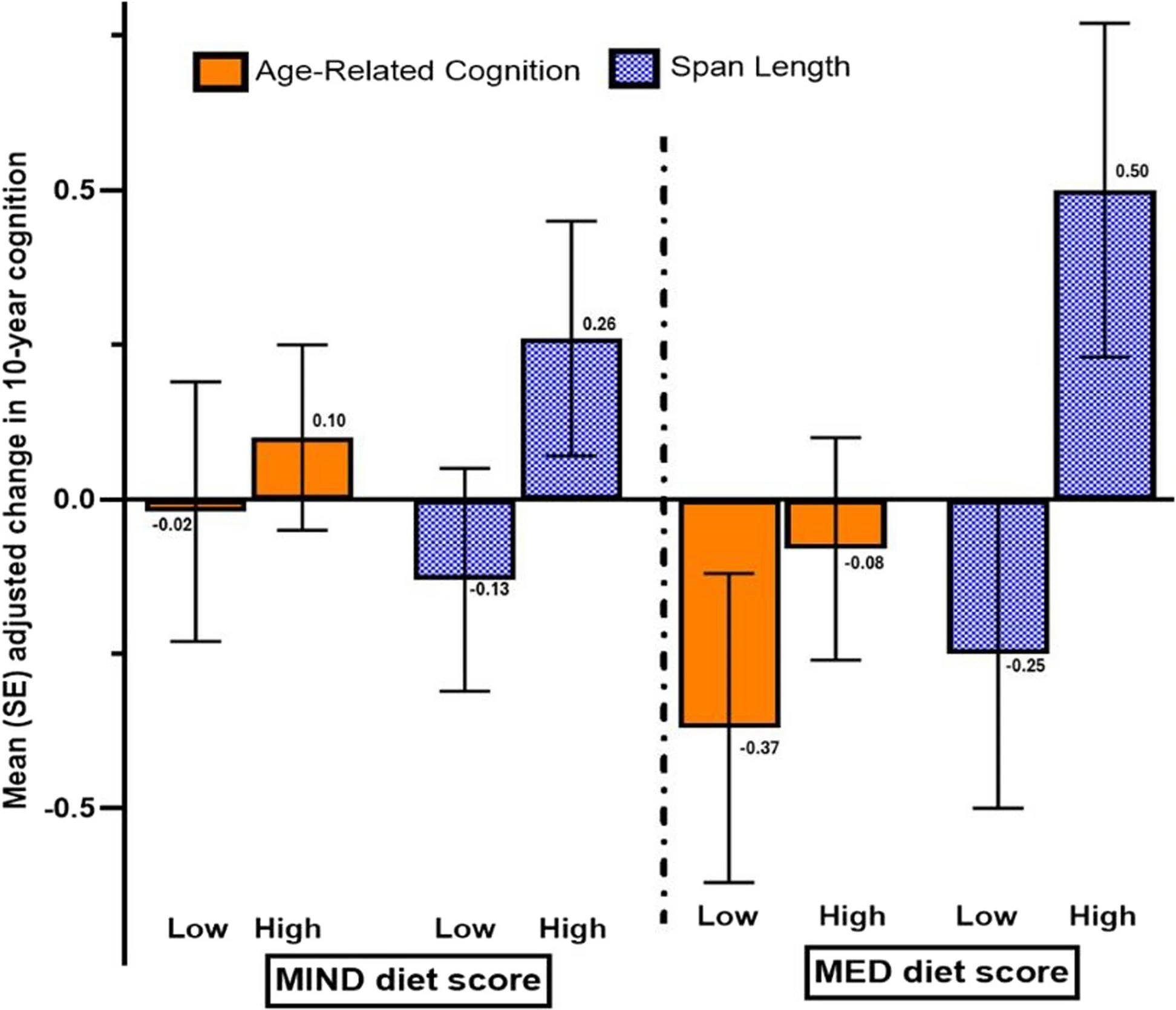
Change in adjusted mean (SE).  Age-related cognitive ability and span length over 10 years in MZ twins discordant for MIND and MED diet scoreChange in adjusted mean (SE). Age-related cognitive ability and span length over 10 years in MZ twins discordant for MIND and MED diet score

Important observations

Assessment of the effect of dietary patterns on baseline cognitive performance revealed no significant correlation between MED diet scores and cognitive test scores. For the MIND diet, each 1-point increase in diet score was found to be associated with faster reaction time and better visual episodic memory after adjusting for demographic, health, and lifestyle confounders.

Evaluation of the effect of dietary patterns on cognitive performance over a 10-year follow-up revealed that increasing adherence to the MED or MIND diet was associated with improved episodic memory.

Assessment of the effect of dietary patterns on 10-year change in cognitive performance in discordant monozygotic twin pairs revealed that the monozygotic twin with a high diet score has less decline in global cognitive ability overall. However, this difference was not statistically significant.

Within each monozygotic pair, the twin with high MED or MIND diet scores showed greater preservation of visuospatial working memory. This observation was significant for the MED diet. No significant effect of MED or MIND diet was observed on 10-year change in other cognitive performance in discordant monozygotic twins.

Regarding the relationship between dietary patterns and gut microbiota, the findings revealed that high adherence to the MIND diet at baseline was associated with higher abundance Ruminococcaceae UCG-010 (short-chain fatty acid-producing bacteria) and lower abundance Dorea at 10-year follow-up. This association became non-significant after adjustment for dietary fiber intake.

Further analysis revealed that greater abundance Ruminococcaceae UCG-010 is associated with lower decline in global cognition and improved spatial working memory at 10-year follow-up.

Importance of study

The study finds that both the MED and MIND diets could effectively preserve episodic and visuospatial working memory in middle age. These neuroprotective effects could be attributed to the high dietary fiber content and increased abundance of short-chain fatty acid-producing bacteria in the gut.

As the scientists report, the possible influence of unidentified genetic factors on the study results in the entire study population cannot be ruled out, as the same pattern of cognitive improvement has not been found in monozygotic twins.

Future studies should include longer follow-up with repeated cognitive assessments to understand the impact of nutrition on cognitive performance in older age.

age Boost diets Mediterranean memory middle mind retention
bhanuprakash.cg
healthtost
  • Website

Related Posts

UCSF and Samsung launch remote study of aging brain health

July 9, 2026

Active birth control pills may increase emotional eating

July 9, 2026

Socioeconomic status confers unequal reductions in metabolic disease among racial, ethnic groups

July 8, 2026

Leave A Reply Cancel Reply

Don't Miss
News

UCSF and Samsung launch remote study of aging brain health

By healthtostJuly 9, 20260

A groundbreaking new study from the Neuroscape Research Center at UCSF, and consumer electronics giant…

Why report e-6929 matters in Canada — Sexual Health Research Lab

July 9, 2026

where we ate in Tokyo (and gluten-free options!)

July 9, 2026

Active birth control pills may increase emotional eating

July 9, 2026
Stay In Touch
  • Facebook
  • Twitter
  • Pinterest
  • Instagram
  • YouTube
  • Vimeo
TAGS
Baby benefits body brain cancer care Day Diet disease exercise finds Fitness food Guide health healthy heart Improve Life Loss Men mental Natural Nutrition Patients People Pregnancy research reveals risk routine sex sexual Skin Skincare study Therapy Tips Top Training Treatment ways weight women Workout
About Us
About Us

Welcome to HealthTost, your trusted source for breaking health news, expert insights, and wellness inspiration. At HealthTost, we are committed to delivering accurate, timely, and empowering information to help you make informed decisions about your health and well-being.

Latest Articles

UCSF and Samsung launch remote study of aging brain health

July 9, 2026

Why report e-6929 matters in Canada — Sexual Health Research Lab

July 9, 2026

where we ate in Tokyo (and gluten-free options!)

July 9, 2026
New Comments
    Facebook X (Twitter) Instagram Pinterest
    • About Us
    • Contact Us
    • Privacy Policy
    • Terms and Conditions
    • Disclaimer
    © 2026 HealthTost. All Rights Reserved.

    Type above and press Enter to search. Press Esc to cancel.