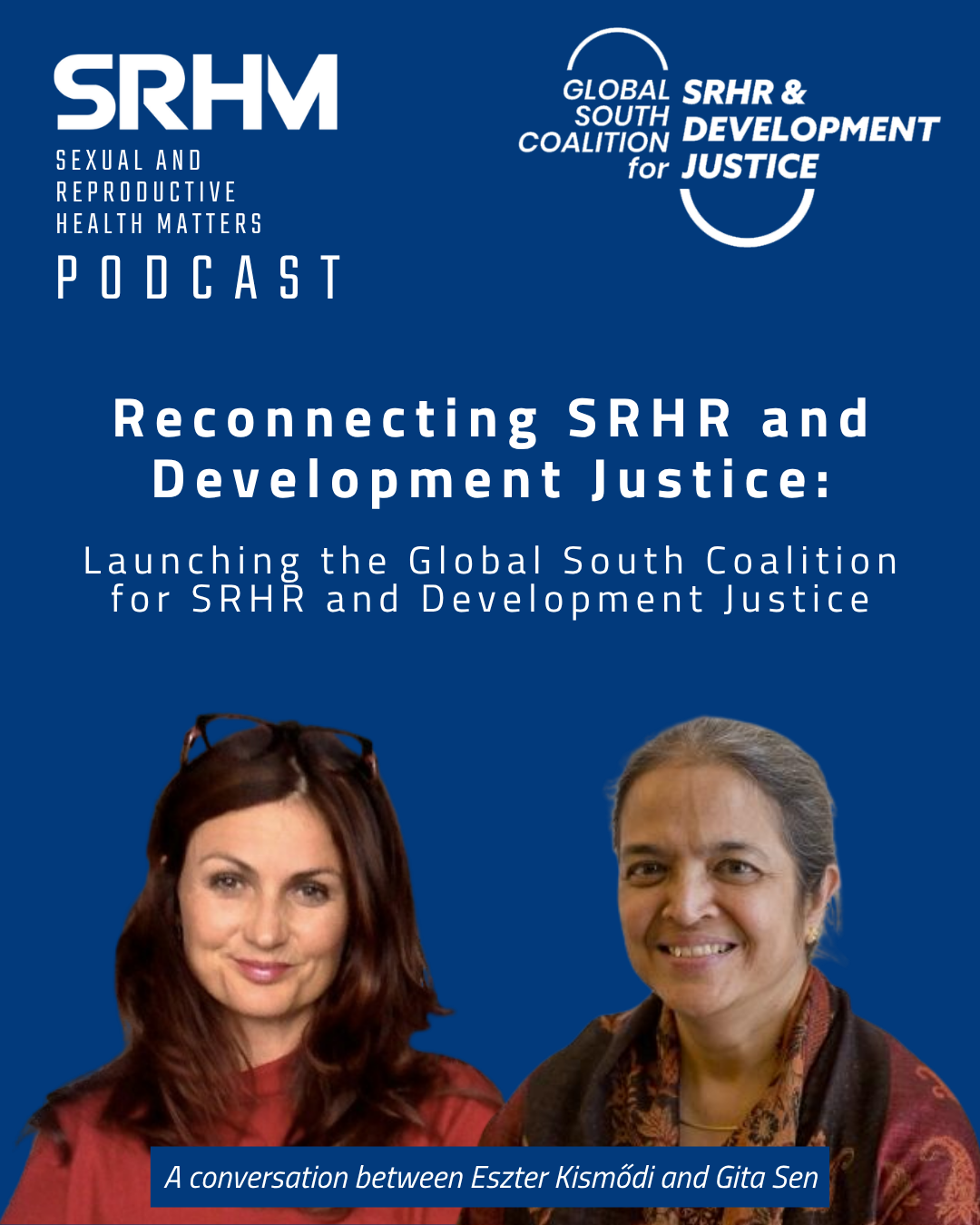
In a recent SRHM podcast, Eszter Kismődi, CEO of SRHM, talks to Professor Gita Sena globally recognized feminist economist from India whose work has been instrumental in shaping global discourses linking gender equality, development justice and sexual and reproductive health and rights (SRHR).
He is a founding member of DAWN (Development Alternatives with Women for a New Era) and serves as Distinguished Professor Emeritus of the Ramalingaswami Center for Equity and Social Determinants of Health at the Public Health Foundation of India, as well as Professor Emeritus at the Indian Institute of Management Bangalore. She is also a member of the Board of Directors of SRHM, its guest editor Special Issue on Disrespect and Abuse in Maternal Care and critic of many SRHM articles.
The discussion highlights both why it is timely and necessary to reconnect SRHR with developmental justice in the current global political moment, and the initiation of Global South Coalition for Sexual and Reproductive Health and Rights and Developmental Justice.
This recording is also available at Apple Podcasts and YouTube.
Professor Gita Sen reflects this Feminist movements have long recognized that sexual and reproductive health and rights cannot be separated from broader issues of development, political economy, and global inequality.. Already in the run-up to the landmark UN conferences of the 1990s – including Rio, Vienna, Cairo and Beijing – feminist advocates stressed that bodily autonomy and gender equality must be understood in the wider context of economic justice, development pathways and structural inequalities between and within countries.
But over time, Discussions about SRHR have often become more fragmentedfocusing on specific thematic areas such as contraception, abortion, adolescent health, HIV or sexuality education, sometimes losing connection with the wider development context that shapes people’s lives. Professor Gita Sen emphasizes that this fragmentation has created openings for opposition actors to reinforce divisions between development and gender agendas, weakening collective political momentum.
The discussion also explores how recent global crises have exposed deep structural inequalities. Experiences during the COVID-19 pandemic have demonstrated stark inequalities in access to vaccines, technologies and resources, reflecting broader imbalances in global economic governance, trade rules, debt burdens and fiscal constraints that affect countries’ ability to invest in health systems. These dynamics highlight how global economic arrangements directly shape health outcomes, access to services, and the realization of rights.
A key issue in the debate is the importance of global leadership of the South in shaping this agenda. Professor Gita Sen emphasizes that the lived realities of inequality and development challenges must be at the center of global debates while building alliances across regions. Development justice, he notes, is not about charity or aid, but about rights, accountability and fairer global economic arrangements.
The Global South Coalition for Sexual and Reproductive Health and Rights and Development Justice is emerging in response to the escalating attacks on gender equality and SRHR and the widening global inequalities that undermine the right to development.
In an era of intersecting global crises, rising debt burdens, austerity pressures, and shrinking space for feminist engagement on global agendas, the coalition seeks to advance a renewed narrative that reconnects SRHR with developmental justice through analysis, advocacy, and collective mobilization across movements, civil society, international rights, and government.
EVENT EVENT
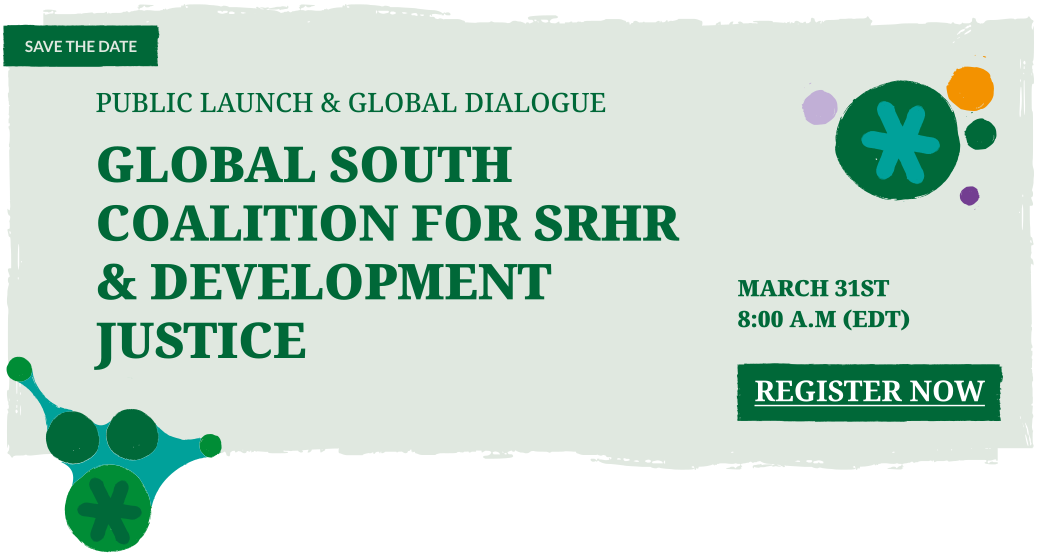 The coalition will officially launch on March 31, 2026 through a multilingual virtual event with interpretation in English, French, Spanish and Portuguese.
The launch will feature a panel moderated by Gita Sen, bringing together leading voices working at the intersection of SRHR, human rights and development justice, including:
- Rajat KhoslaExecutive Director, Partnership for Maternal, Newborn and Child Health (PMNCH)
- Magdalena SepúlvedaDirector, UNRISD, former UN Special Rapporteur on extreme poverty and human rights
- Tlaleng MofokengUN Special Rapporteur on the Right to Health
- Chee Yoke LingExecutive Director, Third World Network
- Levi Singhyouth advocate, SRHR Africa Trust;
The event will explore how stronger connections between SRHR and development justice can help respond to current global challenges and strengthen collective action across sectors and regions.
Learn more: www.srhrdevelopmentjustice.org