

Close Menu
Healthtost
  • News
  • Mental Health
  • Men’s Health
  • Women’s Health
  • Skin Care
  • Sexual Health
  • Pregnancy
  • Nutrition
  • Fitness
  • Recommended Essentials
What's Hot

What foods to avoid if you have fatty liver disease

April 18, 2026

Rose Byrne is raw, magnetic and unfiltered as a woman in crisis

April 18, 2026

Can a girl be so tight it hurts? The Truth About Pelvic Strain – Vuvatech

April 18, 2026
Facebook X (Twitter) Instagram
  • About Us
  • Contact Us
  • Privacy Policy
  • Terms and Conditions
  • Disclaimer
Facebook X (Twitter) Instagram
Healthtost
SUBSCRIBE
  • News

    Scientists find unexpected immune pathways for mRNA cancer vaccines

    April 18, 2026

    Researchers discover how cell membrane composition drives cancer proliferation

    April 17, 2026

    Scientists warn of a silent rise in resistant Aspergillus and Candida

    April 17, 2026

    Clinical barriers hinder access to hormone therapy after cervical cancer treatment

    April 16, 2026

    Waters debuts industry’s first extended-range MALS detector for UHPLC/UPLC, powering rapid characterization of large molecules

    April 16, 2026
  • Mental Health

    Rose Byrne is raw, magnetic and unfiltered as a woman in crisis

    April 18, 2026

    Can a single mother change her child’s surname in India?

    April 16, 2026

    Is it anxiety or OCD? 2 psychology experts explain the difference

    April 14, 2026

    Understanding the different types of treatment: C…

    April 10, 2026

    How does Medicare’s new Mental Health Check In work? Is this low-intensity CBT likely to help?

    April 10, 2026
  • Men’s Health

    35-minute bodyweight chest workout routine at home

    April 16, 2026

    Vaping may increase risk of cognitive decline in young adults, study finds

    April 14, 2026

    Opinion: Prediction markets are betting against public health

    April 14, 2026

    A monk’s method for falling asleep fast

    April 13, 2026

    The Future of MenAlive: From Men’s Health to Relational Healing and Transformation

    April 13, 2026
  • Women’s Health

    Can a girl be so tight it hurts? The Truth About Pelvic Strain – Vuvatech

    April 18, 2026

    At 76, she went from knee pain every night to climbing 7 flights without pain

    April 17, 2026

    Strong liver, strong woman: 4 habits every woman should embrace

    April 16, 2026

    How the CEO of Cadence OTC Made Sex Talk

    April 16, 2026

    New developments in screening for osteoporosis and osteopenia

    April 15, 2026
  • Skin Care

    How to Get Glowing Skin: Beauty Guide

    April 17, 2026

    Fact or Fiction? 12 skincare myths, busted

    April 15, 2026

    Wait – can makeup really cause a reaction to gluten?

    April 14, 2026

    CoolSculpting Elite – SkinCare Physicians

    April 13, 2026

    Why Your Skin Barrier Is The Most Important Thing You’re Ignoring – Lifeline Skin Care

    April 12, 2026
  • Sexual Health

    The importance of sex and intimacy in the elderly

    April 18, 2026

    Judicial reform is the only real way out of today’s political hell

    April 15, 2026

    Personal and Professional considerations between generations

    April 15, 2026

    Can you get tested for herpes without an outbreak?

    April 14, 2026

    At the Intersection of Autism, LGBTQIA+ Identity and Kink — Sexual Health Alliance

    April 13, 2026
  • Pregnancy

    Transfer to birth center C-section, birth center VBAC and Surprise Footling Breech Transfer to home

    April 18, 2026

    What is an Onbuhimo? Everything you need to know about this underrated carrier

    April 18, 2026

    Is Saffron Milk safe in the 9th month of pregnancy?

    April 16, 2026

    Serious maternal complications affect nearly 3 per cent of pregnancies, Ontario study finds

    April 11, 2026

    Third Trimester Nutrition Guide for Indian Moms

    April 10, 2026
  • Nutrition

    What foods to avoid if you have fatty liver disease

    April 18, 2026

    Peanut Chicken Bowl + $75 Peanut Lover’s Giveaway

    April 18, 2026

    7 selective tips that really work

    April 17, 2026

    Baked Egg Muffin Cups with Vegetable Crust

    April 17, 2026

    Sweet rhubarb butter & strawberry rhubarb

    April 15, 2026
  • Fitness

    WWE’s Nia Jax Body Transformation is ready for WrestleMania 42

    April 18, 2026

    Shakeology reviews are at: Over 1 billion servings and counting:

    April 17, 2026

    Training Strategies to Build Your Own Terminator Army – Tony Gentilcore

    April 15, 2026

    10 Mental Health Tips for Those Who Work From Home

    April 14, 2026

    7 shoulder exercises that keep your arms strong and pain-free after 40

    April 14, 2026
  • Recommended Essentials
Healthtost
Home»Nutrition»The science of diet and weight loss
Nutrition

The science of diet and weight loss

healthtostBy healthtostFebruary 15, 2024No Comments7 Mins Read
Facebook Twitter Pinterest LinkedIn Tumblr Reddit WhatsApp Email
The Science Of Diet And Weight Loss
Share
Facebook Twitter LinkedIn Pinterest WhatsApp Email

Dieting and “lifestyle programs” can feel so seductive in a culture that tells you your body is wrong and needs to be fixed. But what does science actually say about dieting for weight loss? Operates? Is it sustainable? Does it improve our overall health? We dive into all that and more in today’s post.Content warning: references to stigmatizing language about weight used in research, weight loss numbers

New Year, New Me messages are rampant at the start of the year and with that comes an onslaught of New Year’s resolutions and nutrition company marketing in full force.

I’ve heard January referred to as “National Diet Month” because so many diet / wellness / “lifestyle” companies (or whatever they call themselves these days) are rampant at this time of year and many people are especially vulnerable to their marketing . messages entering the new year.

What the $77 billion diet industry doesn’t tell you is all the research that shows diets don’t work long term. Because their value is based on repeat customers – the same people who try their program over and over and over again.

It’s helpful to know what the scientific literature says about diet and weight loss, but even more important (IMO) than the research is YOUR lived experience. Have diets worked for you in the past? How long did they work? Have you finally gained the weight back? Did the diets/lifestyle programs feel sustainable to you? Why or why not? You know your body best.

Diet and weight loss research

A 2007 review of the scientific literature on diet and weight loss by Mann et al. found that only 14 research studies looked at weight loss outcomes after 4 years or more. This means that all other dieting and weight loss literature has a very short-term follow-up (usually 1 year). These study designs benefit the diet industry because we know that diets work in the short term, but anywhere from two to several years, most people regain the weight.

The review found that of the studies they looked at, participants lost about 10-65 pounds. At follow-up, most of the weight had been regained. Results ranged from a net loss of 15lb to an 8lb weight gain from where they started.

30-64% of participants ended up at or above their starting weight before the diet.

Only 9% of participants ended up with a BMI of less than 35. And those who lost more than 15% of their weight actually doubled their mortality risk.

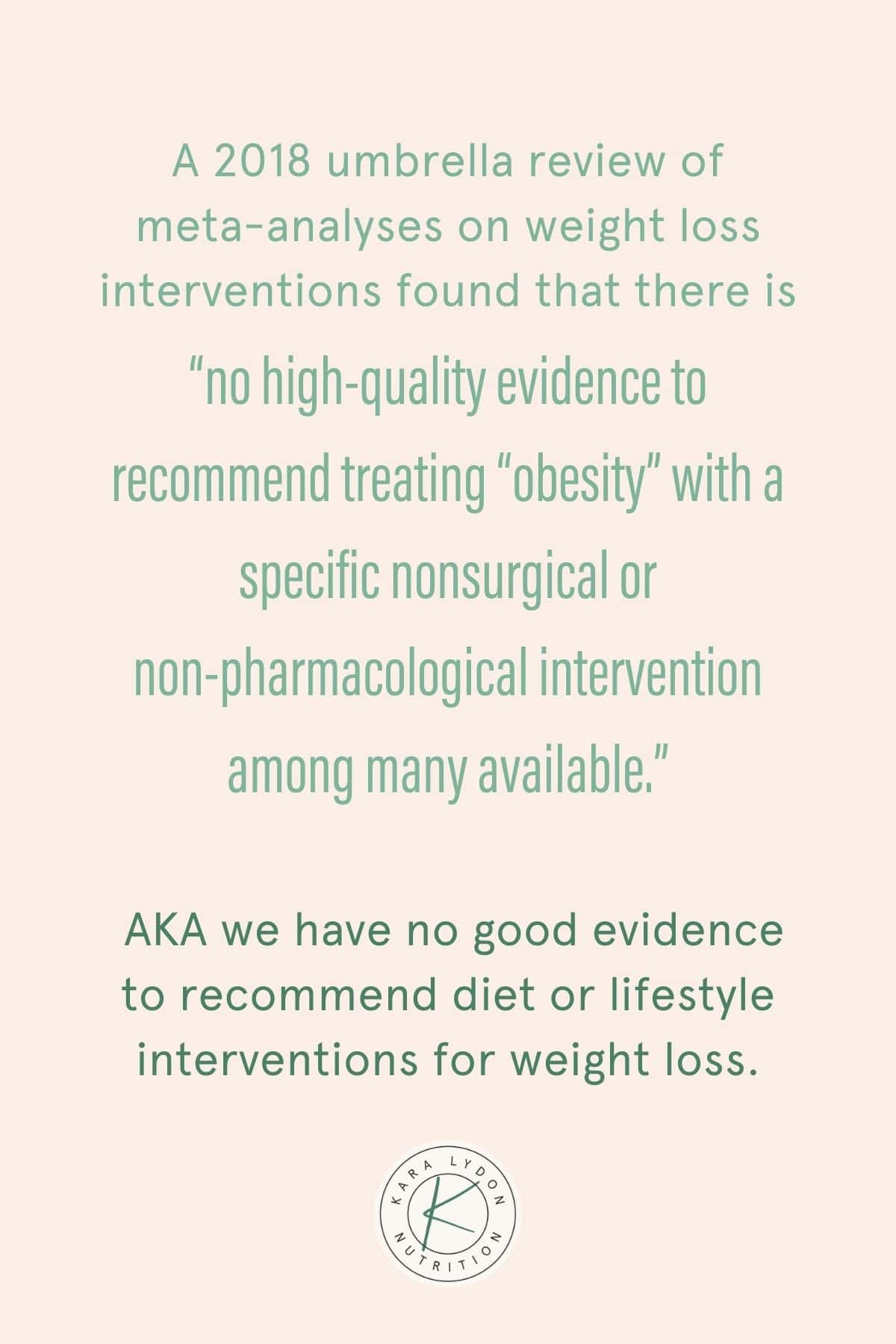
A 2018 general review of meta-analyses on weight loss interventions found that “there is no high-quality evidence to recommend treating ‘obesity’ with a specific non-surgical or non-pharmacological intervention among many available”. AKA we don’t have good evidence to recommend dietary or lifestyle interventions for weight loss.Graphic with quote: "A 2018 general review of meta-analyses on weight loss interventions found that there "there is no high-quality evidence to recommend a treatment "portliness" with a specific non-surgical or non-pharmacological intervention among many available." AKA we don't have good evidence to recommend dietary or lifestyle interventions for weight loss."Graphic with quote: "A 2018 general review of meta-analyses on weight loss interventions found that there "there is no high-quality evidence to recommend a treatment "portliness" with a specific non-surgical or non-pharmacological intervention among many available." AKA we don't have good evidence to recommend dietary or lifestyle interventions for weight loss."
Naturalistic studies (where you observe people in their natural environment and record behaviors) have concluded that diet is actually a predictor of weight gain. So diets not only don’t work but also predict weight gain. A number of meta-analyses and comprehensive reviews have reported the same results – that lifestyle interventions actually lead to weight gain, especially with long-term follow-up.

Other reviews have shown that 3-5% weight loss is possible for years afterwards if all aspects of treatment are maintained. To give this more context, that would be a 6-10 lb weight loss for a 200 lb person. The health benefits of this type of moderate weight loss are unclear. And most people are looking for 30% weight loss, not 3-5%.

Are there health risks associated with weight due to weight cycling?

Studies show that weight cycling (weight loss, weight gain, rinse and repeat) is a risk factor for diabetes, dyslipidemia, poorer self-esteem, insulin resistance, hypertension, and visceral fat.

A 15-year study showed that the highest death rate was in people who lost weight and not those who gained weight or remained stable. That too other studies it shows us Weight cycling can be worse for your health than staying at/maintaining a higher weight.

What if the health risks we see associated with weight are actually due to repeated attempts to lose weight and the stress it puts on the body rather than actual body size?

We know that health-promoting behaviors (exercise, eating more fruits and vegetables, getting enough sleep) can reduce mortality risk regardless of any weight changes. Yes correctly. You can improve your health indicators without losing weight.
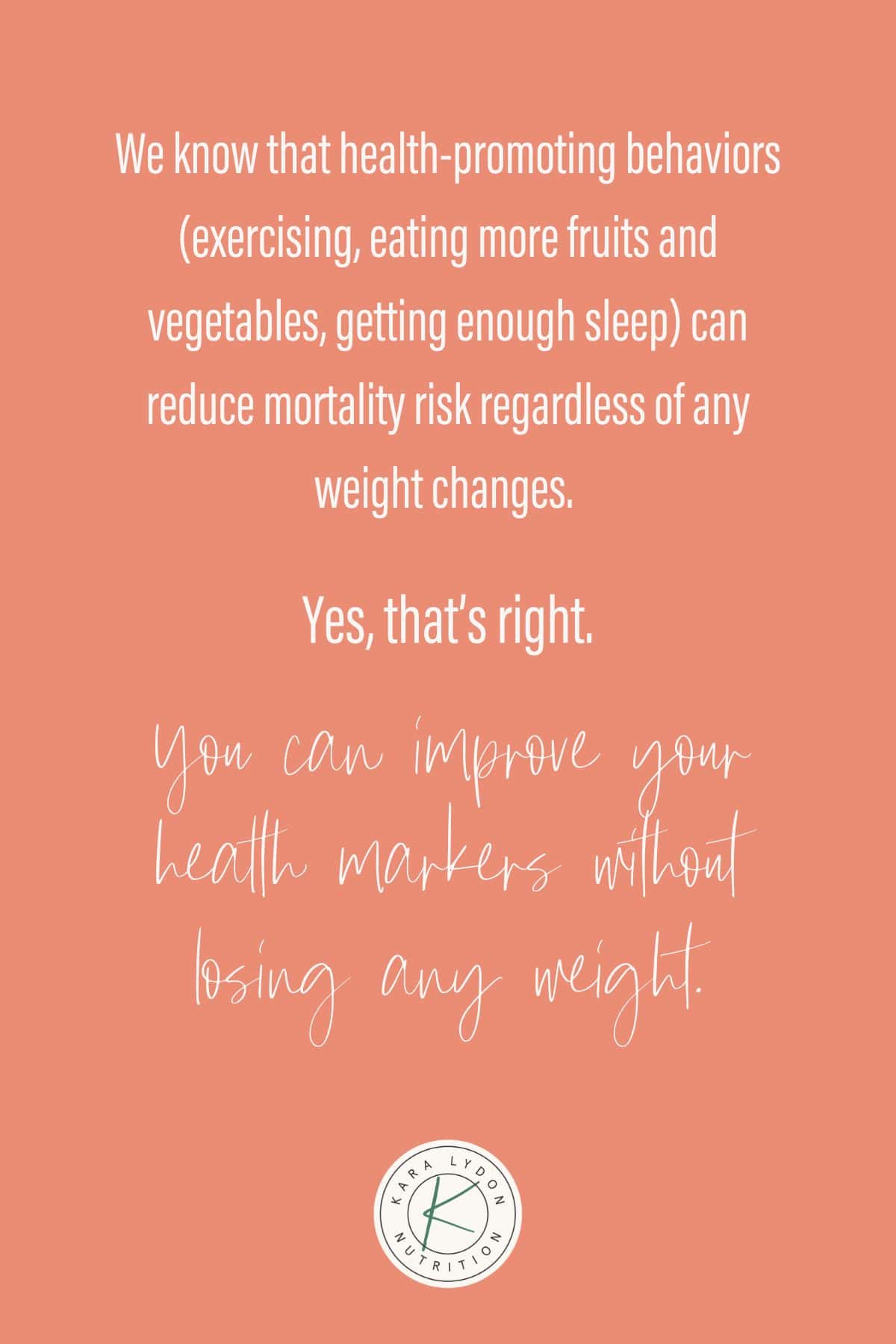
Graphic with quote: "We know that health-promoting behaviors (exercise, eating more fruits and vegetables, getting enough sleep) can reduce mortality risk regardless of any weight changes.  Yes correctly.  You can improve your health indicators without losing weight."Graphic with quote: "We know that health-promoting behaviors (exercise, eating more fruits and vegetables, getting enough sleep) can reduce mortality risk regardless of any weight changes.  Yes correctly.  You can improve your health indicators without losing weight."It is also important to consider how weight stigma or anti-fat bias plays into the association data we see between higher weights and worse health outcomes. It has been reported in the literature that “bias can reduce efforts to engage in healthy lifestyle behaviors through negative emotional distress and unhealthy eating patterns.”

It’s also worth noting that all studies on weight and health risks are correlated. And when you learn how to read and analyze the research, the one thing that is always emphasized is “correlation does not equal causation”. We cannot say that weight causes chronic disease – there is no literature to support this.

If you look at all the data on smoking/tobacco use and lung cancer and see that there is a correlation between them with yellow teeth and lung cancer, you would never say yellow teeth caused the cancer, you would say it is a side effect of smoking. Yellow teeth are not a behavior.

Just because weight is associated with chronic disease does not mean it is the cause. Weight is also not a behavior.

“Overweight” BMIs have the lowest risk of mortality

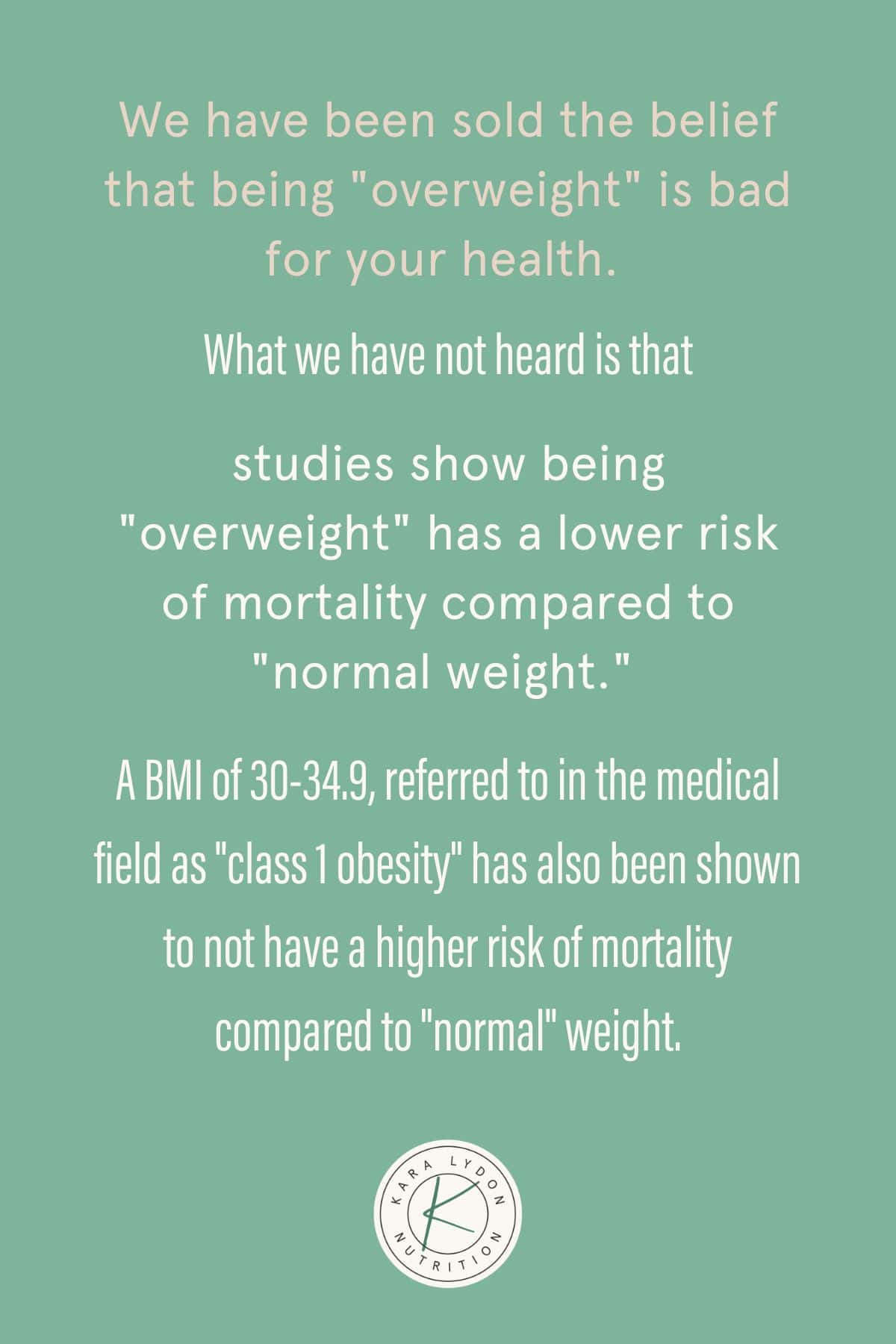
We’ve been sold the belief that being “overweight” is bad for your health. What we haven’t heard is this studies show Being ‘overweight’ has a lower risk of mortality compared to ‘normal weight’. A BMI of 30-34.9, referred to in the medical field as “obese category 1” has also been shown to have no higher risk of mortality compared to “normal” weight.Graphic with quote: "We have been sold the belief that it is "overweight" it is bad for your health.  What we haven't heard is that studies show it exists "overweight" has a lower mortality risk compared to "Normal weight." A BMI of 30-34.9, referred to in the medical field as "obesity category 1" has also been shown not to have a higher risk of mortality compared to "normal" weight."Graphic with quote: "We have been sold the belief that it is "overweight" it is bad for your health.  What we haven't heard is that studies show it exists "overweight" has a lower mortality risk compared to "Normal weight." A BMI of 30-34.9, referred to in the medical field as "obesity category 1" has also been shown not to have a higher risk of mortality compared to "normal" weight."
Why isn’t anyone talking about the protective effect of being “overweight”? Because that wouldn’t be good for all the pharmaceutical companies that sell weight loss drugs and the diet industry that sells their lifestyle programs.

BMI is bullshit anyway, but I could write another whole blog post on that topic, so I’ll save that for another time.

Bibliographical references:

Mann, T., Tomiyama, AJ, Westling, E., Lew, A.-M., Samuels, B., & Chatman, J. (2007). Medicare’s quest for effective obesity treatments: Diets are not the answer. American psychologist, 62(3), 220–233.

Solmi, M., Köhler, CA, Stubbs, B., Koyanagi, A., Bortolato, B., Monaco, F., … & Carvalho, AF (2018). Environmental risk factors and non-pharmacological and non-surgical interventions for obesity: A general review of meta-analyses of cohort studies and randomized controlled trials. European Journal of Clinical Investigation, 48(12), e12982.

Lissner, L., Odell, PM, D’Agostino, RB, Stokes, J., Kreger, BE, Belanger, AJ, & Brownell, KD (1991). Variability of body weight and health outcomes in the Framingham population. New England Journal of Medicine, 324(26), 1839–1844.

Tolvanen, L., Ghilotti, F., Adami, H.-O., Ye, W., Bonn, SE, Bellocco, R., & Lagerros, YT (2023). Prospective study of weight loss and all-cause, cardiovascular, and cancer mortality. Scientific Reports, 13(1), 5669.

Mulligan, AA, Lentjes, MAH, Luben, RN, Wareham, NJ, & Khaw, KT (2018). Weight change and 15-year mortality: results from the European Prospective Investigation on Cancer in Norfolk (EPIC-Norfolk) cohort study. European Journal of Epidemiology, 33(1), 37–53.

Flegal, KM, Kit, BK, Orpana, H., & Graubard, BI (2013). Association of all-cause mortality with overweight and obesity using standard body mass index categories: A systematic review and meta-analysis. GLASS, 309(1), 71–82.

eator more blog posts like this see:

Diet Loss Science weight
bhanuprakash.cg
healthtost
  • Website

Related Posts

What foods to avoid if you have fatty liver disease

April 18, 2026

Peanut Chicken Bowl + $75 Peanut Lover’s Giveaway

April 18, 2026

7 selective tips that really work

April 17, 2026

Leave A Reply Cancel Reply

Don't Miss
Nutrition

What foods to avoid if you have fatty liver disease

By healthtostApril 18, 20260

What foods should you avoid or minimize if you’ve been diagnosed with fatty liver disease?…

Rose Byrne is raw, magnetic and unfiltered as a woman in crisis

April 18, 2026

Can a girl be so tight it hurts? The Truth About Pelvic Strain – Vuvatech

April 18, 2026

Transfer to birth center C-section, birth center VBAC and Surprise Footling Breech Transfer to home

April 18, 2026
Stay In Touch
  • Facebook
  • Twitter
  • Pinterest
  • Instagram
  • YouTube
  • Vimeo
TAGS
Baby benefits body brain cancer care Day Diet disease exercise finds Fitness food Guide health healthy heart Improve Life Loss Men mental Natural Nutrition Patients People Pregnancy research reveals risk routine sex sexual Skin Skincare study Therapy Tips Top Training Treatment ways weight women Workout
About Us
About Us

Welcome to HealthTost, your trusted source for breaking health news, expert insights, and wellness inspiration. At HealthTost, we are committed to delivering accurate, timely, and empowering information to help you make informed decisions about your health and well-being.

Latest Articles

What foods to avoid if you have fatty liver disease

April 18, 2026

Rose Byrne is raw, magnetic and unfiltered as a woman in crisis

April 18, 2026

Can a girl be so tight it hurts? The Truth About Pelvic Strain – Vuvatech

April 18, 2026
New Comments
    Facebook X (Twitter) Instagram Pinterest
    • About Us
    • Contact Us
    • Privacy Policy
    • Terms and Conditions
    • Disclaimer
    © 2026 HealthTost. All Rights Reserved.

    Type above and press Enter to search. Press Esc to cancel.