


Close Menu
Healthtost
  • News
  • Mental Health
  • Men’s Health
  • Women’s Health
  • Skin Care
  • Sexual Health
  • Pregnancy
  • Nutrition
  • Fitness
  • Recommended Essentials
What's Hot

Gut-friendly diet linked to lower risk of coronary heart disease mortality

July 9, 2026

New Sunscreen Ingredient: Is This The SPF Upgrade We’ve Been Waiting For?

July 9, 2026

5 Easy High Fiber Bowl Recipes

July 8, 2026
Facebook X (Twitter) Instagram
  • About Us
  • Contact Us
  • Privacy Policy
  • Terms and Conditions
  • Disclaimer
Facebook X (Twitter) Instagram
Healthtost
SUBSCRIBE
  • News

    Socioeconomic status confers unequal reductions in metabolic disease among racial, ethnic groups

    July 8, 2026

    Only one in 10 Australians know the Black Triangle safety symbol

    July 8, 2026

    Study reveals why patients with rare leukemia develop resistance to tagraxofusp

    July 7, 2026

    Countable Labs and Promega Announce Collaboration Agreement to Facilitate End-to-End Biological Sample Preparation and Rare Variant Detection

    July 7, 2026

    New virus insights lay foundation for treatment of JC polyomavirus infection

    July 6, 2026
  • Mental Health

    Almost 20% of new mums have anxiety or depression, but a promising psychedelic treatment is on the horizon

    July 7, 2026

    How can ART help us improve our mental health? With 3 Ways

    July 5, 2026

    How much do friends affect the mental health of teenagers? What a new study can (and can’t) tell us

    July 3, 2026

    What happens in your blood when you are stressed? We put it to the test

    June 28, 2026

    Why negative news grabs our attention and what it means for our mental health

    June 25, 2026
  • Men’s Health

    Gut-friendly diet linked to lower risk of coronary heart disease mortality

    July 9, 2026

    Men don’t just avoid their health. Many lose themselves.

    July 8, 2026

    The Crazy Hard Standards of the Hardest PE Program in History

    July 8, 2026

    Why our relationships are becoming more dishonest and what we can do about it

    July 7, 2026

    Definitive Guide: The Primal Blueprint

    July 7, 2026
  • Women’s Health

    Taite Heller on Why Barre Became a Top-5 Fitness Trend

    July 8, 2026

    Sunscreen TikTok convinces young people

    July 7, 2026

    Biology, Myths and Real Care

    July 7, 2026

    The shape of the strong black woman

    July 6, 2026

    208: What Mold Really Does to Your Health and How to Find It with Brian Karr

    July 5, 2026
  • Skin Care

    New Sunscreen Ingredient: Is This The SPF Upgrade We’ve Been Waiting For?

    July 9, 2026

    How to achieve the perfect tan

    July 8, 2026

    How I did it: I plump the skin without fillers

    July 6, 2026

    Natural bug bite relief with herbal remedies

    July 4, 2026

    Why Jojoba Beads Beat Coconut Shell Pow

    July 3, 2026
  • Sexual Health

    Complete Career Guide — Sexual Health Alliance

    July 8, 2026

    Because your sexual health matters more than you think

    July 5, 2026

    Fildena 150 How It Works: Mechanism & Benefits

    July 4, 2026

    Climate justice is reproductive justice

    July 2, 2026

    5 STDs that can cause bruising

    July 2, 2026
  • Pregnancy

    Calf Raises During Pregnancy: Step-by-Step Guide and Benefits

    July 8, 2026

    Tri-Tri Triplet Pregnancy with Vaginal Birth Story – The Birth Hour Triplet Pregnancy and Vaginal Birth Story with Ashlie Holladay

    July 7, 2026

    Common pregnancy drugs linked to higher rates of autism diagnosis in large study

    July 6, 2026

    Monsoon Infections During Pregnancy: Safety Tips for Expectant Moms

    July 5, 2026

    How to be the support she really needs

    July 4, 2026
  • Nutrition

    5 Easy High Fiber Bowl Recipes

    July 8, 2026

    Salmon Teriyaki Recipe (Ridiculously Easy!) • Kath Eats

    July 8, 2026

    Can exercise counteract a high-fat meal?

    July 6, 2026

    Natural ways to boost energy throughout the day

    July 6, 2026

    My story with iron deficiency as a plant-based nutritionist and runner

    July 4, 2026
  • Fitness

    Using External Signaling to Improve Linear Acceleration – Tony Gentilcore

    July 8, 2026

    5 Simple Screen Changes That Can Improve Sleep and Focus

    July 7, 2026

    How to prevent muscle loss while losing weight

    July 5, 2026

    The role of nutrition in maintaining energy during regular exercise

    July 5, 2026

    Junior Nsemba’s 3 best drills for strength, speed and dominance on the rugby field

    July 3, 2026
  • Recommended Essentials
Healthtost
Home»News»The impressive diagnostic skills of GPT-4 were demonstrated
News

The impressive diagnostic skills of GPT-4 were demonstrated

healthtostBy healthtostApril 21, 2024No Comments5 Mins Read
Facebook Twitter Pinterest LinkedIn Tumblr Reddit WhatsApp Email
The Impressive Diagnostic Skills Of Gpt 4 Were Demonstrated
Share
Facebook Twitter LinkedIn Pinterest WhatsApp Email

In a recent study published in the journal PLOS Digital Healthresearchers assessed and compared the clinical knowledge and diagnostic reasoning capabilities of large language models (LLMs) with those of human ophthalmology experts.

Study: Large language models approximate expert-level clinical knowledge and reasoning in ophthalmology: A cross-sectional study. Image credit: ozrimoz / Shutterstock

Record

Generative Pre-trained Transformers (GPTs), GPT-3.5 and GPT-4, are advanced language models trained on massive Internet-based datasets. They power ChatGPT, a conversational artificial intelligence (AI) noted for its medical application success. Despite previous models struggling in specialized medical tests, the GPT-4 shows significant advances. Concerns remain about data “contamination” and the clinical relevance of test scores. Further research is needed to validate the clinical applicability and safety of language models in real medical settings and to address existing limitations in their expert knowledge and reasoning abilities.

About the study

The questions for the Part 2 examination of the Fellowship of the Royal College of Ophthalmologists (FRCOphth) have been extracted from a specialist manual that is not widely available online, minimizing the likelihood of these questions appearing in LLM training data. A total of 360 multiple-choice questions spanning six chapters were extracted and a pool of 90 questions was isolated for a mock examination used to compare the performance of LLMs and MDs. Two researchers aligned these questions with the categories established by the Royal College of Ophthalmologists and classified each question according to Bloom’s levels of cognitive processes. Questions with non-text elements that were unsuitable for LLM entry were excluded.

Exam questions were entered into versions of ChatGPT (GPT-3.5 and GPT-4) to collect responses, repeating the process up to three times per question where necessary. Once other models such as Bard and HuggingChat became available, similar tests were conducted. Correct answers, as defined by the textbook, were noted for comparison.

Five specialist ophthalmologists, three intern ophthalmologists and two general practitioners independently completed the virtual examination to assess the practical application of the models. Their answers were then compared with the answers of the LLMs. After testing, these ophthalmologists rated the LLMs’ responses using a Likert scale to rate accuracy and relevance, without knowing which model provided which response.

The statistical design of this study was powerful enough to detect significant performance differences between LLMs and human doctors, aiming to test the null hypothesis that both would perform similarly. Various statistical tests, including chi-squared and paired t-tests, were applied to compare performance and assess the consistency and reliability of LLM responses versus human responses.

Study results

Of the 360 ​​questions contained in the FRCOphth Part 2 exam manual, 347 were selected for use, including 87 from the mock exam chapter. The exceptions were mostly questions with pictures or tables, which were unsuitable for input into LLM interfaces.

Performance comparisons revealed that GPT-4 significantly outperformed GPT-3.5, with a correct response rate of 61.7% versus 48.41%. This advance in GPT-4 capabilities was consistent across different types of questions and subjects, as outlined by the Royal College of Ophthalmologists. Detailed results and statistical analyzes further confirmed the strong performance of GPT-4, making it a competitive tool even among other LLMs and human doctors, especially junior doctors and trainees.
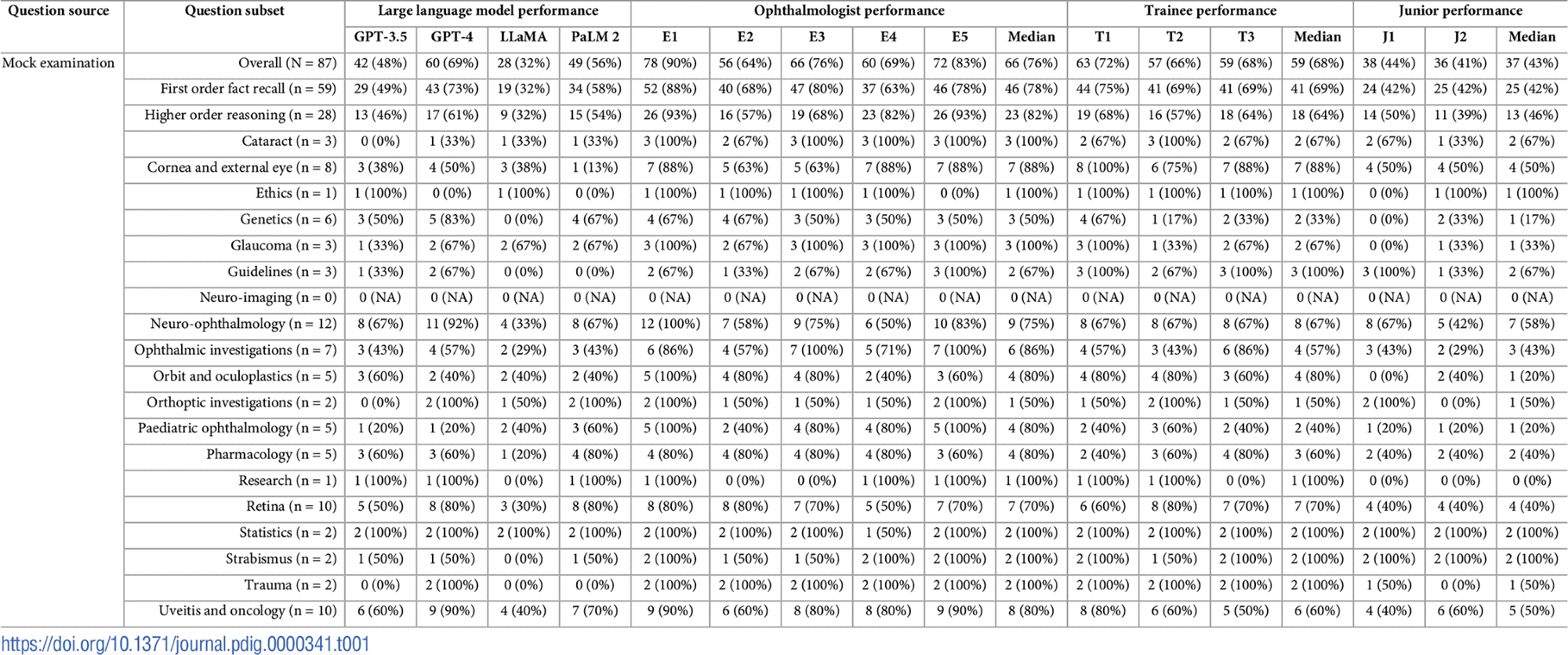
Exam features and detailed performance data.  Topic and question type distributions are presented along with the scores achieved by LLMs (GPT-3.5, GPT-4, LLaMA and PalM 2), Ophthalmologists (E1-E5), Ophthalmologists (T1-T3) and non-ophthalmologists (T1-T3). specialized young doctors (J1- J2).  Median scores do not necessarily add up to the overall median score, as fractional scores are impossible.Exam features and detailed performance data. Topic and question type distributions are presented along with the scores achieved by LLMs (GPT-3.5, GPT-4, LLaMA and PalM 2), Ophthalmologists (E1-E5), Ophthalmologists (T1-T3) and non-ophthalmologists (T1-T3). specialized young doctors (J1- J2). Median scores do not necessarily add up to the overall median score, as fractional scores are impossible.

In the specially adapted 87-question mock exam, the GPT-4 not only outperformed among LLMs, but also scored comparably to ophthalmologists and significantly better than juniors and interns. Performance across different groups of participants showed that while specialist ophthalmologists maintained the highest accuracy, trainees approached these levels, far outperforming junior non-ophthalmology specialists.

Statistical tests also highlighted that agreement between responses given by different LLMs and human participants was generally low to moderate, indicating variation in reasoning and application of knowledge between groups. This was particularly evident when the differences in knowledge between the models and human doctors were compared.

A detailed examination of the mock questions against the actual exam standards showed that the mock setup closely mirrored the actual FRCOphth Part 2 Written Exam in difficulty and structure, as agreed upon by the ophthalmologists involved. This alignment ensured that the assessment of LLMs and human responses was based on a realistic and clinically relevant framework.

In addition, qualitative feedback from ophthalmologists confirmed a strong preference for GPT-4 over GPT-3.5, correlating with quantitative performance data. The higher accuracy and relevance scores for the GPT-4 highlighted its potential utility in clinical settings, particularly in ophthalmology.

Finally, an analysis of the cases where all LLMs failed to provide the correct answer showed no consistent patterns related to the complexity or subject matter of the questions.

demonstrated diagnostic GPT4 impressive skills
bhanuprakash.cg
healthtost
  • Website

Related Posts

Socioeconomic status confers unequal reductions in metabolic disease among racial, ethnic groups

July 8, 2026

Only one in 10 Australians know the Black Triangle safety symbol

July 8, 2026

Study reveals why patients with rare leukemia develop resistance to tagraxofusp

July 7, 2026

Leave A Reply Cancel Reply

Don't Miss
Men's Health

Gut-friendly diet linked to lower risk of coronary heart disease mortality

By healthtostJuly 9, 20260

A national analysis shows that diets that support a healthier gut microbiota may help identify…

New Sunscreen Ingredient: Is This The SPF Upgrade We’ve Been Waiting For?

July 9, 2026

5 Easy High Fiber Bowl Recipes

July 8, 2026

Using External Signaling to Improve Linear Acceleration – Tony Gentilcore

July 8, 2026
Stay In Touch
  • Facebook
  • Twitter
  • Pinterest
  • Instagram
  • YouTube
  • Vimeo
TAGS
Baby benefits body brain cancer care Day Diet disease exercise finds Fitness food Guide health healthy heart Improve Life Loss Men mental Natural Nutrition Patients People Pregnancy research reveals risk routine sex sexual Skin Skincare study Therapy Tips Top Training Treatment ways weight women Workout
About Us
About Us

Welcome to HealthTost, your trusted source for breaking health news, expert insights, and wellness inspiration. At HealthTost, we are committed to delivering accurate, timely, and empowering information to help you make informed decisions about your health and well-being.

Latest Articles

Gut-friendly diet linked to lower risk of coronary heart disease mortality

July 9, 2026

New Sunscreen Ingredient: Is This The SPF Upgrade We’ve Been Waiting For?

July 9, 2026

5 Easy High Fiber Bowl Recipes

July 8, 2026
New Comments
    Facebook X (Twitter) Instagram Pinterest
    • About Us
    • Contact Us
    • Privacy Policy
    • Terms and Conditions
    • Disclaimer
    © 2026 HealthTost. All Rights Reserved.

    Type above and press Enter to search. Press Esc to cancel.