

Close Menu
Healthtost
  • News
  • Mental Health
  • Men’s Health
  • Women’s Health
  • Skin Care
  • Sexual Health
  • Pregnancy
  • Nutrition
  • Fitness
  • Recommended Essentials
What's Hot

Brain-Gut Health Initiative supports AI-assisted diagnosis of psychiatric disorders

April 25, 2026

Yeong Kim (Rian) – The Structural Elegance of Intellect and Honor

April 25, 2026

Researchers identify new genetic links to Hyperemesis Gravidarum

April 25, 2026
Facebook X (Twitter) Instagram
  • About Us
  • Contact Us
  • Privacy Policy
  • Terms and Conditions
  • Disclaimer
Facebook X (Twitter) Instagram
Healthtost
SUBSCRIBE
  • News

    Brain-Gut Health Initiative supports AI-assisted diagnosis of psychiatric disorders

    April 25, 2026

    Researchers uncover new mechanism linking metabolism, immunity and skeletal health

    April 25, 2026

    Genetic research identifies rare DNA changes that cause common heart valve damage

    April 24, 2026

    Air quality in infancy may fundamentally shape long-term immune development

    April 24, 2026

    The endoscopic procedure may prevent weight regain after stopping GLP-1

    April 23, 2026
  • Mental Health

    I hate hope: How to manage hope when you have treatment-resistant bipolar disorder

    April 19, 2026

    Rose Byrne is raw, magnetic and unfiltered as a woman in crisis

    April 18, 2026

    Can a single mother change her child’s surname in India?

    April 16, 2026

    Is it anxiety or OCD? 2 psychology experts explain the difference

    April 14, 2026

    Understanding the different types of treatment: C…

    April 10, 2026
  • Men’s Health

    45-Minute No-Equipment Home Workout (Full Body)

    April 23, 2026

    Study finds many UK adults want to avoid ultra-processed foods but can’t clearly define them

    April 21, 2026

    How can you get the best sleep?

    April 21, 2026

    The Crazy Hard Standards of the Hardest PE Program in History

    April 20, 2026

    Becoming revolutionaries in our time: Calling men to change the world for good

    April 20, 2026
  • Women’s Health

    Yeong Kim (Rian) – The Structural Elegance of Intellect and Honor

    April 25, 2026

    I felt ashamed of my dad’s illness

    April 25, 2026

    What are the different stages of puberty?

    April 24, 2026

    Understanding Hot Flashes – HealthyWomen

    April 24, 2026

    Because you are still inflamed

    April 22, 2026
  • Skin Care

    What it is and how to do it right – Lifeline Skin Care

    April 21, 2026

    Best Face Mask Set: What to Use for Your Skin Goals

    April 21, 2026

    Earth Day Activities: A Fun Guide to Plogging and More

    April 20, 2026

    Calm & Correct: The 4-in-1 color correcting treatment

    April 19, 2026

    How to Get Glowing Skin: Beauty Guide

    April 17, 2026
  • Sexual Health

    How accurate are herpes blood tests?

    April 22, 2026

    Understanding the Asexual Spectrum — Sexual Health Alliance

    April 21, 2026

    The importance of sex and intimacy in the elderly

    April 18, 2026

    Judicial reform is the only real way out of today’s political hell

    April 15, 2026

    Personal and Professional considerations between generations

    April 15, 2026
  • Pregnancy

    Researchers identify new genetic links to Hyperemesis Gravidarum

    April 25, 2026

    Loss of Appetite During Pregnancy: A Third Trimester Guide

    April 24, 2026

    Cameron Rodgers wants you to know you’re not the only one Googling “WTF is going on in my body” at 2 a.m.

    April 22, 2026

    A gentle space to navigate the becoming of motherhood

    April 21, 2026

    Transfer to birth center C-section, birth center VBAC and Surprise Footling Breech Transfer to home

    April 18, 2026
  • Nutrition

    Doing the work in the face of fear

    April 25, 2026

    Can the “dark shower” reduce stress and improve sleep?

    April 24, 2026

    High Fiber Smoothie Recipe • Kath Eats

    April 23, 2026

    Which potato is the most nutritious?

    April 22, 2026

    What Really Works (and What Doesn’t)

    April 22, 2026
  • Fitness

    4.24 Friday Faves – The Fitnessista

    April 25, 2026

    The workout we forgot (it’s time to bring it back 💪 )

    April 24, 2026

    Cardio or weightlifting? – Tony Gentilcore

    April 24, 2026

    7 super healthy ways to take care of yourself

    April 23, 2026

    Wake up with these symptoms? Your health may be at risk

    April 23, 2026
  • Recommended Essentials
Healthtost
Home»Mental Health»Noninvasively stimulating brain regions for the treatment of depressive symptoms
Mental Health

Noninvasively stimulating brain regions for the treatment of depressive symptoms

healthtostBy healthtostJune 7, 2024No Comments6 Mins Read
Facebook Twitter Pinterest LinkedIn Tumblr Reddit WhatsApp Email
Noninvasively Stimulating Brain Regions For The Treatment Of Depressive Symptoms
Share
Facebook Twitter LinkedIn Pinterest WhatsApp Email

June 5, 2024
• Research Highlights

Changes in brain activity are known to contribute to the risk for depression. Could changing activity between brain regions also provide treatment for this common but serious mood disorder?

A neuroimaging study funded by the National Institute of Mental Health investigated whether a brain stimulation therapy known as repetitive transcranial magnetic stimulation (rTMS) could target areas deep in the brain through their surface connections. The study offers new evidence that stimulating deeper areas of the brain can reduce symptoms of depression and identifies a potential target for improved depression treatment.

What area of ​​the brain did the researchers look at?

Researchers led by Desmond Oathes, Ph.D. and Kristin Linn, Ph.D. in the Center for Brain Imaging and Stimulation (CBIS) at the University of Pennsylvania Perelman School of Medicine studied an area of ​​the brain called the subgenual anterior cingulate cortex, or sgACC.

Located in the brain’s prefrontal cortex, the sgACC is important for regulating difficult emotions such as sadness and anxiety, and has been linked to risk for depression and other mood disorders. It is part of an emotion-related brain network that includes other sites in the prefrontal cortex. In previous studies, depressed subjects were more likely to improve if rTMS was applied to prefrontal sites highly connected to the sgACC, pointing to this connection as a promising target for rTMS treatment.

How did researchers deal with depression?

Illustration of rTMS.

rTMS is a precise and non-invasive brain stimulation tool used to treat depression and other mental disorders. Brain stimulation treatments can play a critical role when other depression treatments such as medication and therapy have not worked.

rTMS can only directly stimulate the outer layers of the brain. However, brain regions are highly connected, allowing them to support complex functions such as emotion. It also suggests that reaching deeper brain regions, such as the sgACC, may be possible through stimulation of the surfaces connected to them. To achieve this, the researchers used imaging techniques such as functional magnetic resonance imaging (fMRI) to guide rTMS to deeper subcortical areas of the brain.

In a previous study , the research team used rTMS to successfully target the amygdala—a deep brain region associated with anxiety and fear. However, the antidepressant effects of rTMS are not fully understood, and researchers have yet to determine which brain regions to target for the greatest clinical improvement.

What did the researchers do in this study?

Thirty-six adults (18–54 years) with a diagnosis of depression and without psychiatric medication participated in this study. In an initial session, the researchers used fMRI to map each participant’s connectivity from the prefrontal cortex to the sgACC. They used this data to determine the exact stimulation site for each participant’s rTMS treatment to target their sgACC.

All participants then completed three days of rTMS treatment sessions. Before and after treatment, participants completed a short round of rTMS, followed by single TMS pulses during an fMRI brain scan. Taking the single step of stimulating the brain with TMS while recording the fMRI data allowed the researchers to record the brain’s response to rTMS and how it changed during treatment.

Clinicians also assessed participants’ depression symptoms before and after the rTMS sessions to determine whether their symptoms improved and, if so, whether this improvement was related to their response to sgACC.
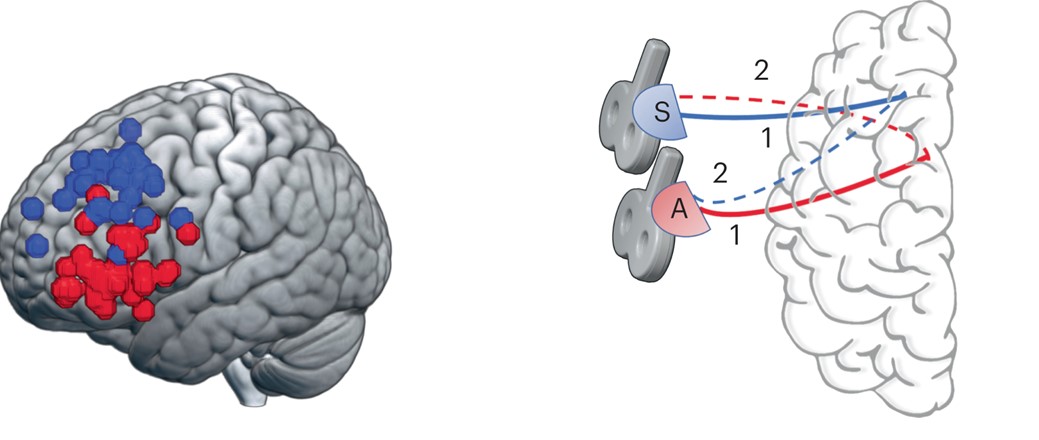
Figure 1: Brain imaging with blue and red circles indicating peaks of functional connectivity with the sgACC and amygdala, respectively, for individual participants.  Figure 2: Two rTMS coils attached to the front of the brain to indicate where they were applied to target the sgACC and amygdala.

Figure 1: Circles represent regional peaks of functional connectivity for individual participants using the baseline fMRI brain scan to guide where the rTMS coil was placed. Figure 2: Coils indicate scalp locations where rTMS was applied. S is the subgeneric goal of the cycle. A is the target of the amygdala. Credit: Oaths et al., Nature Mental Health.

Did rTMS treatment change sgACC response or depressive symptoms?

The researchers successfully used rTMS to stimulate the sgACC through its connections with the surface regions of the brain. This finding shows that fMRI can be used to guide rTMS to deeper areas of the brain.

After 3 days of rTMS treatment, participants’ depression symptoms improved by 34%, and anxiety symptoms improved by 32%. This change in symptoms corresponded to changes in sgACC activity, establishing a therapeutic role for rTMS in the treatment of depression through this pathway.

Importantly, change in depressive symptoms was predicted by initial sgACC response to TMS in the scanner. Participants with a stronger negative sgACC response to rTMS before treatment showed a greater reduction in depressive symptoms after treatment. Pre-treatment sgACC response was not related to change in anxiety symptoms, suggesting the specificity of this pathway to depression.

A greater improvement in depressive symptoms was also associated with a more positive (indicating a weaker) sgACC response after treatment. Consistent with previous studies, the researchers suggest that weakening the connection from the prefrontal cortex to the sgACC had a beneficial effect on depressive symptoms in this sample of adults with the disorder.

What do the results of this study mean?

This study offers critical insight into how rTMS engages neural circuits in the brain to help improve depression, highlighting an important link between the location of brain stimulation and change in depressive symptoms. Specifically, the researchers targeted and modulated the brain circuitry associated with depression using a safe, non-invasive means of both fMRI and rTMS.

According to the researchers, the findings are some of the strongest evidence to date that subgenital connectivity in the brain is a marker of antidepressant response. The identified pathway from the sgACC to the prefrontal cortex responded to rTMS and provided rapid relief of depressive symptoms. Incorporating fMRI-based brain mapping into rTMS sessions could make it possible to map outer brain regions accessible by rTMS to then stimulate deeper regions underlying depression and other disorders. This could eventually lead to more personalized or effective treatments for many mental disorders.

Although still preliminary, the potential clinical implications of this study are broad. A next step for the researchers is to replicate the findings in larger clinical trials of different people with and without depression and in people diagnosed with other mental disorders, such as post-traumatic stress disorder (PTSD). Knowing that many brain regions and networks play a role in the clinical effects of rTMS, researchers also plan to examine other brain regions to improve treatment and better understand when, how, and for whom rTMS works best.

Report

Oathes, DJ, Duprat, RJ-P., Reber, J., Liang, X., Scully, M., Long, H., Deluisi, JA, Sheline, YI, & Linn, KA (2023). Noninvasive targeting, detection, and modulation of a deep brain circuit to alleviate depression. Nature Mental Health, 11033–1042. https://doi.org/10.1038/s44220-023-00165-2

Grants

MH120811 , MH116920 , MH109991

brain depressive Noninvasively regions stimulating Symptoms Treatment
bhanuprakash.cg
healthtost
  • Website

Related Posts

Wake up with these symptoms? Your health may be at risk

April 23, 2026

I hate hope: How to manage hope when you have treatment-resistant bipolar disorder

April 19, 2026

Calm & Correct: The 4-in-1 color correcting treatment

April 19, 2026

Leave A Reply Cancel Reply

Don't Miss
News

Brain-Gut Health Initiative supports AI-assisted diagnosis of psychiatric disorders

By healthtostApril 25, 20260

Psychiatric disorders affect millions worldwide, but their diagnosis is still based on clinical observation rather…

Yeong Kim (Rian) – The Structural Elegance of Intellect and Honor

April 25, 2026

Researchers identify new genetic links to Hyperemesis Gravidarum

April 25, 2026

Doing the work in the face of fear

April 25, 2026
Stay In Touch
  • Facebook
  • Twitter
  • Pinterest
  • Instagram
  • YouTube
  • Vimeo
TAGS
Baby benefits body brain cancer care Day Diet disease exercise finds Fitness food Guide health healthy heart Improve Life Loss Men mental Natural Nutrition Patients Pregnancy research reveals risk routine sex sexual Skin Skincare study Therapy Tips Top Training Treatment Understanding ways weight women Workout
About Us
About Us

Welcome to HealthTost, your trusted source for breaking health news, expert insights, and wellness inspiration. At HealthTost, we are committed to delivering accurate, timely, and empowering information to help you make informed decisions about your health and well-being.

Latest Articles

Brain-Gut Health Initiative supports AI-assisted diagnosis of psychiatric disorders

April 25, 2026

Yeong Kim (Rian) – The Structural Elegance of Intellect and Honor

April 25, 2026

Researchers identify new genetic links to Hyperemesis Gravidarum

April 25, 2026
New Comments
    Facebook X (Twitter) Instagram Pinterest
    • About Us
    • Contact Us
    • Privacy Policy
    • Terms and Conditions
    • Disclaimer
    © 2026 HealthTost. All Rights Reserved.

    Type above and press Enter to search. Press Esc to cancel.