


Let’s be honest: lube doesn’t have nearly enough airtime. It’s tucked away behind the drugstore counter, bought with the same vigor as a hangover snack, and rarely discussed openly—even though it’s one of the most useful, body-positive products you can have. Whether you’re dealing with vaginal dryness, postpartum sex, looking to ease into menopause, or simply want a more comfortable, pleasurable experience, lube is your best friend. We strongly believe it should be in everyone’s bedside drawer (right next to HANX condomsnaturally).
But we get it. With so much buzz online about “toxic” ingredients and mysterious formulations, it can feel impossible to know what you’re actually putting near your most sensitive parts. So, we thought: why not tell you exactly what we have in ours?
Here’s everything you need to know about HANX water-based lubricant – ingredient by ingredient, myth by myth.
First Things First: Why Water Based?
Not all lubricants are created equal. There are oil-based, silicone-based, and water-based formulas. and each has its place. But water-based lube is widely considered the gold standard for everyday intimate use, and here’s why:
It is condom compatible. Oil-based lubricants can degrade latex condoms (not ideal). Water based? Completely safe with all types of condoms, including HANX natural latex condoms.
It’s kind to your vaginal microbiome. A well-formulated water-based lubricant works with your body, not against it.
It is flexible. Safe to use with sex toys, during penetrative sex, solo play, or just to combat dryness every day.
Cleans easily. So why is it water based?
What’s in the bottle?
Let’s get into it. We know that “Hydroxyethylcellulose” and “Potassium Sorbate” sound like they belong in a chemistry lab rather than a bottle of lube, so we asked our company gynecologist and HANX co-founder Dr Sarah to translate. Think of this as your ingredient cheat sheet.
Aqua (>75%)
Yes, the main ingredient is water. More than three quarters of this formula is pure water base, which is exactly what you want. The high water content is what makes it feel natural, light and comfortable. Your vagina is amazing.
Propylene Glycol (>10% – ≤25%)
This can sometimes get a bad rap, especially from people who have never been into science. Propylene glycol is a humectant – it attracts moisture and holds it where you need it most. It has been reviewed and accepted as safe at this concentration by the Scientific Committee on Consumer Safety (SCCS), is approved as a food additive by the European Food Safety Authority, and is commonly used as a pharmaceutical excipient in vaginal pharmaceutical products. Yes, it may be derived from petroleum (so are many things), but the origin has nothing to do with safety. A very small subset of people may notice a sensitivity to it, as with any ingredient, and if you’re in that camp, it’s worth knowing. But for the vast majority? It’s a well-tolerated, established ingredient that does exactly what it’s supposed to do.
Hydroxyethyl cellulose (>1% – ≤5%)
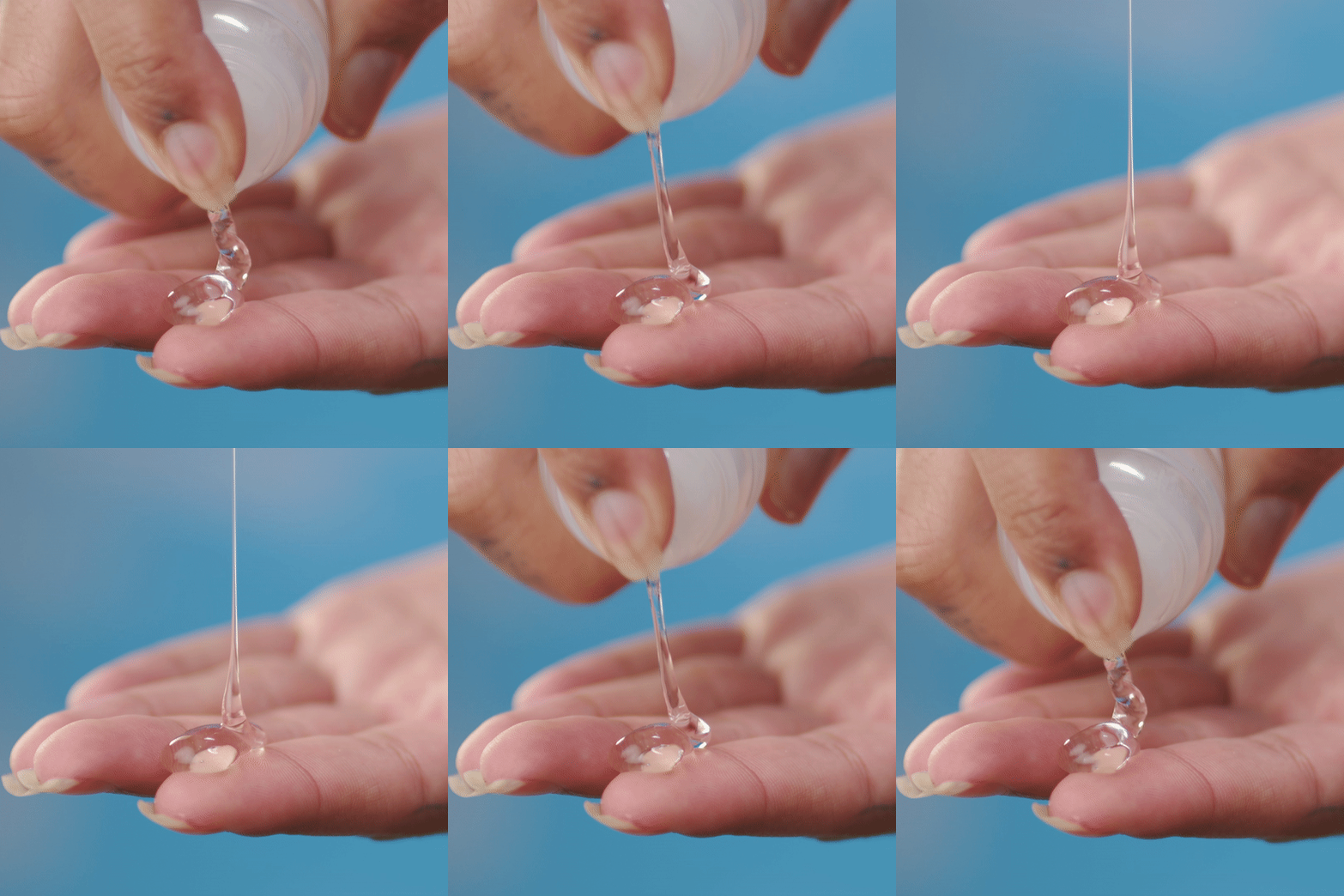
This is the ingredient that gives the lube its texture – the satisfying gel-like texture that really stays where you want it. It is an inert, nonionic polymer (fancy way of saying: very well behaved, no funny business) with no known sensitizing potential. It’s so gentle, in fact, that it’s used in WHO-listed placebo lubricant formulations and pharmaceutical vaginal delivery systems. Are there claims that it disrupts the vaginal microbiome? It is not supported by a single reliable scientific source.
Sodium benzoate and potassium sorbate (>0.1% – ≤1% each)
These two are the preservatives in the formula and are there because a water-based product without preservatives is a breeding ground for bacteria and mold. This is a far greater risk to your personal health than a preservative below 1%. Both are permitted under the EU cosmetics regulation (Annex V), both are approved food additives (E211 and E202 respectively) and both are among the most widely used and well tolerated preservatives in food and personal care worldwide. The “in vitro cytotoxicity” concerns you may have read about online? These apply to much higher concentrations than are present here. Context matters.
Sodium acetate and citric acid (≤0.1% each)
This is where it gets very clever. These two ingredients work together as a pH regulator – keeping the formula in a mildly acidic, physiologically appropriate range that reflects the healthy vaginal environment. A stable, slightly acidic pH is actually protective of the vaginal microbiome, which does not disturb it. Citric acid, by the way, is naturally produced by the human body and is approved without restrictions as a food additive (E330). At less than 0.1%, its presence is completely functional and completely insignificant.
Isopropyl alcohol (≤0.1%)
It is present in trace elements – less than one tenth of one percent. When people worry about isopropyl alcohol in formulations, they think of concentrated, undiluted IPA (the 60-70% stuff used in hand sanitizer). At ≤0.1% in an aqueous formula, there is no substantial risk of drying or irritation. It’s there as a processing aid, doing a quiet, unassuming job in an extremely small concentration.
Cellulose (≤0.1%)
Of vegetable origin, inert and completely insignificant. An extremely small amount of cellulose, a structural polymer found in every plant on earth, poses no known risk of irritation or concern to the microbiome at any concentration.
Sodium Hydroxide (≤0.1%)
The words “sodium hydroxide” (aka caustic soda) can feel alarming. And we understand why. But here’s the thing: this ingredient exists in trace amounts as a pH adjuster and is not present as free caustic soda in the final product. During the synthesis, it reacts with the acidic buffer components and is completely neutralized. It is included in the INCI ingredient list because EU regulations require full transparency of ingredients and not because the final product is in any way corrosive. We love a transparent label, but this one needs some context.
A word from our co-founder
“As a gynecologist, I regularly recommend water-based lube – to patients of all ages, from twenty-somethings dealing with dryness associated with hormonal contraception, to those going through menopause and beyond. The HANX lube formulation has been carefully developed to sit in a physiologically appropriate pH range. The concentration fully complies with EU cosmetic safety regulations and none of them cause me any clinical concerns. their absence here matters.
— Dr. Sarah, Doctor & HANX Co-Founder
Who is HANX lubricant for?
The short answer: everyone in a body! The slightly longer answer:
People experiencing vaginal dryness – either from hormonal contraception, perimenopause, menopause, stress or simply on a given day.
Anyone who uses condoms – is fully compatible with latex and enhances comfort without compromising protection.
Those returning to sex after giving birth – hormonal changes can mean that dryness persists for months after giving birth and lube is really one of the most recommended products in this area.
People with sensitive skin – the formula has been developed with tolerance in mind.
Anyone who just wants better, more comfortable sex. (That should be all of us!)
There is no age requirement, no minimum level of “need” and absolutely no shame.
The bottom line
Every ingredient in HANX water-based lubricant is there for a reason, in a concentration that is safe, well-documented and compliant with EU regulations. The formula is over 75% water, pH balanced to support vaginal health, free of any ingredients restricted for intimate use and completely compatible with condoms.
We think it’s worth knowing exactly what you’re using and why. Because bodies are beautiful and deserve products made with the same care and transparency as you would expect from anything else you put on or on them.
Buy HANX Universal lubricant here.
