


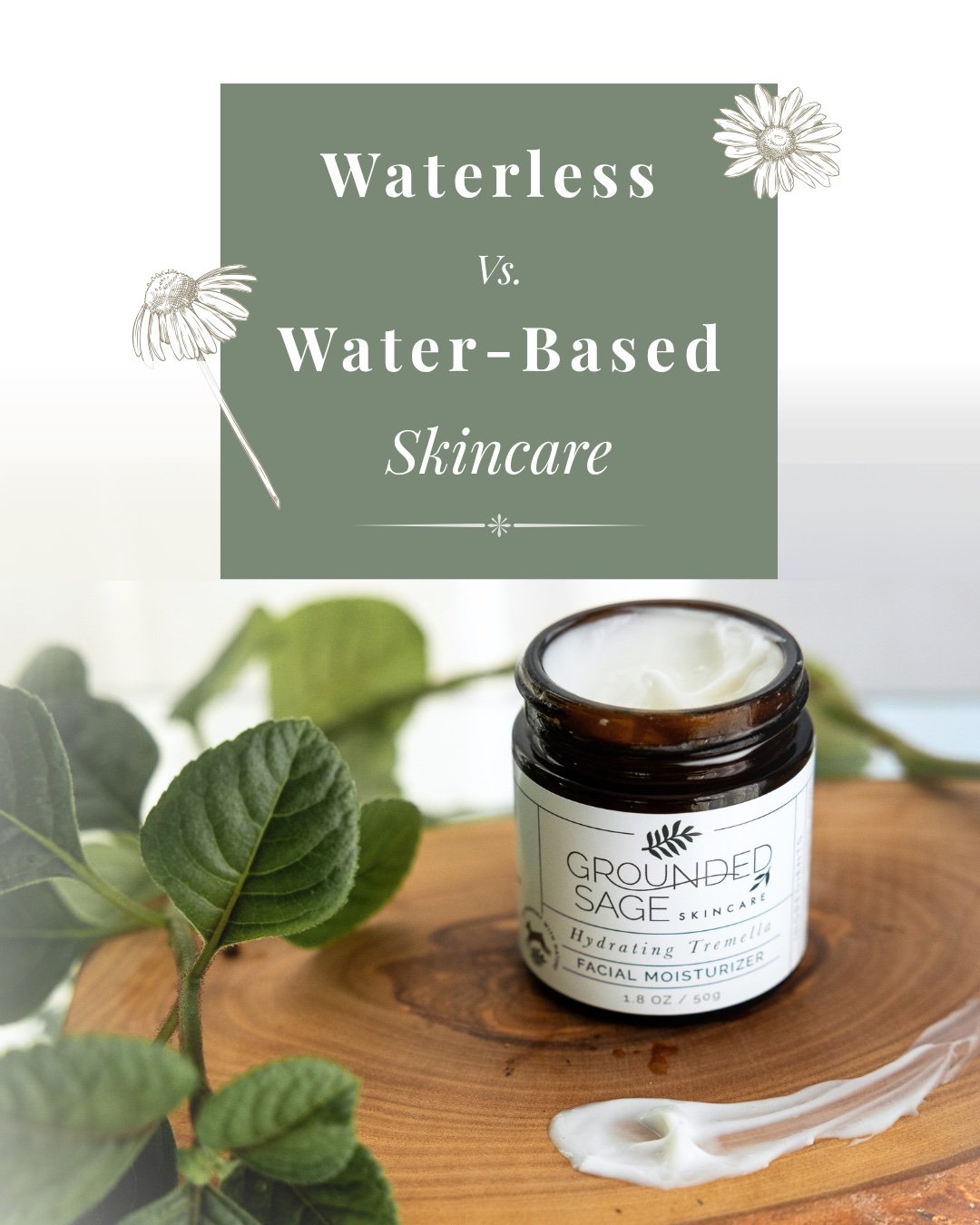
A basic look at one of the most talked about skin care trends: The truth about waterless skin care.
Recently, this phrase has become a trend: “Skin care without water.”
It’s often framed as the “best” choice for your skin. More potent, less diluted, more targeted…But like many things in skin care, the truth is much more subtle.
Let’s break down the truth about waterless skincare: What water actually does in products, how it compares to oil-based alternatives, and what your skin really needs to stay balanced, hydrated and supported.
Is water in skincare just a filler?
If you’ve ever looked at an ingredient list, you probably have water (aqueous) are listed first. This has led to a common question: “Why am I paying for something that is mostly water?” Here’s the truth: water isn’t just filler—it’s functional.
Water in skincare helps deliver water-based ingredients to the skin, creates lightweight textures that absorb quickly, and makes products more accessible and easier to use on a daily basis.
Without water, many formulations would feel heavy, greasy or difficult to spread. In other words: water helps skin care they work well.
Why Your Skin Needs Hydration (Not Just Oils)
Your skin naturally contains water and maintaining this hydration is essential for overall skin health. Proper hydration supports:
- Strong, durable skin barrier
- Elasticity and thickness
- Reduced dryness and irritation
Topical hydration (from water-based products) works alongside internal hydration (what you drink) to maintain optimal skin function. Hydration is not optional for skin health, it is fundamental.
Water-Based and Oil-Based Skin Care: What’s the Difference?
One of the biggest misconceptions in the “waterless” debate is that water and oils do the same thing. They don’t.
Water-based products (hydration)
Water-based skin care includes:
These products hydrate the skin, absorb quickly and feel light and breathable. They are especially useful for dehydrated and acne-prone, congested skin.

Oil-based products (protection)
Oil-based skin care includes:
These products seal moisture into the skin, provide nourishment and protection and absorb more slowly. They are especially useful for dry or damaged / damaged skin. They lock in hydration after water-based steps to support the skin barrier.

👉 To put it simply:
- Water hydrates
- Oils protect and seal
Most skin types benefit from a combination of both.
Can oil-based skin care cause breakouts?
For some people – yes.
While oils can be incredibly supportive, they can also:
- Feels very heavy on the skin
- Sit on the surface instead of being fully absorbed
- They contribute to congestion in acne-prone people
This doesn’t mean that oils are “bad” – it just means that they aren’t ideal for everyone in every situation.
👉 If your skin feels congested, heavy or overly shiny, incorporating more water-based products can help restore balance.

What does “waterless care” really mean?
This is where things get a little confusing.
True waterless care refers to products that do not contain any water-based ingredients. However, many products marketed as ‘anhydrous’ still contain:
- hydrosols (flower water)
- Aloe
- Water-based botanical extracts
While they may not be labeled as “water,” they still function as water-based ingredients. This creates a gray area where “waterless” becomes more of a marketing term than a strict formulation definition.
Oil extracts vs. water extracts: why it matters
Another nuance that is often overlooked is how the ingredients are extracted.
Herbal ingredients can be:
- Extraction of water (infusions, hydrolyzates, aloe-based extracts)
- Oil extraction (vegetable oils, lipid decoctions)
These behave very differently on the skin. Many brands do not clearly distinguish between these types of extract, which can increase confusion about what is actually in a product.
So… should you avoid water in your skin care?
Short answer: no.
Water isn’t something your skin should avoid – it’s something it needs to function.
The real question is not:
“Does this product contain water?”
Of:
“Is this product to support my skin right now?”
A more balanced approach to skin care
Rather than focusing on the extremes, a more grounded approach looks like:
- Use water-based products for hydration
- Use oil-based products for protection
- Pay attention to how your skin responds
- Adapting to the seasons, your environment and your body
Skincare is not one size fits all, and it’s not meant to be.
