


I have been working in the field of Gender-Specific Medicine and Men’s Health for over fifty years. One of the most important lessons I have learned is that men’s health and women’s health cannot be separated. If we improve men’s health, we will also improve women’s health and vice versa.
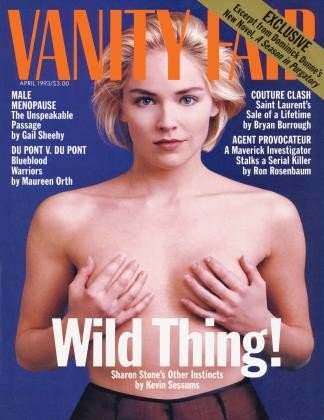
There are many reasons a man might be interested in actress Sharon Stone. It is an amazing fact of my professional life that seeing Sharon on the cover of Vanity Fair led me to write my best-selling books, Male menopause and Surviving male menopause. Here’s how it happened.
While browsing my local bookstore, I was drawn to a copy of it Vanity fair magazine. Well, to be perfectly honest, I was drawn to the cover photo of Sharon Stone, naked to the waist, her arms covering, but only partially, her breasts. Sharon gazed seductively into the reader’s eyes, two-inch letters painted on her bare midsection that spelled “WILD THINGS!” I was sure Sharon had something important to tell me.
However, I never read the article to find out, because just to the left of Sharon’s blonde hair, just below the date of April 1993, were the words that grabbed me by the throat (actually a little further south of my throat) — “Male Menopause: The Untold Passage by Gail Sheehy.” These words were spoken in a quiet but insistent voice.
I had already dealt with menopause issues as my middle-aged wife went through the transition. At first I was skeptical about men going through hormonal changes, but I decided to do the research.
Male menopause was released in 1997 and soon became an international best-seller. It has since been translated into more than fifteen foreign languages. My next book, Surviving Male Menopause: A Guide for Women and Menpublished in 2000. Although we’ve learned a lot about “life change” for women, there’s still a lot of confusion and controversy surrounding the whole idea of what happens in middle age for men.
As Sheehy recognized in his 1993 article, “
If menopause is the silent passage, “male menopause” is the unspoken passage. It is full of secrecy, shame and denial. It is far more fundamental than the end of a woman’s fertile period, because it strikes at the core of what it means to be a man.”
I was one of the first researchers to talk openly about male menopause (also called Andropause or Manopause). Here are some of the important things I’ve learned over the years and shared in my books and articles.
What is male menopause?
Male menopause begins with hormonal, physiological, and chemical changes that occur in all men generally between the ages of forty and fifty-five, although it can occur as early as thirty-five or as late as sixty-five. These changes affect all aspects of a man’s life. Male menopause is therefore a physical condition with psychological, interpersonal, social and spiritual dimensions.
What is the purpose of male menopause?
“The purpose of male menopause is to mark the end of the first part of a man’s life and prepare him for the second half. Menopause is not the beginning of the end, as many fear, but the end of the beginning. It is the passage into the most passionate, powerful, productive and purposeful moment of a man’s life.”
What are the most common symptoms of male menopause?
- Loss of libido and sexual desire, especially with the partner you are with.
- Increased fantasy about sex with others.
- Difficulty developing and maintaining an erection.
- Increased irritability and anger.
- It takes longer to recover from injuries and illnesses.
- Having less stamina for physical activity.
- Increased anxiety and worry.
- Loss of confidence and joy.
What I have learned about male menopause
Over the years, I have found two common points of view: (1) Male menopause does not exist. Only women go through a hormonal life change. (2) If men do go through a change, it is only a hormonal change and can be “cured” by giving men supplemental testosterone.
I learned that neither of these opinions are true. Men go through a change in life, whether we call it Male Menopause, Andropause or Manopause. I called it Male Menopause because I believe there are more similarities than differences between what women and men experience. I also believe, as does Gail Sheehy, that it is much more complex than just a loss of hormones, but affects all aspects of a man’s life.
For most of human existence our lifespan was fairly limited to about forty years. Men and women rarely lived long enough to experience a “life change.” Life was a mountain climb and we reached the top when we were in our 20s and had children to preserve our species. Then it was a quick drop down the mountain when the kids were old enough to survive.
But now people can live into our 80s, 90s and beyond. There is another mountain to climb and what we call Male Menopause is simply the transition to the second mountain. If the top of the first mountain is called ‘Adult’, the top of the second mountain is ‘Super-Adult’ or ‘Elderly’. That’s why I say it “Male menopause is not the beginning of the end, as many fear, but the end of the beginning.”
Too many men die before their time
These are confusing and challenging times for most people, but especially for men. It has been said that “old age is not for sissies”. While many men have been embracing the past few years, too many have given up hope and given up. The suicide rate for men is much higher than the rate for women and gets even worse as we age.
Check out this chart from the Centers for Disease Control (CDC):
Suicide rate among adults aged 55 and older, by age group and sex: United States, 2021

We see the death rates of men on the left and women on the right for four different age groups, along with the different rate for all ages 55-85+ in black. Death by suicide is a huge problem for men as we age, particularly after retirement age.
For these ages 55-64, the suicide rate is 3.4 times higher for men compared to women. 65-74 the suicide rate is 4.6 times higher for men. Between the ages 75-84 the male/female ratio is 8 times higher for males. And for Those 85 and older, the suicide rate is nearly 17 times higher for men than for women. There are challenges that men and women face as we age, but clearly older men feel pressures that women don’t and lose hope for a better future. This has to change.
Welcome to Second Mountain and An Expanded Understanding of Midlife and Aging
My friend and colleague, Chip Conley, is changing our understanding of middle age and what we can expect as we prepare for and climb life’s second mountain. Conley says,
“The midlife crisis is the focus of many jokes, but this long ridiculous stage of life has an upside.”
In his new book, Learning to love middle age: 12 reasons life gets better with age it broadens our vision.
“What if we could reframe our thinking about the natural transition of midlife not as a crisis, but as a chrysalis: a time when something deep awakens within us, as we shed our skin, spread our wings, and fertilize the world with our wisdom?“
We know that middle age and aging are not all sweetness and light. It is not easy to let go of old ways that no longer work for us. We all know what happens to the caterpillar. As Conley reminds us,
“When it’s fully grown, it uses a silk button to attach its body to a branch and then forms a chrysalis. Within this protective chrysalis, the transformative magic of transformation occurs. While it’s a bit dark, dark and lonely, it’s a transition, not a crisis, from the other side, but of course it’s a beautiful one.”
Learning about men’s health, male menopause and how to live well in the second half of life
We have a lot to learn about life in the second half. Chip Conley suggests that there are three stages of middle age:
1. Early middle age (Age 35-50)
During early middle age we tend to experience some of the most challenging physical and emotional transitions – a bit like adult puberty. We realize that we are no longer young, but we are not yet old.
2. The second stage of middle age (50-59)
This is the core of middle age in our fifties, when we have settled into this new age and see some of the positives. We begin to see opportunities for growth and finding passions we never knew we had.
3. Later middle age (60-75)
We are still young enough to see and plan for the next, our earlier years. Chip says,
“At 63, I’m just getting used to this third stage, but I know it’s also when our body reminds us that it doesn’t want to be forgotten.”
I turned 82 last December and have entered the Eldership scene for good. It is a time when we are called to share what we know and have learned throughout our lives. Three years ago, I started the MenAlive Academy for Gender-Specific Healthcare. The Academy offers programs for both men and women who want to learn about the unique mental, emotional and relational issues that men face. It also offers programs for health care providers working with men and their families.
As my colleague Marianne J. Legato, MD, Founder of the Gender Specialist Medicine Foundation, says,
“Everywhere we look, the two sexes are initially and unexpectedly different not only in their normal function but also in how they experience illness.”
If you would like more information about the MenAlive Academy for Gener-Specific Healthcare, drop me a note at Jed@MenAlive.com and put “MenAlive Academy” in the subject line. If you want to read more articles like these, I invite you to subscribe to our free weekly newsletter.
