


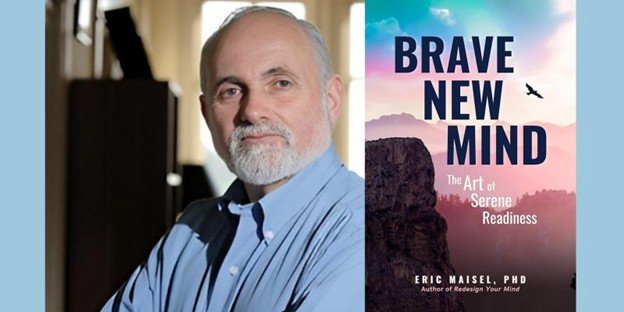
Dr. Eric Maisel is a longtime colleague and friend. He is the author of more than fifty books including Brave New Mind: The Art of Serene Readiness, which I have found to be an extremely important and important resource for all who live in today’s challenging world. I was recently lucky enough to interview Eric for my podcast series.
In Brave New Mind, captures what millions of men and women are experiencing today.
“We’re all rushing with no chance of catching up,” he says. “We desperately need a brave new mind that can take into account our brave new world at once strange and inhumane, full of material goods and loneliness, orchestrated by ruthless billionaires more powerful than governments.”
I first became aware of Eric’s work in 2007 when I read his book, The Van Gogh Blues: The Creative Person’s Path Through Depression. It spoke deeply about the challenges I had faced in my life, dealing with my own depression, as well as what my father experienced. I wrote about our own healing journey in my book, My Distant Dad: Healing the Wound of the Father of the Family and developed an online course, “Healing the Wound of the Father of the Family” for everyone who grew up with a father who was distant, absent or dysfunctional.
“Creative people will experience depression as a matter of course,” he says Van Gogh’s Blues. “It’s a given because they regularly face doubts about the significance of their efforts. It’s a kind of depression that doesn’t respond to drug treatment. What’s needed is treatment in the realm of meaning.”
As a psychotherapist specializing in Gender-Specific Medicine and Men’s Mental, Emotional and Relational Health, I share Dr. Maisel’s perspective on mental illness and mental health. I also agree that things have gotten significantly worse since 2007 when Van Gogh’s Blues first published. Reflecting on today’s world, Eric shares what he sees now.
“Many minds will simply collapse. Millions upon millions of minds will not be able to maintain coherence, motivation, hope or anything else. They will descend into pits with names like depression, anxiety, addiction, suicide. We see this happening everywhere and every day.”
Developing the Art of Serene Readiness
We don’t have to accept the bleak future of mental exhaustion and breakdown. In Brave New Mind, Dr. Maisel offers real solutions such as:
- A way to handle the increasingly stressful moments in all areas of our lives.
- Uniting the powers of calmness and alertness of ourselves.
- Creating new ways to treat depression, anxiety, addiction and other mental illnesses.
- Find renewed strength and motivation that you may have lost.
- Giving new meaning and finding your life’s purpose.
- Developing a brave new mind equal to this moment in time.
In a recent article “The Pathway of Personal Code,” Dr. Maisel says,
“To keep a personal code is to orient your life around principles rather than impulses. It is living purposefully in a world that often rewards expediency. The act of keeping a code, especially when it costs something, restores depth to experience and coherence to one’s identity. It turns mere existence into moral authority.”
In our interview, he spoke of the need to become “rebel warriors,” to stand up for what’s right and challenge the forces that dehumanize people. In my book, The Warrior’s Journey Home, Healing Men, Healing the Planet, I quoted the meditation master Chögyam Trungpa, who described polemics this way:
“Warrior here does not refer to waging war on others. Aggression is the source of our problems, not the solution. Here the word ‘warrior’ comes from the Tibetan pawo which literally means “one who is brave”. Polemics in this context is the tradition of human bravery or the tradition of fearlessness.” Trungpa concludes by saying, “Being a warrior is not being afraid of who you are.”
One of the specific practices I found most helpful Brave New Mind was the use of what Eric Maisel called “First Instructions”. In facing life’s challenges and maintaining a calm readiness to act when called upon to act, Maisel says:
“Imagine offering a simple instruction to your mind and inviting it to use that instruction over and over again.”
He calls these instructions primary instructions. One that I really appreciate and use regularly is this: Make the next one right.
It reminds me to slow down and before I react emotionally and jump into an action, I ask myself, what is the next right thing to do? Eric says,
“This evocative, impressionistic phrase will represent all of the following: that you want to be ethical, productive, proactive, and that what follows is a choice you must make.”
Especially when I’m under pressure and I’m prone to react in ways that aren’t helpful by pausing a little, taking a deep breath and repeating in my head do the next right thing it helps me stay present, relaxed and alert and engage in actions that serve me, my values and what is needed in the world.
If you would like to learn more about Dr. Eric Maisel and his work, you can visit him at Ericmaisel.com.
If you want to watch my fascinating interview with Eric, you can do it here.
You can also subscribe to my free weekly newsletter and learn more about my own work in the world.
