

Close Menu
Healthtost
  • News
  • Mental Health
  • Men’s Health
  • Women’s Health
  • Skin Care
  • Sexual Health
  • Pregnancy
  • Nutrition
  • Fitness
  • Recommended Essentials
What's Hot

Blue LED lights help chemists create complex drug molecules

July 12, 2026

How can you be tired but wired? Blame it on your stone age brain

July 12, 2026

15 No-Cook Dinners for Kids (Because It’s Too Hot to Turn on the Oven)

July 12, 2026
Facebook X (Twitter) Instagram
  • About Us
  • Contact Us
  • Privacy Policy
  • Terms and Conditions
  • Disclaimer
Facebook X (Twitter) Instagram
Healthtost
SUBSCRIBE
  • News

    Blue LED lights help chemists create complex drug molecules

    July 12, 2026

    Harvard University hosts the world’s largest conference dedicated to longevity biotechnology

    July 12, 2026

    Comprehensive insurance-supported oncology symptom management program benefits cancer patients

    July 11, 2026

    Azenta announces the completion of the sale of B Medical Systems to Thelema Sa rl. Whitestone Group acquires 40% stake in Thelema Sa rl, a special purpose vehicle (SPV) established to own B Medical Systems

    July 11, 2026

    Specialized therapies offer a new approach to regenerative medicine

    July 10, 2026
  • Mental Health

    How can you be tired but wired? Blame it on your stone age brain

    July 12, 2026

    Almost 20% of new mums have anxiety or depression, but a promising psychedelic treatment is on the horizon

    July 7, 2026

    How can ART help us improve our mental health? With 3 Ways

    July 5, 2026

    How much do friends affect the mental health of teenagers? What a new study can (and can’t) tell us

    July 3, 2026

    What happens in your blood when you are stressed? We put it to the test

    June 28, 2026
  • Men’s Health

    Low testosterone or just stress? How to tell the difference

    July 11, 2026

    Gut-friendly diet linked to lower risk of coronary heart disease mortality

    July 9, 2026

    Men don’t just avoid their health. Many lose themselves.

    July 8, 2026

    The Crazy Hard Standards of the Hardest PE Program in History

    July 8, 2026

    Why our relationships are becoming more dishonest and what we can do about it

    July 7, 2026
  • Women’s Health

    Menopause and Your Microbiome: How Gut Health Shapes Weight, Mood, and Hormones

    July 11, 2026

    They heard us. Now will they listen?

    July 11, 2026

    Taite Heller on Why Barre Became a Top-5 Fitness Trend

    July 8, 2026

    Sunscreen TikTok convinces young people

    July 7, 2026

    Biology, Myths and Real Care

    July 7, 2026
  • Skin Care

    How our natural hair care achieves salon-level results without silicones

    July 11, 2026

    Coconut Allergy and Skin Care: 20 Questions Finally Answered by a Pharmacist

    July 11, 2026

    New Sunscreen Ingredient: Is This The SPF Upgrade We’ve Been Waiting For?

    July 9, 2026

    How to achieve the perfect tan

    July 8, 2026

    How I did it: I plump the skin without fillers

    July 6, 2026
  • Sexual Health

    Fildena 150 Benefits | Effective ED & Sexual Performance Treatment

    July 11, 2026

    Painful sex after menopause: When is it time to seek treatment?

    July 11, 2026

    Emotional capitalism and artificial intimacy

    July 10, 2026

    Why report e-6929 matters in Canada — Sexual Health Research Lab

    July 9, 2026

    Complete Career Guide — Sexual Health Alliance

    July 8, 2026
  • Pregnancy

    Calf Raises During Pregnancy: Step-by-Step Guide and Benefits

    July 8, 2026

    Tri-Tri Triplet Pregnancy with Vaginal Birth Story – The Birth Hour Triplet Pregnancy and Vaginal Birth Story with Ashlie Holladay

    July 7, 2026

    Common pregnancy drugs linked to higher rates of autism diagnosis in large study

    July 6, 2026

    Monsoon Infections During Pregnancy: Safety Tips for Expectant Moms

    July 5, 2026

    How to be the support she really needs

    July 4, 2026
  • Nutrition

    15 No-Cook Dinners for Kids (Because It’s Too Hot to Turn on the Oven)

    July 12, 2026

    30 Minute Chicken Pesto Pasta (Dietist Approved)

    July 11, 2026

    5 Easy High Fiber Bowl Recipes

    July 8, 2026

    Salmon Teriyaki Recipe (Ridiculously Easy!) • Kath Eats

    July 8, 2026

    Can exercise counteract a high-fat meal?

    July 6, 2026
  • Fitness

    Meet the Belle Vitale™ Supplement System: Two Formulas. A comprehensive approach to hormone health.

    July 11, 2026

    where we ate in Tokyo (and gluten-free options!)

    July 9, 2026

    Using External Signaling to Improve Linear Acceleration – Tony Gentilcore

    July 8, 2026

    5 Simple Screen Changes That Can Improve Sleep and Focus

    July 7, 2026

    How to prevent muscle loss while losing weight

    July 5, 2026
  • Recommended Essentials
Healthtost
Home»Women's Health»What is SPF? A guide to Indian skin
Women's Health

What is SPF? A guide to Indian skin

healthtostBy healthtostMay 10, 2026No Comments5 Mins Read
Facebook Twitter Pinterest LinkedIn Tumblr Reddit WhatsApp Email
What Is Spf? A Guide To Indian Skin
Share
Facebook Twitter LinkedIn Pinterest WhatsApp Email

If you’ve ever stood in a skincare aisle looking at SPF 15, SPF 30, and SPF 50 wondering what the difference really is—you’re not alone. The number on the bottle sounds clear. Is not.

Find out what SPF actually means, why Indian skin has specific needs, and how to stop guessing.

What does SPF actually mean?

SPF stands for Sun Protection Factor. It measures how well a sunscreen protects your skin from UVB rays – the rays responsible for sunburn and contributing to skin cancer.

But the number doesn’t work the way most people think. SPF 30 does not mean double the protection of SPF 15.

Here’s the actual math:

  • SPF 15 blocks about 93% of UVB rays
  • SPF 30 blocks about 97% of UVB rays
  • SPF 50 blocks about 98% of UVB rays

The difference between SPF 30 and SPF 50 is about 1% more UVB blocked. Small gap – but important for prolonged sun exposure, which is the daily reality in India.

Does melanin give Indian skin natural SPF?

Yes – but much less than people assume.

Melanin, the pigment that gives Indian skin its tone, offers some basic UV protection. Dermatologists estimate this to be roughly equivalent to SPF 2–4 naturally. This is not enough for a country where UVI levels regularly reach 8-11 (very high to extreme) in most cities.

The myth that “darker skin doesn’t need sunscreen” is why many Indian women experience hyperpigmentation, uneven skin tone and premature aging sooner than they expect.

How much SPF do you really need?

The honest answer depends on your day, not just your skin tone.

For mostly indoor days (with windows): SPF 30 is a reasonable minimum. UVA rays – the aging rays – penetrate the glass. Even if you never go outside, your skin is exposed.

For daily commuting or outdoor exposure of less than 30 minutes: SPF 30–50.

For extended outdoor time – travel, sports, movement in open vehicles: SPF 50 minimum, reapplied every 2 hours.

Dermatologists in India widely recommend SPF 50 as an everyday standard, not a special occasion product. The margin of extra protection it offers above SPF 30 is worth it given the Indian UV intensity.

Be Bodywise- Telehealth Platform for Women’s Health and Wellness

Here is a list of all our products at Be Bodywise. Happy shopping! Get free online advice from our team of women’s health and wellness doctors and choose from a variety of products to suit your skincare, hair and nutritional needs.

What is In Vivo vs In Vitro SPF Testing?

This is important to understand – not all SPF claims are created equal.

In vitro tests measures SPF in a laboratory environment, on a glass plate. It is standard, but less accurate.

In Vivo Tests measures SPF directly on human skin. It is the gold standard because it reflects actual performance – how the sunscreen actually protects you when you wear it.

When choosing a sunscreen, look for one that has been tested In Vivo. It is an important sign of clinical rigor.

What is a PA rating and does it matter?

SPF only measures UVB protection. The PA rating – the plus signs you see (+, ++, +++, ++++) – measures UVA protection.

UVA rays are responsible for skin aging, dark spots and pigmentation. They penetrate deeper and don’t cause a visible sunburn, so people often ignore them. It shouldn’t.

For Indian skin prone to hyperpigmentation: PA++++ is the goal. This represents the maximum UVA protection currently rated.

How much sunscreen should you really be wearing?

Most people apply 20-25% of the recommended amount and wonder why they tan despite using SPF 50.

The standard guideline is the two finger rule for the face: press the sunscreen along your index and middle finger – this is about the right amount for the face and neck.

For SPF to work as advertised, you need to apply the right amount. Applying too little is equivalent to using a lower SPF.

How to choose the right SPF for Indian skin

  • Look for SPF 50 with PA++++ — this is the practical daily standard for Indian UV levels
  • Tested on Vivo it is more reliable than In Vitro alone
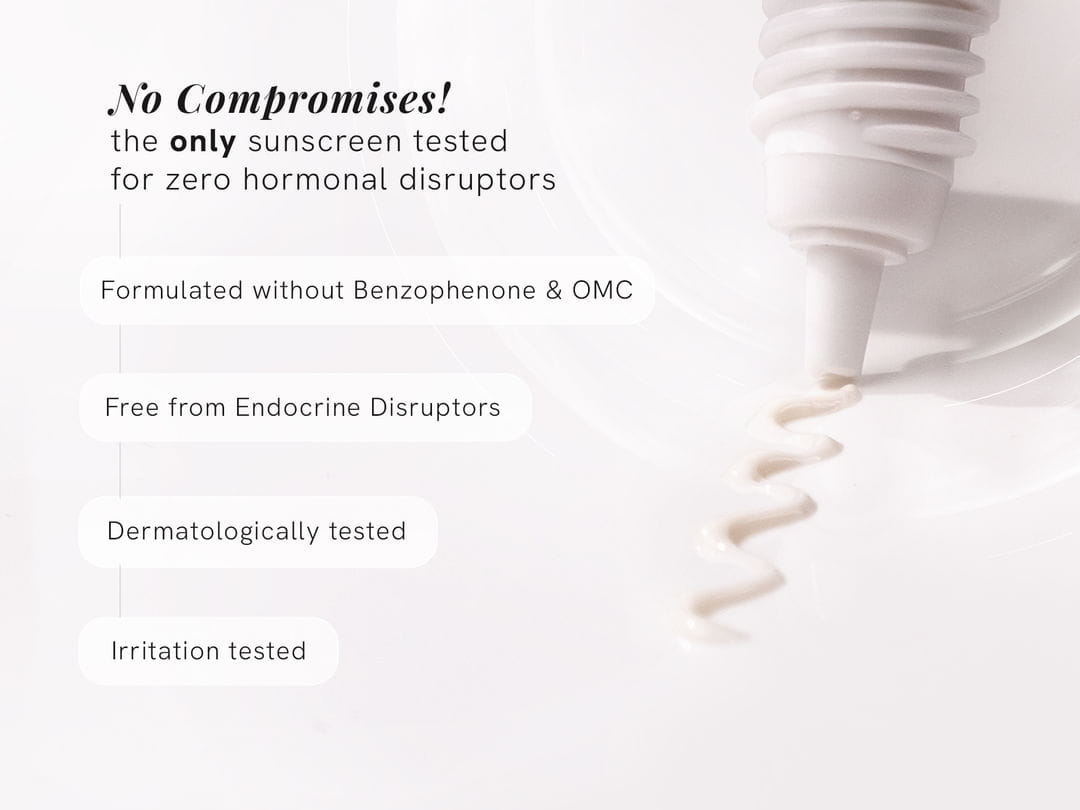
  • Check for no hormone disruptor claims — some chemical sunscreens have raised safety concerns; certified testing addresses this issue
  • No fragrance, no alcohol — cause irritation under sun exposure
  • Non-foodborne — particularly important for acne-prone skin

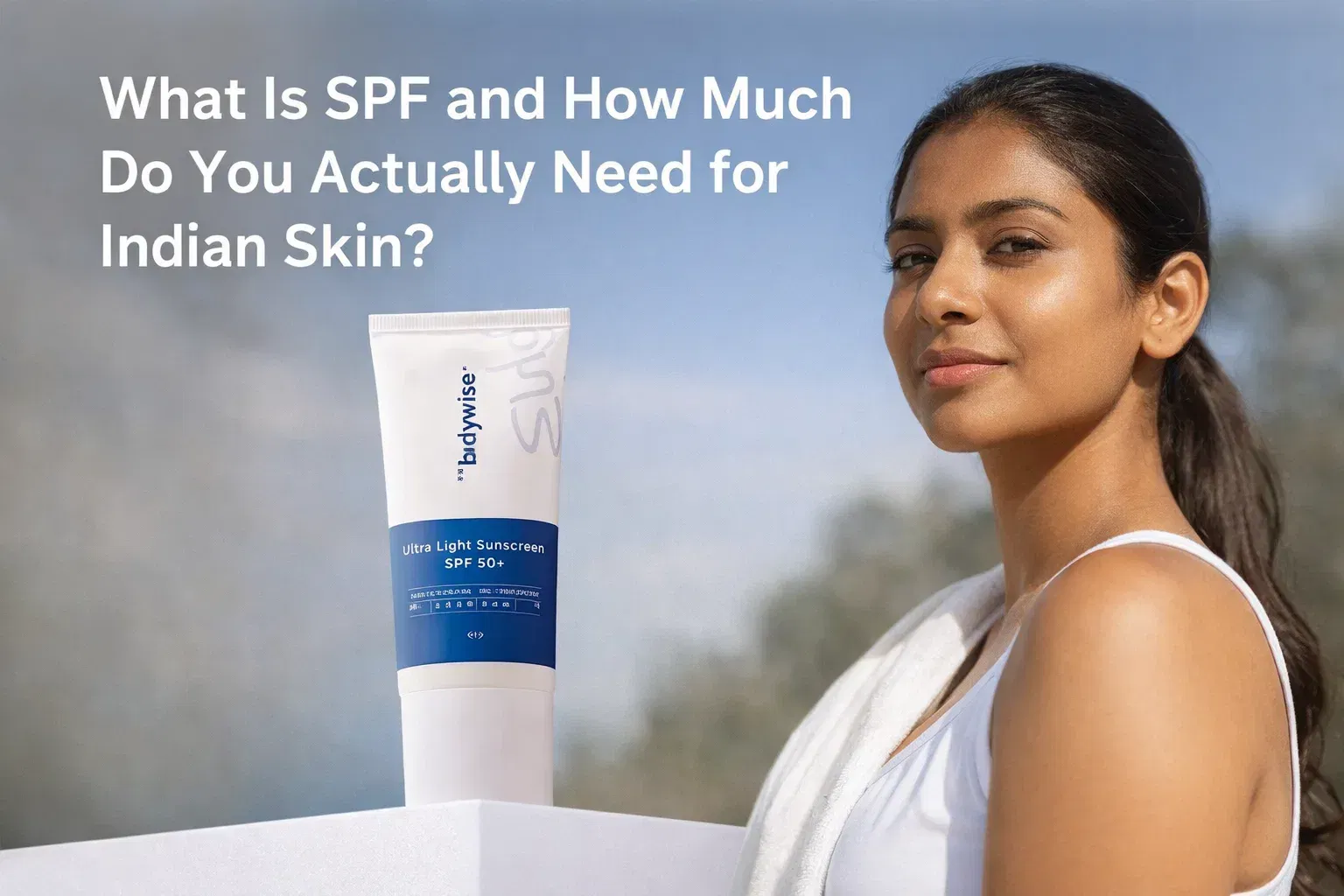
For daily face use, a lightweight SPF 50+ that’s In Vivo tested and certified free of harmful endocrine disruptors is worth considering. Be Bodywise’s Ultra Light Sunscreen SPF50+ meets In Vivo and In Vitro testing standards, is fragrance-free and designed with Korean anti-acne technology – making it suitable for acne-prone and sensitive skin. Compare test certifications and formulation before choosing.

FAQ

Q: Is SPF 50 enough for Indian summer?

Yes, SPF 50 with PA++++ is the right standard for the Indian climate – as long as you apply enough and reapply every 2 hours during outdoor activity.

Q: Does SPF in foundation or BB cream count?

Only if applied in the right amount, which most people don’t do with makeup. Treat SPF in foundation as a bonus, not as primary protection.

Q: Do I need sunscreen in winter or on cloudy days?

Yes. UVA rays pass through clouds and are present all year round. Cloud cover reduces UV radiation by about 20% – not enough to skip SPF.

Q: Can I skip moisturizer if my sunscreen is moisturizing?

If the sunscreen is moisturizing enough for your skin type, yes. Check the ingredient list for humectants like hyaluronic acid or glycerin.

Q: How soon before going out should I apply sunscreen?

Chemical sunscreens take about 20-30 minutes to bind to the skin. Mineral sunscreens work immediately. Apply accordingly.

Q: Does sunscreen run out?

Yes. Most sunscreens have a shelf life of 12-24 months after opening. Expired sunscreen degrades and offers reduced protection.
If you’re exploring SPF options suitable for Indian skin, there are dermatologist-tested formulations made specifically for the Indian climate and skin tones bebodywise.com.

Guide Indian Skin SPF
bhanuprakash.cg
healthtost
  • Website

Related Posts

Menopause and Your Microbiome: How Gut Health Shapes Weight, Mood, and Hormones

July 11, 2026

They heard us. Now will they listen?

July 11, 2026

Coconut Allergy and Skin Care: 20 Questions Finally Answered by a Pharmacist

July 11, 2026

Leave A Reply Cancel Reply

Don't Miss
News

Blue LED lights help chemists create complex drug molecules

By healthtostJuly 12, 20260

In drug discovery, rapidly building complex molecules is the name of the game. Chemists want…

How can you be tired but wired? Blame it on your stone age brain

July 12, 2026

15 No-Cook Dinners for Kids (Because It’s Too Hot to Turn on the Oven)

July 12, 2026

Harvard University hosts the world’s largest conference dedicated to longevity biotechnology

July 12, 2026
Stay In Touch
  • Facebook
  • Twitter
  • Pinterest
  • Instagram
  • YouTube
  • Vimeo
TAGS
Baby benefits body brain cancer care Day Diet disease exercise finds Fitness food Guide health healthy heart Improve Life Loss Men mental Natural Nutrition Patients People Pregnancy research reveals risk routine sex sexual Skin Skincare study Therapy Tips Top Training Treatment ways weight women Workout
About Us
About Us

Welcome to HealthTost, your trusted source for breaking health news, expert insights, and wellness inspiration. At HealthTost, we are committed to delivering accurate, timely, and empowering information to help you make informed decisions about your health and well-being.

Latest Articles

Blue LED lights help chemists create complex drug molecules

July 12, 2026

How can you be tired but wired? Blame it on your stone age brain

July 12, 2026

15 No-Cook Dinners for Kids (Because It’s Too Hot to Turn on the Oven)

July 12, 2026
New Comments
    Facebook X (Twitter) Instagram Pinterest
    • About Us
    • Contact Us
    • Privacy Policy
    • Terms and Conditions
    • Disclaimer
    © 2026 HealthTost. All Rights Reserved.

    Type above and press Enter to search. Press Esc to cancel.