


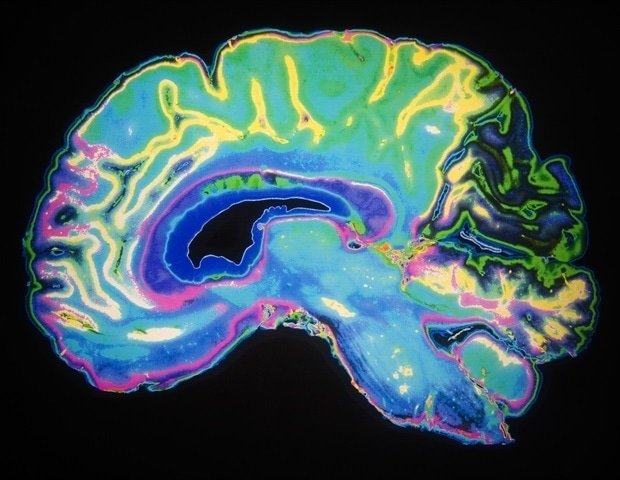
Your brain starts out as a single cell. When all is said and done, it will house an incredibly complex and powerful network of some 170 billion cells. How is it organized along the way? Cold Spring Harbor Laboratory neuroscientists have come up with a surprisingly simple answer that could have far-reaching implications for biology and artificial intelligence.
Stan Kerstjens, a postdoc in Professor Anthony Zador’s lab, frames the question in terms of positional information. “The only thing a cell ‘sees’ is itself and its neighbors,” he explains. “But its fate depends on where it sits. A cell in the wrong place becomes the wrong thing and the brain doesn’t develop properly. So each cell has to solve two questions: Where am I? And who should I become?”
In a study published in NeuronKerstjens, Zador and colleagues at Harvard University and ETH Zurich have proposed a new theory of how the brain is organized during development.
For a long time, researchers believed that cells exchange positional information primarily through chemical signaling. This works well when you’re dealing with just a few cells, Kerstjens explains. But the brain is not a few cells. It’s billions of neurons, each of which needs to land in the right place. Chemical signals can only travel so far before they fade. So how do cells deep in a developing brain automatically “know” where they are?
The answer, Kerstjens suggests, hits close to home. “Think about how human populations have spread across a country over generations,” he says. “Offspring settle near their parents, so people who share a common ancestry end up in neighboring areas, creating large-scale geographic structures without long-range communication. We argue that a similar principle is at work in the developing brain. Cells that come from the same ancestor tend to stay close to each other.”
To test this theory, Kerstjens and colleagues built what they call a “lineage-based model of scalable positional information.” They started with theoretical calculations. They then tested their hypothesis at scale by examining individual and group gene expression in developing mouse brains. Finally, they confirmed their results in zebrafish, showing that the model can be used in brains of different sizes.
Kerstjens says the model supports the idea that chemical signaling works in conjunction with a lineage-based mechanism to convey positional information. And while his work focuses on the brain, the theory could be applied to many other types of growing tissue, including tumors. There may even be implications for self-replicating AI models that pass information from one generation to the next, just as our own brain cells do.
Perhaps most importantly, showing how a single cell grows into a complex organ could help scientists solve fundamental mysteries of the mind.
The brain somehow makes us smart. How did he manage to accumulate this ability, not only in his developmental time, but in evolutionary time? This is a piece in this big puzzle.”
Stan Kerstjens, postdoc in Professor Anthony Zador’s lab
Source:
Journal Reference:
