


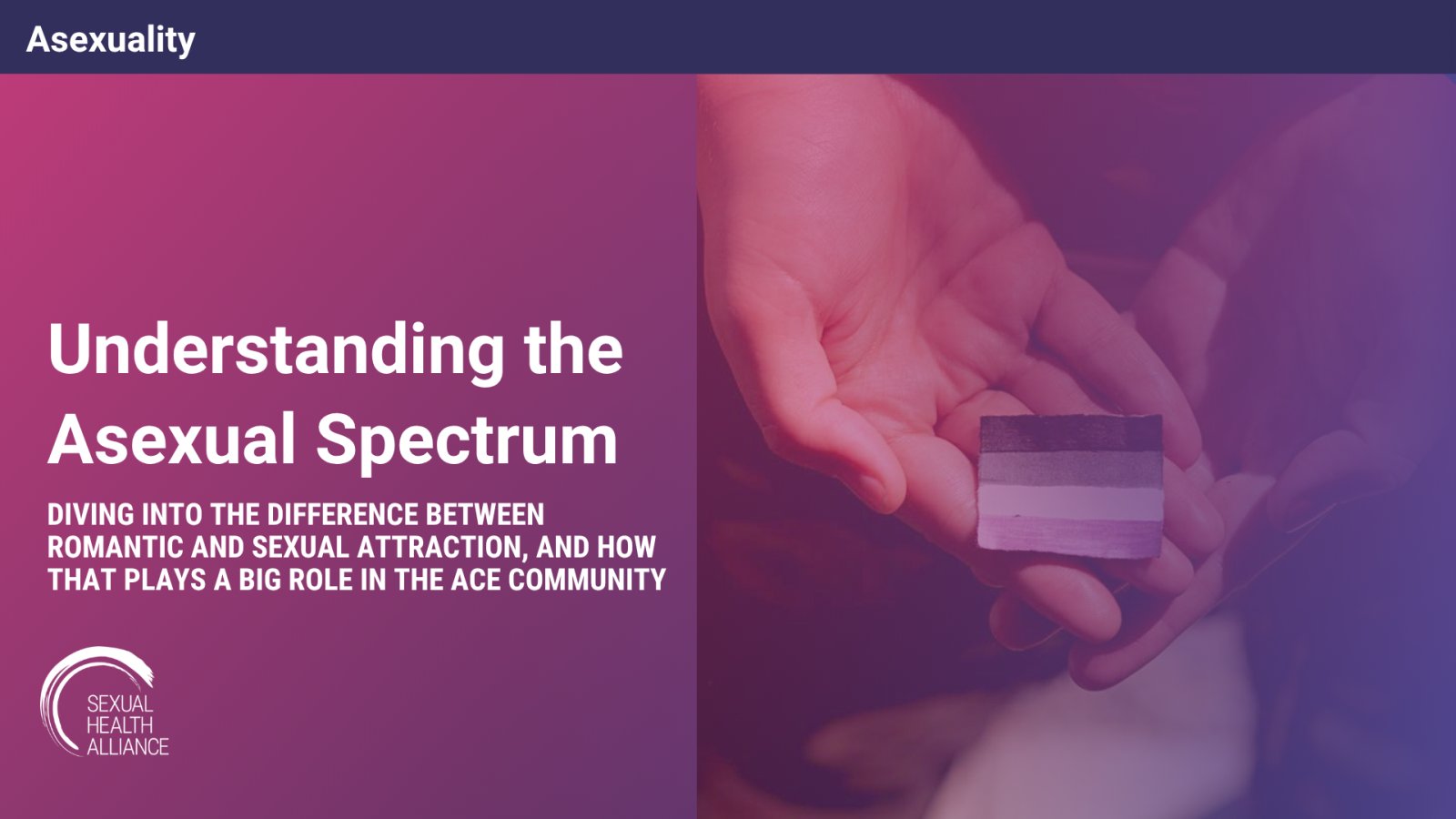
The LGBTQIA+ community is sometimes affectionately referred to as the “Alphabet Mafia.” In part, I think this term comes from the sheer range of language and terms used by people in the community to describe their sexual and romantic orientations and identities. For many people in the community, finding the right word for how they experience the world is really important.
That said, the sheer number of labels can feel daunting, even for those of us who work in this space or identify within the community. It’s okay not to know every term, especially when definitions change over time and new labels emerge to capture different experiences. Honestly, I’d argue that what matters most is a willingness to stay curious, keep learning, and resist the urge to flatten the complexity of the human experience into something more convenient like straight or not straight. With that in mind, let’s talk asexuality: what it is, what it isn’t, and language that some people on the ace spectrum might identify with!
What is Asexuality?
Asexuality is a sexual orientation characterized by little or no sexual attraction to others. It is estimated that about 1% of adults identify as asexualalthough this number is probably an undercount given how underrepresented and misunderstood the identity remains.
Some people argue that due to the nature of asexuality (i.e. the absence of sexual attraction), it doesn’t quite fit the LGBTQIA+ community. However, some clearly support and believe it should be included. Regardless, it is now considered part of the community, although unfortunately there is still definitely a lack of acceptance of asexuality.
One of the most important things to understand about asexual (commonly abbreviated to “ace”) people is that limited or no sexual attraction does not mean no romantic attraction. Many asexual people experience deep, meaningful romantic connections and desire partnership, intimacy, and love, just not necessarily through a sexual lens. But, some don’t, and may not only identify as asexual, but also “aromatic,” which describes experiencing little to no romantic attraction.
Wait. . .What is the difference between sexual and romantic attraction?
This is an important question, though not many people ever think about it, because for the vast majority of individuals the two have always pointed in the same direction.
Sexual attraction refers to the desire for sexual contact or activity with another person.
Romantic attraction refers to the desire for romantic connection (things like emotional intimacy, partnership, wanting to be close to someone in a “more than friends” way that doesn’t necessarily involve sex).
For most asexual people (that is, people who are not asexual), these two experiences co-exist so reliably that they are treated as one. If someone is heterosexual – sexually attracted to people of the opposite sex – they are usually also heteroromantic, meaning they also experience romantic attraction to people of the opposite sex. Most people never have reason to separate the two concepts because they have never experienced them pulling in different directions.
But they can pull in different directions – and not just for people on the ace spectrum!
Take, for example, someone who identifies as bisexual and pansexual. They may experience sexual attraction to people of any gender (pansexual), but experience romantic attraction only rarely or under very specific circumstances (gryzomantic). Or consider someone who is bioromantic and homosexual: they experience romantic attraction to people of more than one gender, but sexual attraction only to people of the same gender. These are not contradictions. they’re just two different pull dimensions with authentic markings.
In the ace community, the alignment between romantic and sexual orientation is considered much less, which is part of why the asexual community has been at the forefront of developing new language around romantic attraction. Asexuality gives us a framework to consider these dimensions separatelycontributing unique and interesting terms that help make sense of more complex experiences!
Asexuality as a spectrum of identities
A quick note before you dive in: each of the following sexual orientation terms has a corresponding romantic orientation. For example, demisexual (relating to sexual attraction) is paired with demiromantic (relating to romantic attraction). To avoid confusion, the following terms only describe sexual orientation, but know that the same concepts can apply to romantic attraction!
It is also worth acknowledging these tags are always in flux. They change over time at the community level, are refined through ongoing conversation, and are applied by individuals in ways that may not exactly match the dictionary definition. One may use a term because it is the closest term available, not because it describes one’s experience with exact precision. So keep this in mind and be sure to be kind and curious when talking about these concepts! None of the following lists are exhaustive, and I would they encourage you to continue exploring.
Asexual Individuals experience little or no sexual attraction to others. As discussed, asexual individuals may still experience romantic attraction and pursue romantic relationships. This is often used as an umbrella term, but an identity in itself!
Demisexual People only experience sexual attraction after forming a strong emotional bond with someone. Demisexuality is not about choosing to wait. it’s about the attraction that just isn’t there until that bond is there.
If you are graysexualyou experience sexual attraction rarely or only under certain circumstances. This may mean that you experience sexual attraction a few times in your life, but it may be more frequent! The term is quite clever: It’s a way of describing an experience that lies in the gray area between asexual and heterosexual!
People who are lithosexual you may feel sexually attracted, but you don’t want that attraction reciprocated. Consequently, lithossexuals generally do not feel compelled to seek out sexual relationships.
And now, some terms I personally encountered for the first time while researching this post – even though sexuality and identity are genuine areas of both professional and personal interest to me. I think it’s an important reminder: there is always more to learn. The vocabulary in this space really evolves in real time, and intellectual humility is not just a nice trait here, but rather a professional necessity. Our job is not to know everything. is to stay curious and keep updating our knowledge base.
Homosexual it is an interest. Sometimes called a WTFsexual (which, frankly, is a wonderfully self-aware name), quoisexual describes someone for whom sexual attraction as a concept simply doesn’t make sense. Notably, this is not because they repress it, but because the framework itself feels inapplicable, inaccessible, or illogical to how they experience the world.
Bisexual characterized by a gradual weakening of sexual attraction or arousal over time. An asexual person may initially experience sexual attraction to someone (in a real and genuine way!), but over time or after sexual activity, the attraction diminishes or disappears altogether. Something to remember with this label is that this change is not a response to relationship problems, incompatibility, or trauma. It’s just their sexuality working.
These are just a starting point. I would sincerely encourage you to keep digging. Resources like the LGBTQIA+ Wiki and community-maintained resources are good places to explore further.
Key takeaways for sexual health professionals
A conceptual understanding of these identities is a start, but clinical practice requires more than vocabulary. Here are some principles worth following:
Ask what the label means to the person across from you. Even when a customer uses a term you recognize, don’t assume you know what it specifically means to them. People adopt labels for a variety of reasons, and their personal definition may differ significantly from the community standard. A question as simple as “What does this term mean to you?” it is important to avoid assumptions.
Don’t pathologize. Low or no sex drive is not inherently a sexual dysfunction. It’s not something that needs to be fixed, cured, or explained, unless the person experiencing it finds it bothersome and wants support. Note also that some asexual identities may function in ways that may look problematic to an outside observer, like maybe asexual, but not dysfunctions!
Be careful about the source of this anxiety. This is perhaps the most nuanced point: if an ace spectrum client is experiencing discomfort, take the time to understand where that discomfort is really coming from. Living in a culture that treats heterosexuality as default and universal is really hard (see my blog post talking about minority anxiety theory). Distress may be a response to this external pressure, not a signal that the client wants or needs to change their orientation. These are very different clinical conditions and mixing them up does real harm! The goal is to help clients feel complete in who they are, not to break down their identity into something more legible to the people around them.
Additional resources
Please note that you are learning about asexuality and ace spectrum identities from someone outside of this community. It’s generally best to learn from community members and from a wide variety of sources! To learn more, I would recommend Asexuality.orgthis article by the Trevor Projectand this resource tailored to healthcare professionals.
Do you want to become an in-demand sexual health professional? Learn more about SHA certification!
