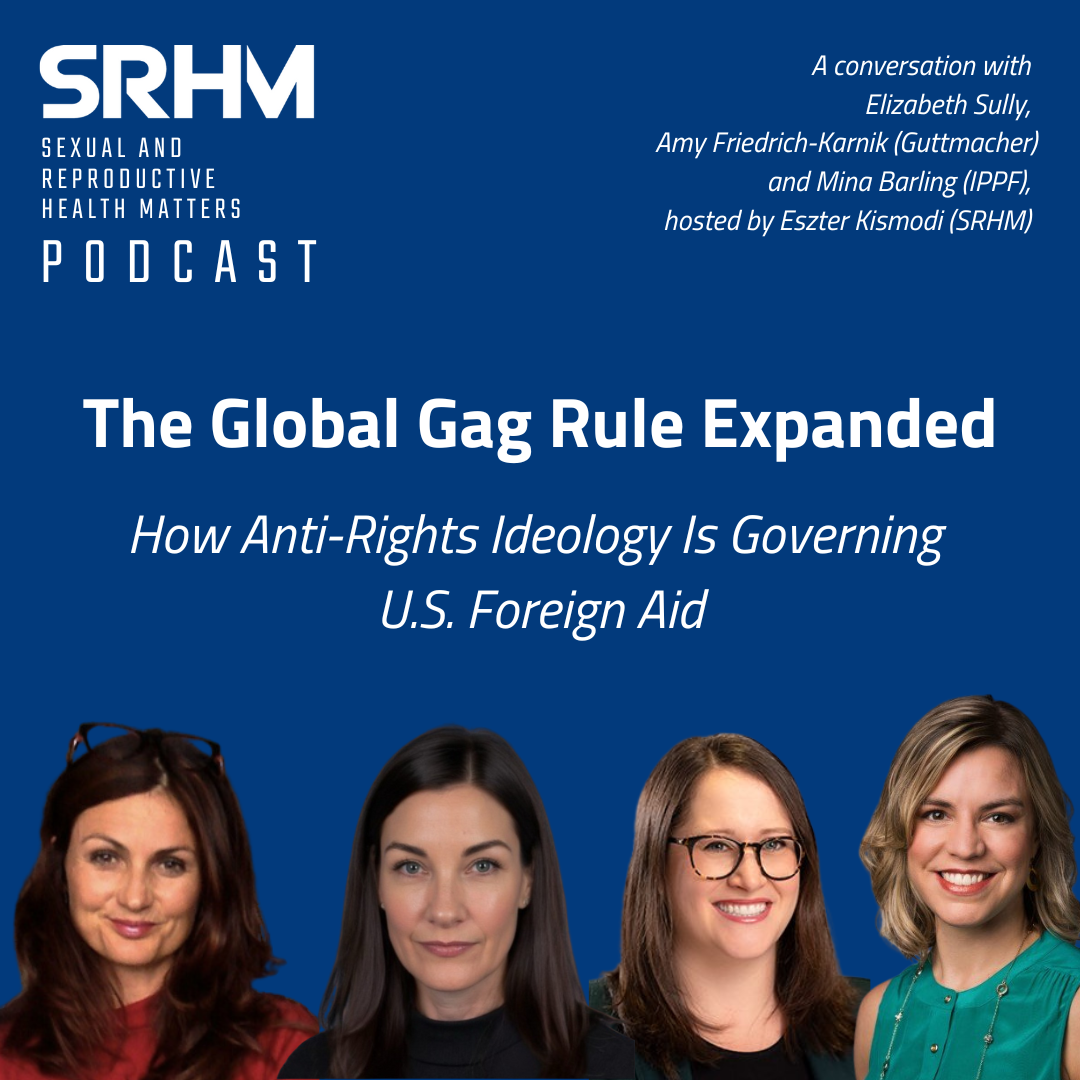
Recent changes in US foreign aid policy mark a major escalation in how anti-rights ideology shapes global health and development financing. In a new episode of the Sexual and Reproductive Health Matters podcast, SRHM convenes leading experts and advocates to clarify the implications of three new US foreign aid rules and what they mean for sexual and reproductive health and rights (SRHR) worldwide.
The episode examines three newly issued US foreign aid rules—the Protection of Life in Foreign Assistance (PLFA) Rule. the Rule to Combat Gender Ideology in Foreign Assistance (CGIFA).and the Anti-Discrimination Equality Ideology in Foreign Assistance (CDEIFA) Rule.all were released on January 23rd and announced to take effect on February 26th, 2026.
The US government bundles these measures under the banner of the “Promoting Human Flourishing in Foreign Assistance (PHFFA) Policy,” grounding them explicitly in the Geneva Consensus Declaration. In practice, these rules represent a major escalation of the Global Gag Rule (Mexico City Policy), expanding far beyond abortion-related restrictions to impose far-reaching restrictions on gender equality, LGBTQI+ rights, diversity, equity and inclusion, and how organizations and national governments can operate, cooperate and deliver programs using US foreign aid.
To explore the nature, scope and implications of these rules, SRHM is added Elizabeth SullyDirector of International Research at the Guttmacher Institute. Amy Friedrich-KarnickDirector of Federal Policy at the Guttmacher Institute. and Mina BarlingDirector of External Relations at the International Planned Parenthood Federation (IPPF). Together, they bring complementary perspectives spanning policy analysis, evidence generation and frontline service delivery and advocacy.
Listen here:
This episode of SRHM Podcast is also available on Apple Podcasts, YouTube, Amazon Music, Goodpods and Pockets.
Implementation of the new rules
The debate places the new rules within the longest trajectory of US foreign aid conditionality, while underscoring how unprecedented their scope and reach are. Unlike previous iterations of the Global Gag Rule, these measures apply to nearly all U.S. civilian foreign assistance and extend to foreign NGOs, U.S.-based organizations, international and multilateral organizations, and, in some cases, foreign governments. The rules restrict not only abortion-related activities, but also gender-affirming care, comprehensive sexuality education, LGBTQI+ inclusion, and programs or policies deemed to promote diversity, equality, and inclusion. This creates profound uncertainty for organizations operating across the health, humanitarian and development sectors.
Adverse effects and risks
Drawing on decades of research and evidence, the debate highlights that such policies do not work in isolation. Evidence from previous applications of the Global Gag Rule shows far-reaching ripple effects on health systems: disruptions in family planning and maternal health services, broken partnerships, delayed progress in reproductive health outcomes, and increased health risks for women, girls and marginalized communities. The current expansion is expected to deepen these harms, particularly in settings already facing shrinking aid budgets and fragile health infrastructure.
A recurring concern throughout the discussion is the risk of over-compliance. Ambiguous definitions, unclear implementation guidelines and fear of losing funding can lead organizations and governments to limit activities beyond what the laws require, amplifying their chilling effect. This risk is particularly acute for multilateral and humanitarian agencies, whose mandates are based on neutrality, inclusion and needs-based service delivery.
New ways of accountability, cooperation and resistance
The episode also explores issues of accountability and resistance. While legal challenges, congressional oversight, and advocacy in the United States remain significant, the debate underscores that these rules raise fundamental concerns for the global community. By regulating aid in multilateral and bilateral channels, US ideology essentially shapes what other donors, governments and international organizations can fund and do. This has serious implications for national sovereignty, multilateral norms, and evidence-based public health practices.
Finally, the discussion turns to the broader response of the movement. Rather than treating each policy cycle as an isolated crisis, panelists highlight the need for deeper reflection on the global health architecture itself: who sets priorities, who counts, and how movements can build stronger cross-sectoral alliances to resist the instrumentalization of agency, rights, and health for geopolitical ends. Focusing the voices of those most affected, championing the scientific evidence, and affirming bodily autonomy and equality as global values emerge as essential to navigating the next period.
As these rules move from policy text to practice, the stakes extend far beyond funding mechanisms. They touch lives, dignity, health systems and the future of rights-based global cooperation. This podcast episode offers critical insight into what’s unfolding and why it matters now.
Please note that blog posts are not peer-reviewed and do not necessarily reflect the views of SRHM as an organization.
SRHM is not responsible for and does not endorse, unless expressly stated, the content of external sites linked to the blog posts.