

Close Menu
Healthtost
  • News
  • Mental Health
  • Men’s Health
  • Women’s Health
  • Skin Care
  • Sexual Health
  • Pregnancy
  • Nutrition
  • Fitness
  • Recommended Essentials
What's Hot

A cancer-causing contaminant in drugs and meat

May 3, 2026

Landmine Training and Why I Love It – Tony Gentilcore

May 3, 2026

Five-target drug beats GLP-1/GIP therapy in obese diabetic mice

May 3, 2026
Facebook X (Twitter) Instagram
  • About Us
  • Contact Us
  • Privacy Policy
  • Terms and Conditions
  • Disclaimer
Facebook X (Twitter) Instagram
Healthtost
SUBSCRIBE
  • News

    Five-target drug beats GLP-1/GIP therapy in obese diabetic mice

    May 3, 2026

    How fast your face ages can predict cancer survival outcomes

    May 2, 2026

    AI scribes save doctors time, but fail to reduce overtime

    May 2, 2026

    Identifying the ages at which Alzheimer’s biomarkers change sharply

    May 1, 2026

    Timing of food may shape how T cells respond to infection and therapy

    May 1, 2026
  • Mental Health

    Every mental health journey starts with being seen

    May 2, 2026

    What animal studies teach us about toxic work environments

    April 27, 2026

    I hate hope: How to manage hope when you have treatment-resistant bipolar disorder

    April 19, 2026

    Rose Byrne is raw, magnetic and unfiltered as a woman in crisis

    April 18, 2026

    Can a single mother change her child’s surname in India?

    April 16, 2026
  • Men’s Health

    3 Day Home Workout Plan: Build Muscle and Burn Fat

    April 30, 2026

    GLP-1 drugs promise broader health benefits, but experts advise caution on use

    April 28, 2026

    Trauma patients recover faster when medical teams know each other well, new study finds

    April 28, 2026

    I did red light therapy for 3 months so I shouldn’t have

    April 27, 2026

    Sex Secrets for Men Over 40: Surviving Male Menopause

    April 27, 2026
  • Women’s Health

    What is the difference between UVA and UVB rays?

    May 1, 2026

    Are you a fungus fanatic? We unpack the nutritional trend of mushroom mania

    April 29, 2026

    What the Patients’ Bill of Rights Could Mean for Black Women

    April 29, 2026

    Navigating sexual health during and after cancer

    April 28, 2026

    Do tampons break the hymen? Facts, Myths and What You Need to Know – Vuvatech

    April 27, 2026
  • Skin Care

    The truth about waterless care: What your skin really needs

    May 2, 2026

    What happens to your skin while you sleep? (the science of “Beauty Sle

    May 1, 2026

    Face Peeling Mask Guide: Shine Without Irritation

    April 28, 2026

    Is your moisturizing face mist really drying out your skin?

    April 28, 2026

    Uses and Benefits of TNW Natural Aloe Vera Face Gel – The Natural Wash

    April 27, 2026
  • Sexual Health

    Boost erectile health and confidence

    May 1, 2026

    Judicial Restrictions on Abortion COVID-19 < SRHM

    April 30, 2026

    Can herpes affect fertility?

    April 29, 2026

    The Importance of Personalized Care in Medication Assisted Therapy (MAT) Programs I Novus

    April 28, 2026

    Your favorite mold is lying to you (a little) — Sexual Health Alliance

    April 28, 2026
  • Pregnancy

    Why is anemia during pregnancy high in Indian women?

    May 2, 2026

    5 things you need for the third trimester

    May 1, 2026

    Eating disorders in pregnancy and breastfeeding: Why “healthy eating” is not always easy

    May 1, 2026

    Comprehensive yoga for pregnancy, birth and beyond

    April 29, 2026

    Midwifery and Life – The postnatal health check New mums don’t know they can ask for

    April 28, 2026
  • Nutrition

    A cancer-causing contaminant in drugs and meat

    May 3, 2026

    How Nutrition Supports Mood, Energy and Gut Health

    May 2, 2026

    How to create a self-care plan when you’re stressed

    May 1, 2026

    I answer the most HOT Questions about Fatty Liver

    April 29, 2026

    Why You’re Not Losing Weight After 35 (Even When You Eat Less)

    April 28, 2026
  • Fitness

    Landmine Training and Why I Love It – Tony Gentilcore

    May 3, 2026

    9 Powerful Fitness Tips for Pear Shaped Bodies

    May 2, 2026

    If you can still do these 7 things at 60, your body is aging better than most

    May 2, 2026

    A Hike Leader’s Must-Have Kit

    April 30, 2026

    Menopausal Hair Loss Solutions: 10 Expert Tips

    April 29, 2026
  • Recommended Essentials
Healthtost
Home»Mental Health»Do you have a mental illness? Because some people answer “yes”, even if they have not been diagnosed
Mental Health

Do you have a mental illness? Because some people answer “yes”, even if they have not been diagnosed

healthtostBy healthtostJune 20, 2024No Comments5 Mins Read
Facebook Twitter Pinterest LinkedIn Tumblr Reddit WhatsApp Email
Do You Have A Mental Illness? Because Some People Answer
Share
Facebook Twitter LinkedIn Pinterest WhatsApp Email

Mental illnesses such as depression and anxiety disorders have become more prevalent, especially among young people. The demand for treatment is increasing and the prescriptions of some psychiatric drugs they have climbed.

These upward trends in prevalence parallel increasing public attention to mental illness. Mental health messages permeate traditional and social media. Organizations and governments are developing awareness, prevention and treatment initiatives with increasing urgency.

The growing cultural focus on mental health has obvious benefits. It raises awareness, reduces stigma and promotes help-seeking.

However, it can also come at a cost. Critics are worried social media locations incubate mental illness and that ordinary unhappiness is pathologized by the overuse of diagnostic concepts and “treatment talk“.

British psychologist Lucy Fulks argues that trends for increasing attention and prevalence are linked. her”Prevalence of inflation hypothesis” suggests that increasing awareness of mental illness may lead some people to be misdiagnosed when they experience relatively mild or transient problems.

Foulkes’ hypothesis implies that some people develop overly broad concepts of mental illness. Our research supports this view. In a new study, we show that concepts of mental illness have broadened in recent years – a phenomenon we call “Creep concept” – that too people differ in the range of their concepts of mental illness.

Why do people self-diagnose mental illnesses?

In our news studywe examined whether people with broad concepts of mental illness are, in fact, more likely to self-diagnose.

We defined self-diagnosis as a person’s belief that they have an illness, whether or not they have received the diagnosis from a professional. We assessed people as having a “broad concept of mental illness” if they judged a wide variety of experiences and behaviors to be disorders, including relatively mild conditions.

We asked a nationally representative sample of 474 US adults whether they believed they had a mental disorder and whether they had received a diagnosis from a health care professional. We also asked about other possible contributing factors and demographics.

Mental illness was common in our sample: 42% reported having a current self-diagnosed condition, the majority of whom had received it from a health professional.

Individuals with greater mental health literacy and less stigmatizing attitudes were more likely to report a diagnosis.
Mental Health America/Pexels

As expected, the strongest predictor of reporting a diagnosis was experiencing relatively severe distress.

The second most important factor after distress was the broad concept of mental illness. When their levels of distress were the same, people with broad concepts were significantly more likely to report a current diagnosis.

The graph below illustrates this result. It divides the sample by levels of distress and shows the percentage of people at each level who report a current diagnosis. People with broad concepts of mental illness (the highest quarter of the sample) are represented by the dark blue line. Individuals with narrow concepts of mental illness (the lowest quarter of the sample) are represented by the light blue line. People with broad concepts were significantly more likely to report having a mental illness, especially when their distress was relatively high.
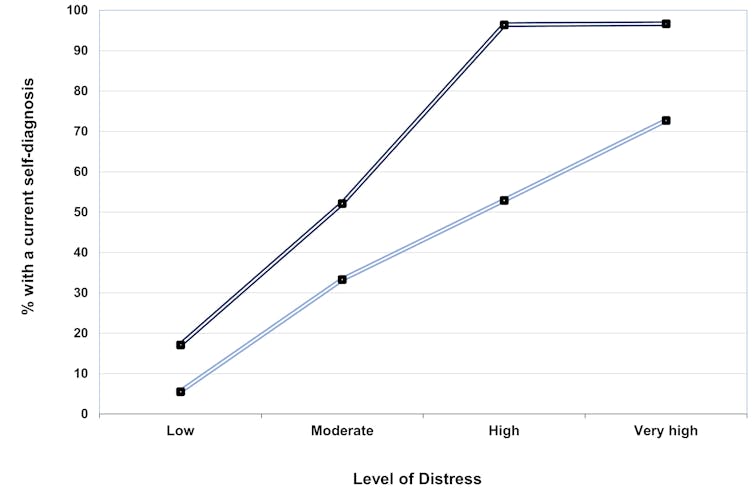
Percentage of participants with broad (dark blue) or narrow (light blue) self-diagnosed mental illness concepts at different levels of distress.
Provided by the authors

Individuals with greater mental health literacy and less stigmatizing attitudes were also more likely to report a diagnosis.

Two interesting further findings emerged from our study. People who self-diagnosed but had not received a professional diagnosis tended to have broader concepts of illness than those who had.

In addition, younger and politically progressive people were more likely to report a diagnosis, according to some previous research, and had broader concepts of mental illness. Their tendency to retain these more expansive concepts partly explained their higher diagnosis rates.

Why does it matter?

Our findings support the idea that extended concepts of mental illness promote self-diagnosis and may thus increase the apparent prevalence of mental illness. People who have a lower threshold for defining distress as a disorder are more likely to self-identify as suffering from a mental illness.

Our findings do not directly indicate that people with broad concepts are overdiagnosing or those with narrow concepts are underdiagnosing. Nor do they prove that they have broad meanings causes self-diagnosis or results in real increases mental illness. However, the findings raise significant concerns.

First, they suggest that increasing mental health awareness can they have costs. As well as enhancing mental health literacy, it can increase the likelihood that people will misidentify their problems as pathologies.

Improper self-diagnosis can have adverse effects. Diagnostic labels can be self-defining and self-limiting, as people believe that their problems are permanent; difficult to control aspects of who they are.
The woman is crying
Some people may misidentify their problems as mental illness.
Karolina Grabowska/Pexels

Second, unwarranted self-diagnosis can lead people experiencing relatively mild levels of distress to seek help that is unnecessary, inappropriate, and ineffective. Recently Australian research found that people with relatively mild distress who received psychotherapy worsened more often than improved.

Third, these effects can be particularly problematic for young people. They are more likely to have broad definitions of mental illness, in part because social media consumption, and face mental health problems at relatively high and increasing rates. Whether extended concepts of illness play a role in youth mental health crisis remains to be seen.

Ongoing cultural changes encourage ever more expansive definitions of mental illness. These changes are likely to have mixed blessings. By normalizing mental illness they can help de-stigmatize it. However, by pathologizing certain forms of everyday discomfort, they may have an unintended disadvantage.

As we grapple with the mental health crisis, it’s important to find ways to raise awareness of mental illness without inadvertently inflating it.

Answer diagnosed illness mental People
bhanuprakash.cg
healthtost
  • Website

Related Posts

Every mental health journey starts with being seen

May 2, 2026

I answer the most HOT Questions about Fatty Liver

April 29, 2026

What animal studies teach us about toxic work environments

April 27, 2026

Leave A Reply Cancel Reply

Don't Miss
Nutrition

A cancer-causing contaminant in drugs and meat

By healthtostMay 3, 20260

Billions of dollars worth of drugs have been pulled from the market for less carcinogenic…

Landmine Training and Why I Love It – Tony Gentilcore

May 3, 2026

Five-target drug beats GLP-1/GIP therapy in obese diabetic mice

May 3, 2026

How Nutrition Supports Mood, Energy and Gut Health

May 2, 2026
Stay In Touch
  • Facebook
  • Twitter
  • Pinterest
  • Instagram
  • YouTube
  • Vimeo
TAGS
Baby benefits body brain cancer care Day Diet disease exercise finds Fitness food Guide health healthy heart Improve Life Loss Men mental Natural Nutrition Patients Pregnancy protein research reveals risk routine sex sexual Skin Skincare study Therapy Tips Top Training Treatment ways weight women Workout
About Us
About Us

Welcome to HealthTost, your trusted source for breaking health news, expert insights, and wellness inspiration. At HealthTost, we are committed to delivering accurate, timely, and empowering information to help you make informed decisions about your health and well-being.

Latest Articles

A cancer-causing contaminant in drugs and meat

May 3, 2026

Landmine Training and Why I Love It – Tony Gentilcore

May 3, 2026

Five-target drug beats GLP-1/GIP therapy in obese diabetic mice

May 3, 2026
New Comments
    Facebook X (Twitter) Instagram Pinterest
    • About Us
    • Contact Us
    • Privacy Policy
    • Terms and Conditions
    • Disclaimer
    © 2026 HealthTost. All Rights Reserved.

    Type above and press Enter to search. Press Esc to cancel.