


·
By Amy Suzanne Upchurch, Founder + CEO of Pink Stork, Certified Health Coach, INHC
Yes — and the evidence for why gets more compelling every decade after 30. After 30, women begin to lose muscle mass at a rate that accelerates with age, creatine stores decline in tandem, and the cognitive demands of work, caregiving, and life don’t decrease to compensate. Creatine monohydrate is one of the most extensively studied supplements available, with a strong evidence base to support muscle strength, cellular energy, and emerging evidence for cognitive function specifically in women. The question isn’t really whether creatine works. The question is whether the evidence is strong enough to warrant action – and for women over 30, it is.
What changes after 30 that makes creatine relevant
Three converging changes after 30 make a particularly strong case for creatine supplementation in women.
First, muscle mass. Sarcopenia—the age-related loss of muscle tissue—begins in earnest in the early to mid-30s and accelerates during the perimenopausal transition. Muscle isn’t just a physical asset. supports metabolic rate, insulin sensitivity, bone density and physical independence throughout life. Creatine supplementation combined with resistance training has a well-established evidence base to support lean muscle mass, upper and lower body strength, and functional physical performance in women.†
Second, creatine stores. Women naturally have 70-80% lower endogenous creatine stores than men to begin with. After 30, these stores decrease further with age, and the hormonal changes of perimenopause—which can begin in the mid-to-late 30s—further affect creatine synthesis and uptake. The gap between what the body produces and what muscle and brain tissue needs widens precisely when the demands on both increase.
Third, cognitive demand. Women over 30 often take on top career and caring responsibilities at the same time. The brain depends on the phosphocreatine-ATP system for rapid energy regeneration during sustained cognitive work. A systematic review and meta-analysis of 2024 at Frontiers in Nutrition found that creatine supplementation produced improvements in cognitive function in women, with particularly notable effects on processing speed.
“Once someone turns 30, I want you to lift heavy.”
— Dr. Tosin Odunsi, MD, MPH, FACOG, Obstetrics and Gynecology
What the research actually shows about women
The research base for creatine in women has grown significantly. A peer-reviewed lifetime analysis published on Nutrients The examination of creatine across the female lifespan found that creatine supplementation in premenopausal women is effective in supporting strength and physical performance, and that postmenopausal women may experience benefits in skeletal muscle size and function—particularly at higher doses—as well as beneficial effects on bone health when combined with resistance training.
One study found that women experienced a 15% improvement in exercise performance compared to a 6% improvement in men from comparable creatine supplementation protocols—a result consistent with the hypothesis that women benefit more from creatine supplementation because they start from a lower baseline.
For the cognitive image, the Frontiers in Nutrition The 2024 meta-analysis found that women showed particularly marked improvements in processing speed, and a separate study in Scientific Reports demonstrated that creatine helped maintain cognitive performance during sleep deprivation—a condition that many women over 30 navigate regularly.
Is creatine only for women who work out?
No. The benefits of creatine are not limited to athletic performance. The phosphocreatine-ATP system works in every cell that makes high energy demands — including brain cells, which account for about 20% of the body’s total energy consumption. The cognitive benefits of creatine do not require exercise as a co-intervention.
That said, combining creatine with resistance training produces the most consistently documented physical benefits. If you don’t currently lift, starting a resistance training practice alongside creatine supplementation is one of the highest-paying wellness investments available to women over 30. National Center for Complementary and Integrative Health notes that creatine supplementation with exercise has well-documented support for strength and muscle mass.
“You really want muscles. For everything.”
— Dominique Landry, founder of Fit Enough
What about the concern that creatine is a “bodybuilder supplement”?
This context reflects the history of creatine research, which has focused almost exclusively on male athletes until relatively recently. As research on women has expanded, the picture has changed. A 2020 analysis of creatine studies specifically in women found that it was not associated with significant weight gain, liver or kidney complications, or serious side effects. The muscle adaptation that creatine supports in women tends toward improved tone and functional strength rather than significant gains in size—a distinction that research supports and that most women find relevant.
Creatine monohydrate is included in NIH Office of Dietary Supplements summary of evidence for exercise and athletic performance as one of the most extensively studied and best supported ergogenic aids available.
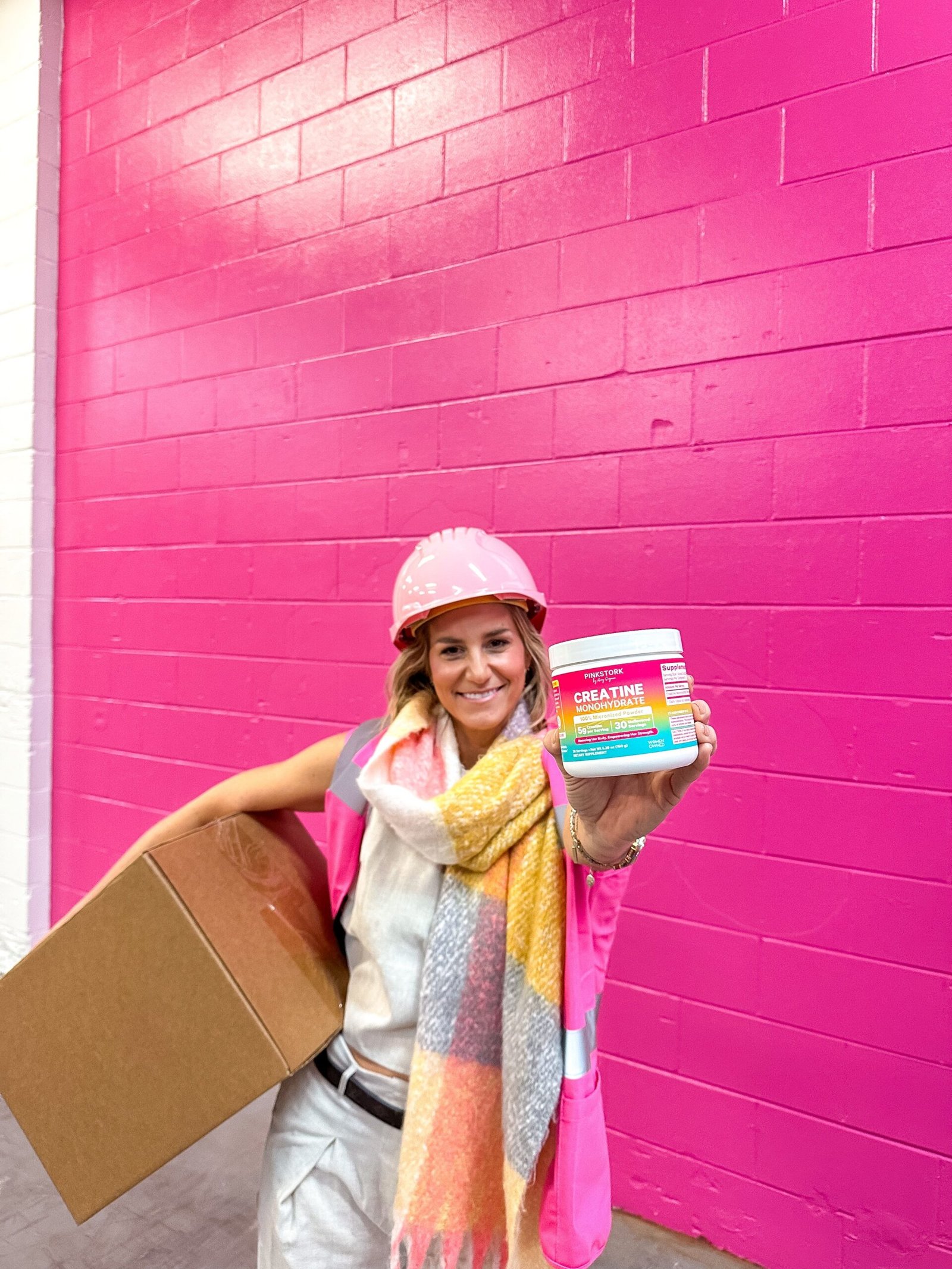
Pink Stork Creatine Monohydrate: designed for women
Pink Stork’s Creatine Monohydrate, a one-ingredient powder designed for women, provides 5 grams of micronized creatine monohydrate per serving – the dose used in all clinical research – with no added fillers, sweeteners, flavors or sugars. No taste. Vegan, non-GMO, gluten-free, dairy-free and soy-free. Third party tested in cGMP certified labs.
Micronization ensures complete dissolution in water, coffee (cold) or smoothies without rubbing or residue. A measuring tape. An ingredient. Thirty servings.
For women over 30 whose energy concerns extend beyond physical performance to cellular aging, our NAD+ supplement with 500 mg of clinically studied NR supports cellular energy production and healthy aging through a complementary mechanism — NAD+ precursors address the mitochondrial energy layer, creatine addresses the phosphocreatine-ATP regulatory layer.†
“I want to be able to move and move well and be healthy for a long time.”
— Amy Suzanne Upchurch, Founder and CEO of Pink Stork
This goal is worth starting now. For perimenopause-specific insight—how falling estrogen affects creatine metabolism and why the window of action is earlier than most women realize—see our guide to creatine and perimenopause. For the cognitive angle, see Creatine and Working Memory in Women.
Frequently asked questions
What dose of creatine should women over 30 take?
Most clinical research uses 3-5 grams per day as a typical maintenance dose, taken consistently without a loading phase. Pink Stork Creatine Monohydrate provides 5 grams per serving, according to the most commonly studied dosage. Consult your healthcare provider about your specific situation.
Will creatine make me look bulky?
Research in women consistently shows that creatine supplementation supports improvements in strength and lean mass, with muscle adaptation tending toward improved tone and functional capacity rather than significant increases in size. A 2020 analysis of studies in women found that creatine was not associated with significant overall weight gain.
Should I take creatine?
No. A loading phase (20 grams per day for 5-7 days) saturates muscle creatine stores faster, but research shows that 3-5 grams per day without a loading phase reaches the same saturation in about 3-4 weeks. For most women, the slower approach with no loading phase poses no practical disadvantage.
Can I take creatine with my other supplements?
Yes. Creatine monohydrate is compatible with the other supplements in the Pink Stork range. It naturally combines with NAD+ for cellular energy support and with the cortisol complex for the stress response layer. Consult your healthcare provider about your complete routine.
Is creatine safe during pregnancy or breastfeeding?
There is not enough research to confirm the safety of taking creatine supplements during pregnancy or breastfeeding. Always consult your healthcare provider before starting creatine if you are pregnant, nursing, or trying to conceive.
When will I see results from creatine?
The physical performance benefits of creatine are usually felt after 2-4 weeks of consistent daily use at 5 grams per day. Cognitive effects, based on available research, are generally seen after 4-8 weeks of continuous supplementation. Creatine builds up in tissues over time – consistency matters more than timing.
† These statements have not been evaluated by the Food and Drug Administration. This product is not intended to diagnose, treat, cure or prevent any disease. Always consult your healthcare provider before starting any new supplement, especially during pregnancy, breastfeeding, or when managing a medical condition. Keep away from children.
