


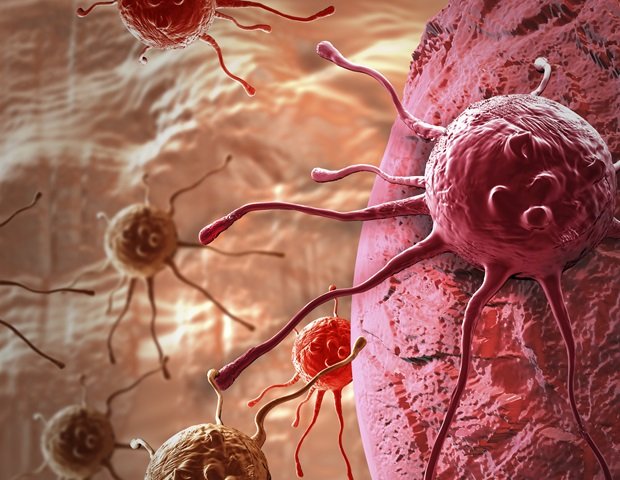
A new collaborative study reports the discovery and implementation of a novel therapeutic strategy to selectively target EGFR and other kinases by controlled release in tumor microenvironments to improve therapeutic efficacy, with promising results. The results were published in Bioorganic Chemistry.
The study was conducted by researchers from the University of Eastern Finland, as well as North Carolina State University, USA, the University of North Carolina at Chapel Hill, USA and the University of Oslo, Norway.
Tyrosine kinase inhibitors (TKIs) are clinically limited by unwanted inhibition of the epidermal growth factor receptor (EGFR) and other kinases in healthy tissues, causing toxicities and limiting the drug’s therapeutic window.
In this study, we evaluated carbamate capping of the 4-anilinoquinazoline hinge nitrogen as a scaffold-centric strategy to modulate exposure and facilitate controlled activation in a panel of EGFR-TKIs.”
Christopher Asquith, Senior Researcher, School of Pharmacy, University of Eastern Finland
The researchers investigated a β-eliminating sulfone ligand design for topical release from alginate hydrogels. Hydrolysis profiling revealed that efficient parent drug release occurred only at basic pH, defining key limitations for depot formulations in mildly acidic bulk microenvironments. In parallel, they developed AQ-TKI prodrugs that are activated by nitroreductase (NTR). Nitroimidazole carbamate increased polarity and adjusted solubility while maintaining favorable compound pharmacokinetic profiles. All prodrugs were chemically stable under physiologically relevant conditions and underwent efficient NTR-dependent release to regenerate the parent TKIs.
Molecular dynamics simulations and protein-ligand Boltz-2 affinity predictions showed impaired binding and reduced kinase target space for intact prodrugs relative to the parent compounds, consistent with higher IC50 values in cell-free EGFR assays and support for impaired basal activity prior to activation. Together, these results establish carbamate AQ derivatization as a generalizable platform for EGFR-TKI prodrug design and provide quantitative design rules linking scaffold coverage, stability, activation, and target engagement.
“Carbamide capping of 4-anilinoquinazoline TKIs enables controlled prodrug activation and reduces EGFR binding and basal activity. This proof-of-concept study demonstrates broad applicability to clinically used and research compounds. This work is an important contribution to both the targeted therapy and anticancer research fields at North Pierre University.”
Source:
Journal Reference:
