



Written by Gunjan Khorgade, Snehal Sinha and Pramila Sharma, Action Research and Training for Health (ARTH)
“It feels good when your periods stop. You don’t have to worry when you travel, you become stress-free.”
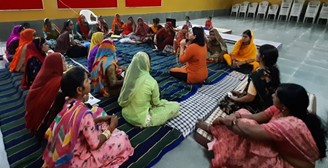
said 35-year-old Fefli Bai1 with a smile that sparks infectious laughter from the assembled women. On World Contraception Day (September 26, 2023), Action Research and Training for Health (ARTH), a non-profit organization working on SRHR in rural and tribal communities of Rajasthan, India, convened a consultation with twenty-six women to discuss the their experiences of changes in menstrual bleeding caused by the use of topically available contraceptives. The government health system in the region provides combined oral pills, Copper-Ts and injectables, while ARTH clinics provide oral pills, injectables, Copper-Ts and hormonal IUDs. All facilities also provide male condoms. Contraceptive-induced menstrual changes (CIMCs) are known to be the main reason for discontinuation of contraceptive use. So we thought it would help our intervention to recognize and understand how women perceive these changes and how they react. Each woman is likely to respond in her own way to period changes, so understanding her perceptions should help a provider address her concerns.
In a systematic review entitled “There Might Be Blood: a scoping review of women’s responses to contraceptive-induced changes in menstrual bleeding“2, Chelsea Polis and colleagues explain the role of contraceptive-induced changes in menstrual bleeding in causing dissatisfaction and discontinuation. They analyze how menstrual changes can affect women’s daily routines, including participation in housework, school, sports or religious activities along with other areas, including emotional relationships. Their work concludes that contraceptive-induced changes in menstrual bleeding are a key aspect of women’s and their partners’ contraceptive experience and a determinant of satisfaction, discontinuation or switching.
Most contraceptives are known to cause menstrual changes in a pattern – injectables, hormonal IUDs and implants lead to scanty periods for a few months and then amenorrhea. However, some women may initially have irregular bleeding, which even if minimal, is unpredictable. Combined oral pills cause regular but minimal withdrawal bleeding each month, while Copper-Ts can cause pain and heavier periods. In the absence of adequate post-adoption counseling and support from health providers, women are left to cope with these menstrual changes on their own. While many women are relieved that a monthly period indicates non-pregnancy, several others tolerate amenorrhea well, appreciating the advantages of avoiding monthly blood loss. However, most people are against spotting, spotting, unpredictable or painful bleeding.
“When my child was one and a half years old, I used Antara (injectable contraceptive) once. The next month my period lasted a day or two. Over time my periods stopped and I was worried. What if blood pooled inside my body? So I stopped taking the injection”
For several women who used injections, the menstrual changes did not last long because after three to four doses, the state assistant nurse midwife ruled out further injections and advised them to undergo sterilization. Gopi, a 30-year-old mother of two, was worried about her eyesight failing as a result of having irregular or no periods. Recalling her experience with injectable contraception, she said:
“My eyes will get weak and I might go blind if I don’t have my period.”
When asked if any of them had actually suffered from vision impairment, the assembled women denied it. They had heard about it from older women in the community and that was why they were scared.
On a very different note, several other women appreciated the benefits of not having a period after using birth control. They said that without periods they were free to go about their daily business and felt more energetic – reducing anemia and stopping menstrual pain or cramping due to scanty periods or amenorrhea are among the known non-contraceptive benefits of hormonal methods.
“You know, I don’t feel tired now. When I used Mukti (hormonal coil) my periods stopped after some months. At first I was scared but soon I started to see its benefits. I feel stronger now, I don’t get tired easily. And you know the best? I don’t have to worry about changing pads every month,” said Indira, 28, when asked about her experience with amenorrhea.
A look of relief crossed 32-year-old Savita’s face as she remarked:
“It’s good that I get a double benefit from Antara (injectable). I don’t get pregnant and I don’t have my period – I don’t worry about spots or stains while traveling anywhere.”
However, some women in the consultation had clear ideas about wanting a period every month – for them, it meant not getting pregnant. Most women revealed that they would like to have “a few periods”. In addition, the flow of blood each month was perceived as a cleansing process that rids the body of impure blood.
Women also talked about restrictions at home during periods and how this affected contraceptive use. When a woman “sits apart” at home and does not enter the kitchen, she signals to those around her that she is having her period. After amenorrhoea caused by contraceptives, some women were not “sitting apart”, their mothers-in-law wondered why and revealed the reason. Other women shared concerns about sudden or unexpected bleeding that caught them off guard – this particular contraceptive effect was particularly unwelcome.
“When I started injecting, my periods became irregular. They didn’t come for two months and then suddenly one day there was spotting. I was not prepared — how to cook or worship? So I stopped the injection and started using oral pills. Now I have regular periods,” said 28-year-old Seeta, who lived in a remote village in the foothills of the Aravali mountain range.
When asked about Copper-T, many women said they had heard from others that it could lead to excessive bleeding, “travel through the body” or damage the uterus. Heavy bleeding triggered a desire to remove —
“I had to remove the Copper-T because of heavy bleeding. My body became weak.”
Mangi, 30, did not clearly remember having a Copper-T inserted after her third delivery. Just before leaving the state facility to be discharged, he went to the bathroom and found a device had come out. She confided in her mother-in-law who told her to keep it quiet.
We know that frontline primary care workers in the region have not been systematically trained in how to counsel and support women in coping with the menstrual changes expected from contraceptive use. Meanwhile, India’s fifth National Family Health Survey (2019-21) points to a growing shift among women towards reversible contraceptive options. This highlights the importance of building a deeper, practical understanding of contraceptive-induced menstrual changes among frontline workers so that they can help women better navigate their fertility journeys by providing advice, treatment or referral as needed. Knowing how women respond to contraceptive-induced menstrual changes would be critical to promoting continued use of reversible contraception across India.

______________________________
- All names on this blog have been changed
- Polis, CB, Hussain, R., & Berry, A. (2018). There may be blood: a scoping review of women’s responses to contraceptive-induced changes in menstrual bleeding. Reproductive health,15(1), 114.
