


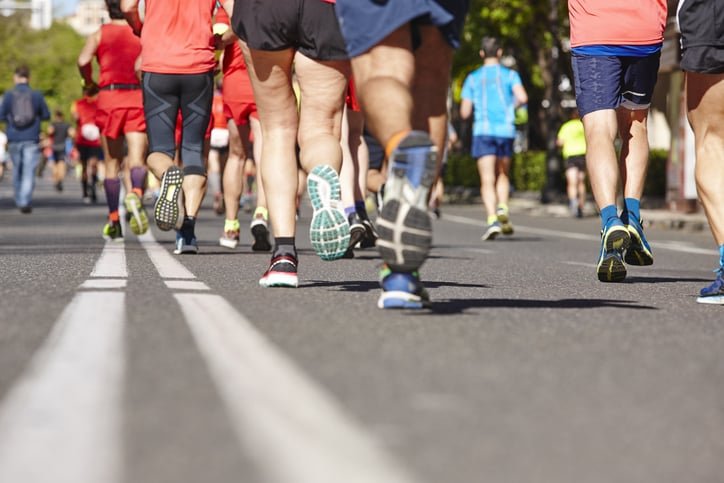
For people who walk or run, lane 1 of the track is the holy grail when training. It is the minimum distance per lap. They say a track is 400 meters, but it’s only 400 meters if you run in lane 1. Runners in lanes 2, 3 or 4 run a longer distance and each lane is 7.67 meters longer than the previous one.
I mention this as running and walking are becoming more common and more people are flocking to the track. When watching professional races, especially when runners are going for world record attempts, you will often see runners move into lane 2 in races like the 5,000 or 10,000 meters. This is common courtesy because the runner is going for a record and you don’t want to get in his way. It is also a sign of respect and deference to a faster runner.
However, to the average person, runners are hesitant to talk about people in lane 1. I try to never push a walker out of lane 1 when I’m running or doing a faster workout. I might be guilty of making a pass in lane 2 instead of lane 3, or on the outside of lane 1, where I might startle that walker if they have their headphones in.
Off the track, I give another runner or walker a lot of space by stepping out or crossing the road, especially if it’s a family or someone walking their dog, but on the track, it’s different because of how much of an impact it has on training. When I’m on the track and I hear a faster runner coming up behind me, I usually pull into lane 2.
But I’ve had runner friends get annoyed that walkers take up lane 1 and they don’t have the hint that it interferes with the runner’s training. I have a friend who got into a fight with a few walkers over this very issue. The walkers didn’t budge and told him that no one owns the track (fair point). I rarely say anything, but occasionally I get irritated if it’s a line of three or four walkers following the track from lanes 1 to 3, or with people parking their bikes on the track and forcing everyone to move around.
If I’m on the track during an easy run, I care a lot less or not at all, but I think when we runners are doing workouts like 6 mile repeats at 7 mile pace, detail oriented runners can get pretty upset about the perceived lack of training control.
. . .
It sounds like such a small issue for people who don’t run on tracks or those who aren’t runners or walkers. But it is one of many examples of the difficulty of sharing public spaces in society.
For younger runners who share this frustration with me, I tell them that running is an occupational hazard, something they unfortunately have to get used to. Yes, no one owns the piece, and some will get the hint, some won’t. Others don’t generally know how we runners think about track and field etiquette. But ultimately, we can control our own actions, not the actions of others, and it’s easier to go into these situations with lower rather than higher expectations (at least for me).
There are also tracks where this is unavoidable for runners. I think about my experience running on the track at McCarren Park in Brooklyn, New York. The weather was terrible that day (snowing) so it was less crowded than usual, but it is known as one of the few tracks accessible to the public in New York City, so there were still about 20 people on the track. Sometimes we had to pull over to lanes 3 or 4 when passing people. But there were other runners passing us as I was going with one of my friends on a 5k PR attempt.
Generally, I’m someone for whom the pros of running on a packed track outweigh the cons. No one is out there trying to get into a fight, but I get some social motivation and energy from other people shaking and other people to watch the workout. I get energy by passing the same group of people 10 or more times in a single run.
It’s also good practice for many races where runners have to pass multiple people – in many lower-production races that aren’t the Boston or New York Marathons, there’s a good chance the course isn’t completely blocked off, or the 5k merges with the 10k, or the marathon merges with the half marathon. It takes a ton of weaving and yelling “on your left!” to get through these crowds, which isn’t ideal, but it’s part of different runners sharing the same space.
. . .
There is a lot of etiquette that goes into sharing a path, but also a sidewalk or path. As a group, taking up the entire path or sidewalk is considered rude, so the groups I run with try not to so that cyclists, runners, and walkers can all pass. We haven’t been perfect every time, but we try to be good at sharing. It’s harder when there’s no sidewalk and a group of runners need to share the road with cars — all you have to do is try to run single file and on the opposite side of the road from traffic.
Many times, it is an infrastructure design problem — the sidewalk is not very wide or there is no sidewalk and we have to share a limited space. The track also has limited space and walking and running are becoming more popular.
It’s not the same, but recently, my social algorithm has been showing me a bunch of videos of drivers hitting cyclists on the road. I saw a video on Instagram of a fairly narrow road with no bike lane and hardly any shoulder. They were a group of six to eight cyclists and occupied 2/3 of the right lane. The car would have to cross the double yellow lines to pass the cyclists and if there was oncoming traffic, they would just have to share the road.
The car gave some space and ended up hitting two of the cyclists. He was later blamed and the news agency said he thought the cyclists were wrong to take up so much of the road.
I wasn’t surprised that a guide would think that way, but I was surprised when I saw the comments on the post. More than 10,000 people liked a comment that said ‘I stand with the driver’, while around a third said ‘I stand with the cyclist’. There’s been a ton of blame for the victims of cyclists taking up so much of the road and riding two bikes across the street.
Again, this is more of an infrastructure issue of a narrow road, probably built for cars rather than road bikes. Although I run on these roads and used to bike to commute to college, I still get nervous about cyclists when I ride. I’m not mad, but just worried about whether I’m giving enough space and whether I’ve checked well enough for oncoming traffic.
Anyway, thinking about lane 1 of the track and those videos of cyclists and drivers debating who is right when a car hits a bike makes me think about how we share our public spaces. We can only control our behavior and not the behavior of others.
But it helps to know that (most) people have no intention of hindering or harming the people around us. For fellow runners trying to make track breaks, the other people in lane 1 can be a blessing in disguise, a sign not to go crazy on the breaks every lap. Effort is what matters, and exercise is more important than occasionally going into lane 2 or 3.
—
This post was previously published in Runner’s Life.
***
You might also like these posts on The Good Men Project:
 Escape the Act Like a Man Box Escape the Act Like a Man Box |  What do we talk about when we talk about men? What do we talk about when we talk about men? |  Because I don’t want to talk about race Because I don’t want to talk about race |  The first myth of Patriarchy: The acorn on the pillow The first myth of Patriarchy: The acorn on the pillow |
Sign up for The Good Men Project newsletter
(function($) { window.fnames = []; window.ftypes = []; fnames[0]=’EMAIL’; ftypes[0]=’email’; })(jQuery); var $mcj = jQuery.noConflict(true);

If you believe in the work we do here at The Good Men Project, join us as a Premium Member today.
All Premium members can watch The Good Men Project ADS-free.
Need more information? A full list of benefits is here.
Photo source: iStock
The post Lane 1 of the Track appeared first on The Good Men Project.
