


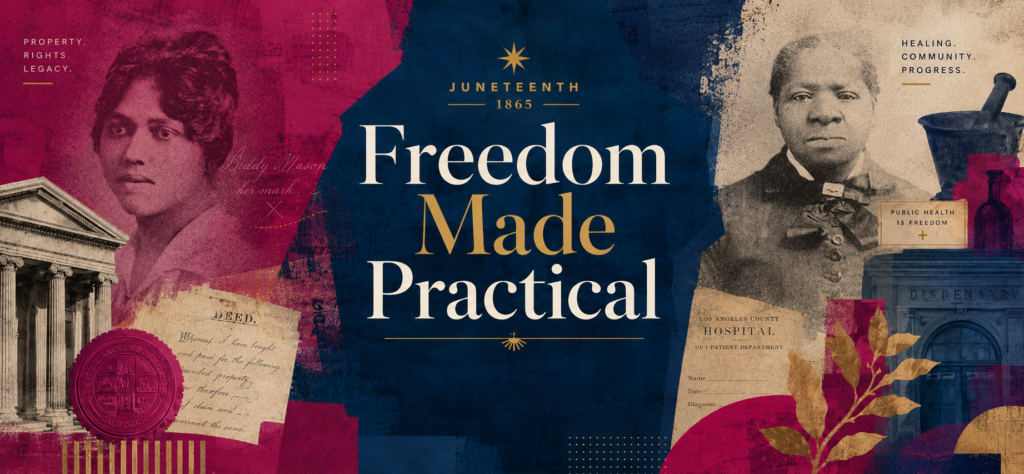
Juneteenth asks us to remember that freedom in America has never been simple. It was delayed, then denied, then fought and protected and passed by people who understood a harsh truth. A piece of paper means very little when your daily life is still shaped by violence and exclusion and the silent insistence of waiting your turn.
This is why this celebration deserves more than a superficial celebration. Yes, we honor joy. We gather, feast and celebrate the freedom owed to our ancestors from the beginning. But we also need to tell the fuller story, especially now, when so many hands are busy trying to rewrite Black history, erase the edges of it, and erase the parts that tell the truth about this country.
And if we’re going to tell the truth, we need to talk about black women.
Black women have always been the glue. We fed the movements and opened the clinics. We bought land, had babies, raised the money, organized the voters, and built trails where the map showed none. All too often our names are lost in the version of history that is repeated out loud. But work is everywhere if you know where to look.
This June, we are remembering four black women whose lives show us what freedom looks like when it is translated into action: Bridget “Bidi” Mason, Dr. Ruth Janet Temple, Captain Mary Lee Mills and Georgia Gilmore. Their stories are not just about survival. They are about brilliance and strategy, ownership and care, the kind of power that changes an entire community.
Freedom is property
Imagine a black woman in 1856 walking into a California courtroom to demand her freedom. This was Bridget “Biddy” Mason. Born into slavery in 1818, she was dragged across the country by the people who claimed to own her, eventually ending up in California, a state where slavery was illegal. The law still did not protect her by itself. Freedom on paper is not the same as freedom in practice, and Mason had to fight for what was already rightfully hers.
In January 1856, she petitioned the Los Angeles County Court for the freedom of herself and the 13 members of her extended family, the women and children whose futures hung alongside her own. The court ruled in her favor. That victory alone would be enough to remember. But Mason was just getting started. She became a nurse and midwife, saved every dollar she could, bought land in Los Angeles and became one of the city’s first black landowners. She then turned that foundation outward, using what she built to care for her neighbors and leave a legacy that stretched far beyond her own life.
Biddy Mason reminds us that freedom is not just about escape. Freedom is property. It’s having a real say over your work and your children, your body and your money and the shape of your future. She took a freedom she had to earn in a courtroom and turned it into land, care and lasting strength for the people around her.
Freedom is access to care
A generation later, Dr. Ruth Janetta Temple carried the same spirit into medicine. Born in 1892 in Natchez, Mississippi, she became the first black woman doctor licensed to practice in California. The title matters. What he did with it matters more. In 1918, he opened a clinic in Southeast Los Angeles because he saw a community closing in without care and refused to look the other way.
Temple and her husband turned their own home into the engine of this care. Their five-bedroom bungalow became the Temple Health Institute, treating people who otherwise might have. This was not public health as a slogan. It was public health as a door that opened when someone needed it.
By 1947, he was running a newly built $300,000 interracial clinic run by the city of Los Angeles in the Southeast District. The Atlanta Daily World wrote that she had “perhaps more responsibility than any other woman physician in the United States regardless of race.” More than 50 employees responded.
Sit with that for a second. A black female doctor leading an interracial public health clinic in 1947, in a country still ruled by segregation and medical racism, is no small thing. The life of Dr. Temple tells us that freedom is also like access to care. You seem to be seen and believed and treated with respect. It’s like a black woman stepping into a system that was never built for her and then helping to run it, serving the people the country had ignored for far too long.
Freedom transcends borders
Captain Mary Lee Mills pushed this idea of freedom even further out into the world. Born in 1912 in Wallace, North Carolina, she came to the Jim Crow South and became a registered nurse in 1934. From there she built a career in public health, obstetrics and nursing education that took her far beyond her hometown.
Prior to her work abroad, Mills served communities close to home. A story from her early years tells of her driving a woman pregnant with triplets an entire hour to Durham after hospitals in Person County turned her away. This moment has so much. It shows what happens when a health care system knocks on the door and shows exactly what kind of person plants her foot in and says that door is not the end of the story.
In 1946, Mills joined the United States Public Health Service and was transferred to Liberia, where she became chief of nursing. He helped build the bones of a public health system there: nursing schools, health centers, vaccination stations, educational campaigns. Her work later took her to Lebanon, South Vietnam, Cambodia and Chad, supporting nursing care, disease prevention and community health wherever she went.
Captain Mills understood something that we all too easily forget. Health care is not charity. It’s freedom. A community without nurses, without clinics and vaccines and maternal care, is a community called to survive without the basic conditions that make freedom real. Mills spent her life building these conditions, often in places where women and children needed systems durable enough to last a single emergency.
Freedom thrives in secret
Then there’s Georgia Gilmore, whose story reminds us that movements don’t work with speeches alone. Born in Montgomery County, Alabama in 1920, Gilmore was a cook, mother and one of the women who quietly kept the Montgomery Bus Boycott alive. This boycott lasted 381 days. History loves to remember the public figures of the movement. He doesn’t always remember the people who made the day-to-day logistics possible.
Gilmore knew that a movement is based on more than courage. It works with money, with food and transport, with trust. So she created the Club from Nowhere, a secret network of black women who cooked and sold dinners, pies and cakes to finance the boycott. The name was protection. If anyone asked where the money came from, the answer was simple. Nowhere.
But it came from somewhere. It came from black women’s work and kitchens and quiet courage. Gilmore and the women around her funded the carpool system that kept people moving while refusing to ride on segregated buses. After filing for discrimination and losing her job over it, she turned her home into a restaurant. Her home became the place where the leaders of the movement came to eat, meet, and map out what came next.
Georgia Gilmore’s story makes one thing clear. Working for freedom often happens invisibly. It happens in kitchens and living rooms, in church basements and beauty shops. It happens when women who already carry too much somehow find the strength to carry a move.
The proof we can’t lose
Put them together and you’ll see that freedom was never a single thing. For Bridget “Biddy” Mason, it looked like winning in court and turning her hard-earned land into an inheritance. For Dr. Ruth Janetta Temple, it looked like building real access to care in a community that the system had overlooked. For Captain Mary Lee Mills, it seemed like taking public health across borders and insisting that nurses and vaccines and prevention could save lives. For Georgia Gilmore, it seemed to fuel a movement and finance the resistance one plate at a time.
This is history we cannot afford to lose.
If we only tell the stories of black women through suffering, we miss the rest of the truth. We lack flash and strategy. We miss the humor and the skill and the sheer imagination it took to build something that would last in a country that kept knocking on the door. Black women have never just endured America. We shaped it and challenged it, healed it and organized it, and all too often, held the whole thing together.
Juneteenth reminds us that freedom is delayed. These women remind us that freedom still had to be put into practice after the announcement.
He had to defend himself in court.
It had to be integrated into clinics.
It had to travel through public health systems.
It had to be cooked up, sold and delivered quietly to keep a boycott alive.
So this June, we say their names: Bridget “Biddy” Mason. Dr. Ruth Janetta Temple. Captain Mary Lee Mills. Georgia Gilmore.
Not because they are the only ones.
Because it is part of the proof.
Black women have always been at the center of the history of freedom in this country. And if someone tries to rewrite this history, we have a responsibility to write it stronger.
