


For years, I’ve criticized companies that sell supplements using science, proprietary blends, influencer testimonials, and vague promises to “replace 20+ supplements” and “support wellness.” And as for the green and red powders, I put almost all of them in the “pass” category.
When a follower asked me to review IM8, I knew it was going to be the same old supplement garbage. IM8 was founded by David Beckham and has been endorsed by a bunch of athletes and people who may be famous but I’ve never heard of…none of them impress me at all. Let’s face it: celebrity products and endorsements are an absolutely horrible way to determine a product’s effectiveness. Why do I care if Jay Shetty and some MMA fighter thinks Beckham’s supplement is amazing?
What is IM8?
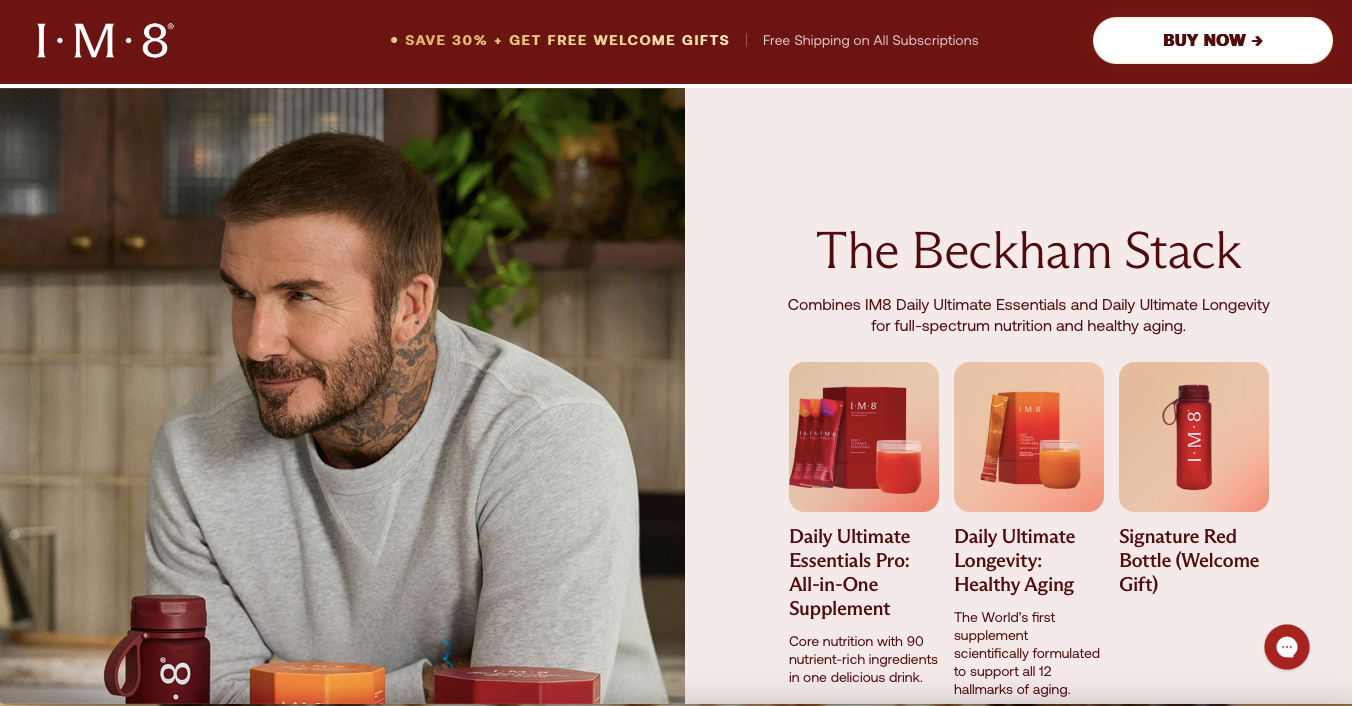
IM8 is a line of 2 supplements: IM8 Daily Ultimate Essentials Pro ($346 CAD/90 days) and IM8 Daily Ultimate Longevity ($459/90 days). If you have even more money to burn, the “David Beckham stack” is both products plus a handy shaker cup and hand mixer, all for the low price of $806 CAD/90 days. Any product purchase gives you 90 days of free access to the IM8 “transformation program”, which I’m sure is intended for the very people who can afford these products, aka those who need a health makeover the least outside of anyone.
Once you get past the IM8’s pretty packaging and “premium” claims, the truth is revealed.
One good thing about IM8 is that the products are NSF certified for sports. This means:
- the products contain what the labels say
- have been tested for contaminants
- they have been tested for more than 280 banned substances
For athletes and non-athletes alike, this is valuable information, especially when the supplement industry hasn’t always been honest about what actually on some products.
That said, the NSF certification doesn’t tell us if a supplement really works. It is not intended to test the claims a company makes or hold them up to existing research. It’s strictly a matter of quality control.
Throughout the IM8 website you will see the usual claims:
Clinically proven.
95% more energy.
Better digestion.
Better sleep.
These claims are so exaggerated and proven in the supplement realm that frankly, they don’t bother me anymore. And rightly so, because like many other products, the IM8 research did not support them.
Yes, IM8 actually has research behind their products, but you don’t have to dig too deep to see the flaws.
IM8 conducted 12-week randomized placebo-controlled trials of both Essentials Pro and Ultimate Longevity. The Essentials trial involved only about 60 participants and the Longevity trial only 25. Although both studies were completed in 2025, neither has been published in a peer-reviewed journal. There are results for the Essentials test listed on the IM8 website, which you can see in the screenshot below.
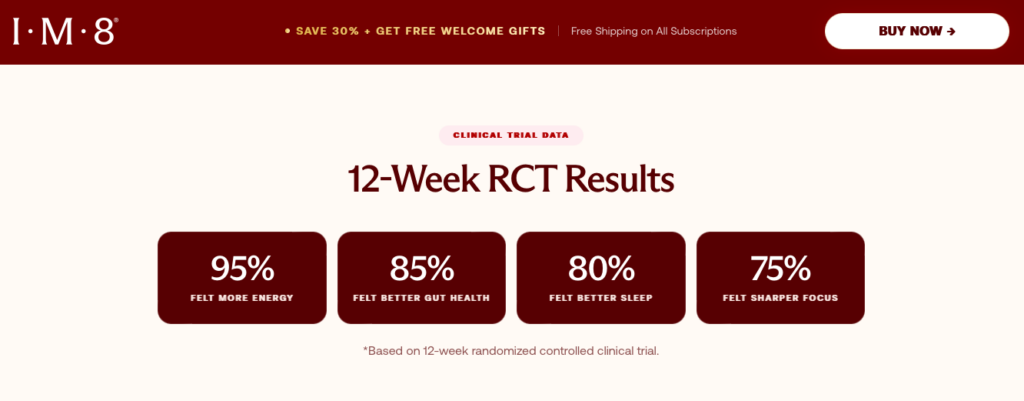
75% “felt more focused”? “Feel more energy”? What’s up with the word “felt”? Right – because the results were apparently based on participant questionnaires rather than objective physiological measurements (which were promised but not delivered, perhaps because they weren’t up to par). This is an important detail, because if you’re going to make big claims, you should have a lot of research to back them up.
Unfortunately, a short, small study that is mostly qualitative and hasn’t even been published is not. The results of the Longevity study are MIA, by the way.
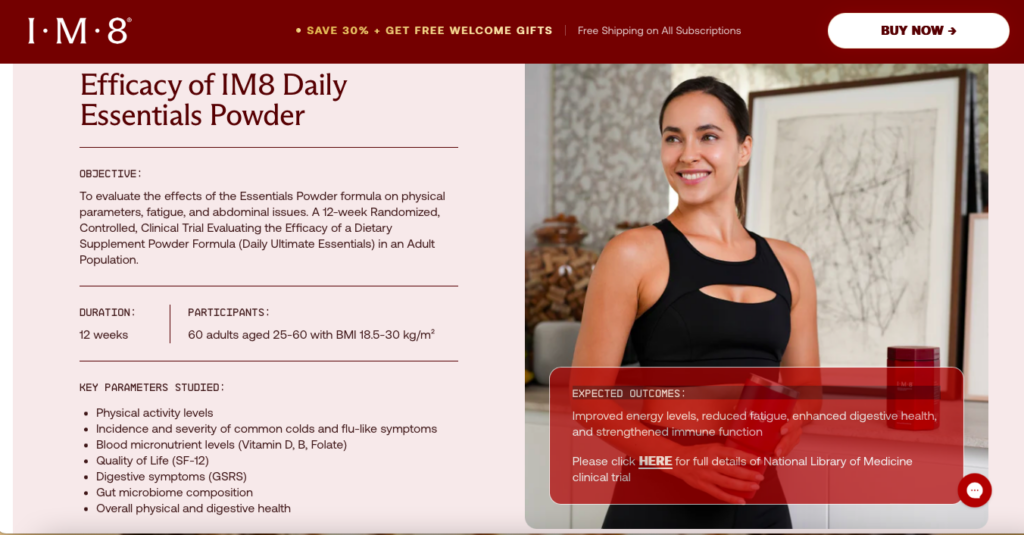
I don’t care about all the parameters of the study, I want to see the actual studies. The link in the “expected results” section leads to Clinicaltrials.gov pageand nothing else.
And just FYI, the IM8 advisory board contains doctors who have blocked me for ripping them off for their false and misleading nutrition claims. Among them are Amy Shah and James DiNicolantino. I would be embarrassed to be associated with these people in any way, let alone support my product by being on the “advisory board”. No thank you.
More is not always better.
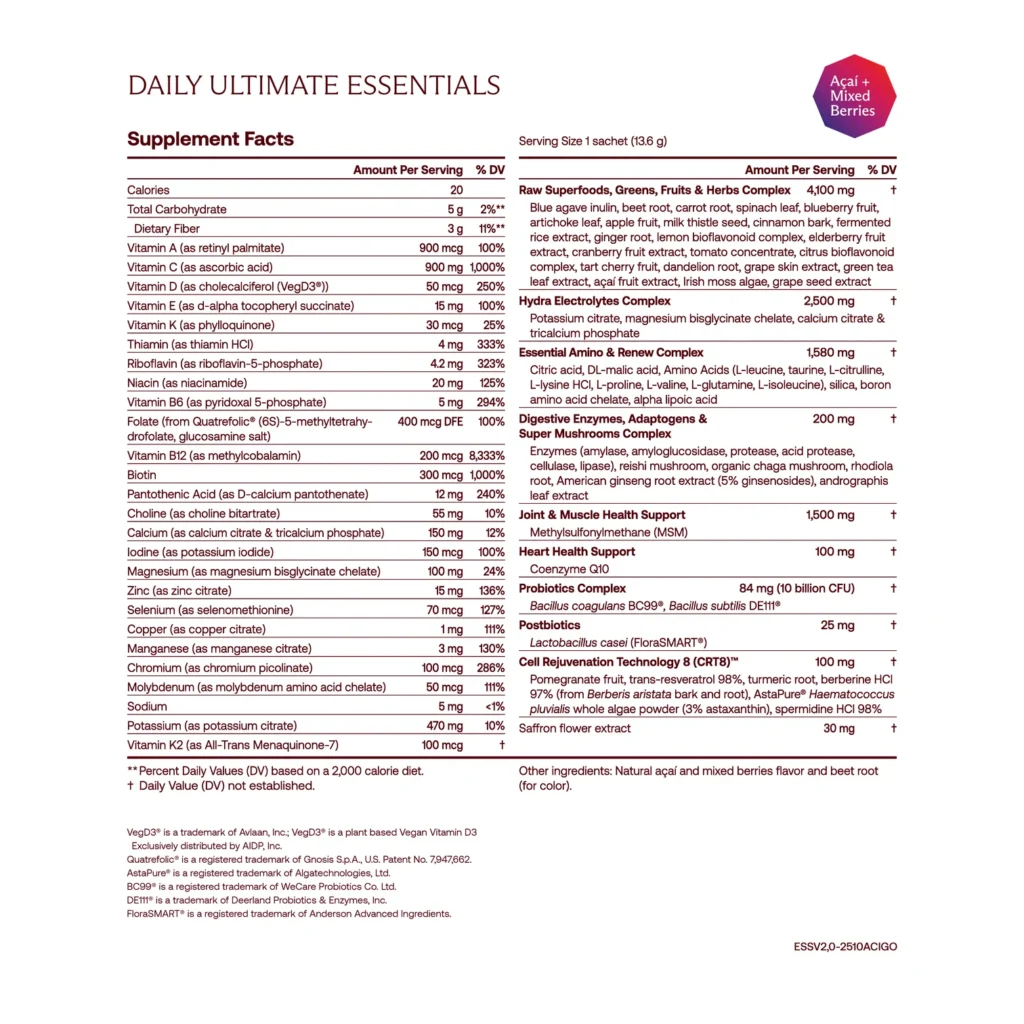
IM8 proudly advertises over 90 ingredients. This is not as impressive as it sounds, because in nutrition, and especially with supplements, more is not always better. Unfortunately, consumers have been conditioned to believe that more ingredients equals more health and value.
There are many scientific problems with “kitchen sink” supplements, the first being proprietary blends. And IM8 has plenty of them in both products.
I always speak out against proprietary blends in nutritional supplements because I think it’s a shady way to hide the true amounts of each ingredient you’re taking. Is it above the safe limit? Below the effective dose? Is it enough to cause side effects? One never knows until one discovers that the supplement is either ineffective or when it ends up doing harm.
So transparency matters and we have no idea if IM8 “cell rejuvenation technology 8™” contains significant doses or pixie dust.
With multi-ingredient products, there is also the potential issue of interaction between ingredients. Once you combine dozens upon dozens of vitamins, herbs, probiotics, antioxidants, adaptogens, enzymes, amino acids and phytonutrients, predicting how they will interact becomes extremely difficult.
Sometimes the ingredients may complement each other, but sometimes they compete for absorption. More often than not, taking so many ingredients together makes it impossible to know what anything really does.
Most people don’t need all – or any – of these.
This is probably my biggest criticism of multi-ingredient supplements like IM8. Supplements must fill nutritional gaps, not attempt to replace an entire diet or imply through marketing that they are essential for health.
NO ONE needs that much vitamin C, most of which is simply excreted in the urine. Or, 8000% of the DRI for vitamin B12, or that high dose of all other B vitamins, which are readily available in food. Most of us do not use supplemental digestive enzymes, probiotics or essential amino acids. It’s all smoke and mirrors to make customers think they’re getting all these things they don’t eat in their diet. It’s unreal.
Taking nutrients you don’t need generally provides no added benefit, and taking everything “just in case” is not evidence-based nutrition. Most of the ingredients in IM8 are relatively benign (aka useless) unless you are really low or deficient in those nutrients. IM8 says its ingredients are “clinically dosed,” which means nothing if, again, you’re not low or deficient in them. Healthy people who eat a varied diet generally don’t need supplements for that many things.
I generally recommend targeted supplements rather than combining dozens of ingredients into one product, especially when such complex formulations usually don’t provide optimal doses of anything.
Note that I am not saying anything about the IM8 longevity supplement. This is because I am sick and tired of the longevity trend that is literally not backed up by anything. IM8 Ultimate Longevity contains NAD, which has not been shown to do anything for longevity in humans. Nanda. It also contains several proprietary blends, which we have already discussed. I don’t want to sound extreme, but it’s all rubbish.
The celebrity effect
I have to mention it and let’s be honest: David Beckham is not associated with this product because he is a nutritionist. It’s there because trust sells supplements and consumers naturally assume that if someone as fit and successful as Beckham creates and uses a product, there must be something special about it. Well, there isn’t. This is a Marketing 101 tactic, so consider yourself warned.
For most healthy adults, I would rather see money spent not on supplements, but on:
- fruits and vegetables
- adequate protein
- strength training
- sleep
- preventive health care
- seeing a registered dietitian if needed
These interventions have dramatically stronger evidence than any supplement.
My verdict
No matter how many ingredients are in a product, and no matter how fit and famous the founder, there is still no evidence that replacing a healthy diet and lifestyle with an expensive powder is a shortcut to better health.
IM8 is smart marketing wrapped around science that is still much weaker than consumers are led to believe.
