

Close Menu
Healthtost
  • News
  • Mental Health
  • Men’s Health
  • Women’s Health
  • Skin Care
  • Sexual Health
  • Pregnancy
  • Nutrition
  • Fitness
  • Recommended Essentials
What's Hot

Knowing your plants is a plus – but formulation has different rules – Sally B’s Skin Yummies

June 15, 2026

Complete Career Guide — Sexual Health Alliance

June 15, 2026

The vaginal health boom and why it matters

June 14, 2026
Facebook X (Twitter) Instagram
  • About Us
  • Contact Us
  • Privacy Policy
  • Terms and Conditions
  • Disclaimer
Facebook X (Twitter) Instagram
Healthtost
SUBSCRIBE
  • News

    Study reveals frequent stop and start patterns with GLP-1 drugs

    June 14, 2026

    New DNA test improves diagnosis of rare genetic disorders

    June 14, 2026

    Non-invasive sequencing expands the possibilities of prenatal genetic testing

    June 13, 2026

    Clever student masters art of fake wounds to create life-saving simulations for army and NHS

    June 13, 2026

    New peptide strategy may protect brain cells involved in Parkinson’s disease

    June 12, 2026
  • Mental Health

    Performing under pressure? For athletes it depends on 3 main things

    June 14, 2026

    GLP-1 drugs like Ozempic promise more than just weight loss. But what is science versus hype?

    June 10, 2026

    Expectations of Indian Daughters: 10 Weird

    June 8, 2026

    How to Encourage a Child to Try New, Scary Things (Without Injuring Him in the Process)

    June 5, 2026

    Why your wearable health tracker can make you feel anxious

    June 1, 2026
  • Men’s Health

    Fathers shape childhood obesity risk long before birth

    June 10, 2026

    5 Diet-Boosting Tips to Spread Protein Throughout the Day

    June 9, 2026

    The Louis L’Amour Workout | The Art of Manliness

    June 9, 2026

    Stopping authoritarian strongmen and returning to the roots of our partnership

    June 8, 2026

    Low testosterone changes your body: See what a DEXA scan can reveal

    June 4, 2026
  • Women’s Health

    Uncovering the Latest Amino Acid Link to Weight Loss: The Cysteine ​​Link

    June 14, 2026

    Our Health Survey is ongoing. We have until July 13 to fight back.

    June 14, 2026

    Why is my sex drive so low? 10 common causes of low libido in women

    June 13, 2026

    “How to Show Up” – Supporting a woman undergoing cancer treatment

    June 13, 2026

    Does your cervix dilate during your period? Truth About Dilation And Cramps – Vuvatech

    June 12, 2026
  • Skin Care

    Knowing your plants is a plus – but formulation has different rules – Sally B’s Skin Yummies

    June 15, 2026

    Why Skin Barrier Repair C – Lifeline Skin Care

    June 14, 2026

    Can You Eat Your Way To Dewier Skin? Hyaluronic acid for skin hydration

    June 14, 2026

    The New Shower Standard | Get to know the body cleansing gels

    June 13, 2026

    Why adult acne occurs and how to care for breakout-prone skin

    June 12, 2026
  • Sexual Health

    Complete Career Guide — Sexual Health Alliance

    June 15, 2026

    Sex after 50—Sexuality as we age

    June 12, 2026

    5 unexpected ways to improve your sex life

    June 11, 2026

    Fildena 100 Safety Guide | Tips and information for safe use

    June 10, 2026

    Pride Month and LGBTQ+ Men’s Health: Why Inclusive Care Matters

    June 9, 2026
  • Pregnancy

    Nosebleeds in Pregnancy: Causes and Safe Treatments

    June 14, 2026

    What can they do for women? – Pink stork

    June 14, 2026

    A one-of-a-kind pregnancy magazine: for reflection, healing and growth

    June 11, 2026

    Your No-BS guide to surviving a summer pregnancy

    June 9, 2026

    How to detect pre-eclampsia early before it becomes dangerous

    June 7, 2026
  • Nutrition

    The vaginal health boom and why it matters

    June 14, 2026

    Diagon Alley, Gringotts, Toothsome & Our Last Day • Kath Eats

    June 14, 2026

    Which beans are best at preventing the spread of cancer?

    June 13, 2026

    The energy equation: PFF at every meal

    June 12, 2026

    How to fuel a marathon, according to a nutritionist and ultra runner

    June 11, 2026
  • Fitness

    My experience at Korean Head Spa

    June 14, 2026

    The Fitness Zeitgeist – Tony Gentilcore

    June 13, 2026

    Too busy for the gym? Try this 21-minute workout

    June 12, 2026

    5 Reasons Yoga Moms Turned to Silent Heavy Silicone Vests

    June 11, 2026

    Ankles, knees and hips: 10 joint-friendly exercises

    June 9, 2026
  • Recommended Essentials
Healthtost
Home»Mental Health»Hypnosis isn’t just a gimmick or TV act – science shows it helps with anxiety, depression, pain, PTSD and sleep disorders
Mental Health

Hypnosis isn’t just a gimmick or TV act – science shows it helps with anxiety, depression, pain, PTSD and sleep disorders

healthtostBy healthtostDecember 16, 2024No Comments6 Mins Read
Facebook Twitter Pinterest LinkedIn Tumblr Reddit WhatsApp Email
Hypnosis Isn't Just A Gimmick Or Tv Act Science
Share
Facebook Twitter LinkedIn Pinterest WhatsApp Email

We’ve all seen it, usually on TV or on stage: A hypnotist selects a few members of the audience, and with what appears to be little more than a steely gaze or a few choice words, they’re suddenly “under the spell.” Depending on what the hypnotist suggests, the participants laugh, dance and play without inhibition.

Or maybe you’ve experienced hypnosis in another way – with a trip to a hypnotherapist for a series of sessions to help you quit smoking, lose weight, manage pain or deal with depression. This is no longer uncommon. thousands of Americans have done the same thing. And many were helped.

Hypnosis has been found to be effective for treatment irritable bowel syndromeand can be beneficial for weight reduction, sleep disorders and worry. For mild to moderate depression in adults, hypnotherapy is as effective as cognitive behavioral therapyand can help with depression in children. Hypnosis is also used for therapy phobias, PTSD and yes pain control during surgery and dental procedures in both adults and children.

However, despite the evidence, its widespread use, and its growing popularity, hypnosis is still viewed with skepticism by some scientists and curiosity by much of the public. As a researcher who studies altered states from a cognitive and neuroscientific perspective, I’m happy to help pull back the curtain to show you how hypnosis works.

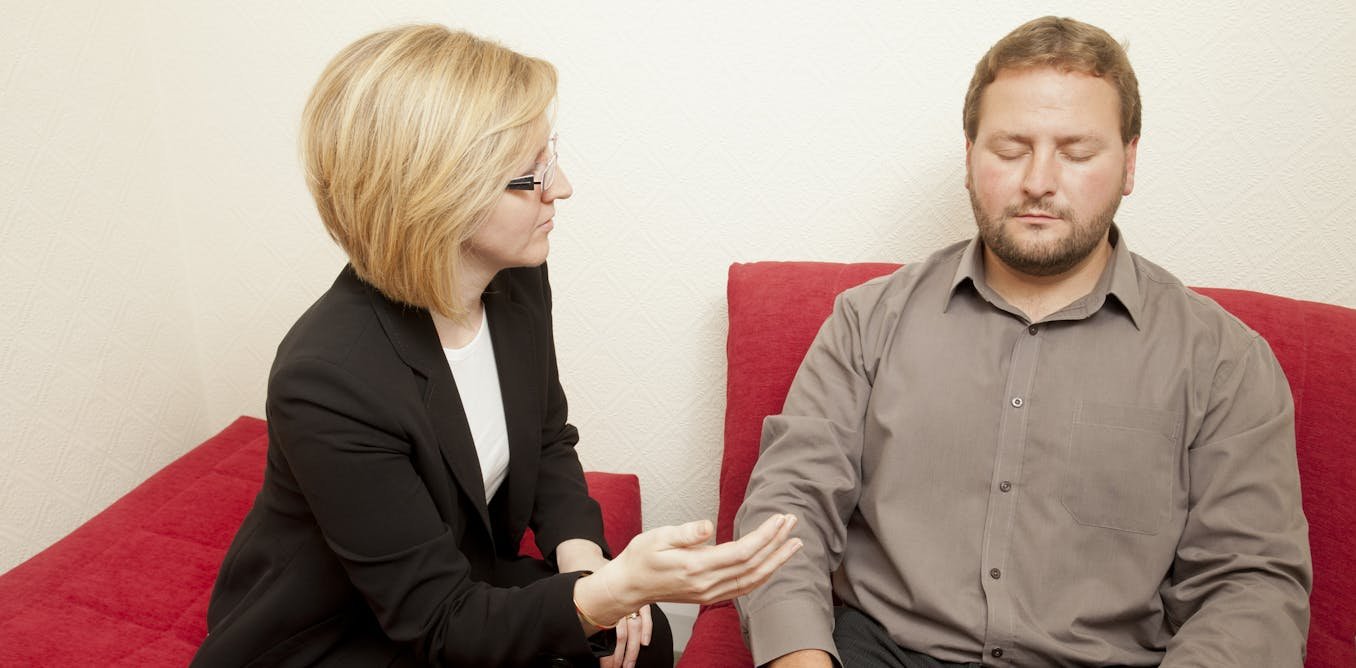
People are more hypnotizable if they are receptive to therapy.
PeopleImages/iStock via Getty Images Plus

A hypnotherapy session

Simply put, hypnosis is a process that helps people imagine different experiences that feel very real. When this happens, the person can be said to be in a state of hypnosis.

Little is known about what characterizes a hypnotic state in terms of brain activity, but neuroimaging studies indicate a decrease in activity in the parts of the brain responsible for self-referential thinking and daydreamingand increased connections between the parts responsible for attention and action.

These results are consistent with the idea that hypnotized subjects are in a state that inhibits internal thoughts and other distractions, such as bodily sensations or noises, that might interfere with hypnosis.

A therapist’s first set of suggestions usually includes “hypnotic induction”, which helps the subject to increase his response to other suggestions. An induction might be: “Now I’m going to count from 5 to 1. On each count, you’ll feel even more relaxed and that you’re going deeper and deeper into hypnosis.”

When responding to sentences, the subject’s experience feels involuntary. That is, it happens to them, rather than being created by them. This is known as the classic sentence effect. After a suggestion to move his arm, the subject may feel that his arm is being raised on its own, rather than being raised of his own volition.

For perceptual cues, experience can be quite real and different from voluntary imagination. If I ask you to imagine hearing a dog barking outside, it takes effort and the experience doesn’t feel like a dog actually barking outside. But through hypnotic suggestion, responders will feel as if they are hearing a dog barking and will be unaware of any effort to do so.

What makes people hypnotize?

You can’t force anyone to be hypnotized. Willingness to participate, positive attitude, motivation and expectation are extremely important. So is the ability to put aside the fact that the situation is imaginary. It’s like being completely absorbed in the story and characters of a movie – so engrossed you forget you’re in a theater.

A good relationship with the therapist is also critical. If you refuse to cooperate or decide that hypnosis will not work, it won’t happen. A good comparison might be meditation: You can listen to a meditation recording, but if you don’t want to follow the instructions, or if you’re unmotivated or distracted, it won’t have any effect.

Few traits predict whether someone is easily hypnotizable, but people are not created equal ability to respond to hypnotic suggestions. Some people experience a wide range of propositions intensely. others, not so much. There are indications that women respond slightly better to hypnotic suggestions by men, and that maximum hypnotizability occurs during late childhood and early adolescence.

From a neuroscientific perspective, it appears that hypnotic suggestions do not act directly on our executive functions, but rather about our self-monitoring features. That is, hypnosis does not directly determine our behaviors for us. Instead, it modifies the way the brain keeps track of what it’s doing. So when the hypnotist suggests that you raise your hand, you are still making that decision – even though your experience may seem like the hand is moving on its own.

Some myths and realities about a hypnotherapy session.

Exposure therapy, self-hypnosis

The goal of hypnotherapy is to induce changes in negative feelings, perceptions and actions. Let’s say you have a fear of public speaking. Through cues, the therapist can get you to experience speaking in front of an audience. Again, it’s true – your anxiety level will increase, but eventually you’ll get used to it and learn to deal with the anxiety, even as the therapist suggests increasingly difficult scenarios.

Hypnosis can also be used as a preparation or replacement exposure therapywhich is a method of treating phobias or anxiety related to specific situations by gradually exposing the patient to increasingly difficult situations. If you are afraid of birds, the therapist may suggest that you hold a feather. then imagine approaching a bird in a cage. then imagine going to the park and feeding pigeons. This is more effective and looks more real than just visualizing.

The hypnotherapist can also teach self-hypnosis techniques. Subjects can learn to induce a state of relaxation associated with a gesture, such as closing the left hand.

Hypnotic suggestions like this reduce anxiety by promoting its activation parasympathetic nervous systemwhich stimulates bodily functions during periods of rest, such as digestion and sexual arousal, and deactivates sympathetic nervous systemwhich stimulates the fight or flight response.

Progress can occur after less than 10 sessions with some disorders, such as insomnia in children. But it may take more time others, such as depression. And just as hypnosis isn’t right for everyone, it isn’t right for everything.

Additionally, not all hypnotherapy products on the market are backed by scientific evidence. It is safer to go to a hypnotherapist who is licensed in your state. You should ask if they are affiliated with or certified by a professional hypnotherapist association. You can then confirm their membership on the club website. For example, the American Society of Clinical Hypnosis allows you to search for members by name.

Although Medicare does not cover hypnotherapy, some private insurances partially cover the cost for certain conditions, provided the treatment is performed by a licensed clinical mental health professional. A session usually costs between US$100 and US$250.

act anxiety depression Disorders gimmick helps Hypnosis Isnt Pain PTSD Science shows Sleep
bhanuprakash.cg
healthtost
  • Website

Related Posts

Performing under pressure? For athletes it depends on 3 main things

June 14, 2026

New DNA test improves diagnosis of rare genetic disorders

June 14, 2026

Increased stress, reduced sleep change the structure and function of the brain in children

June 11, 2026

Leave A Reply Cancel Reply

Don't Miss
Skin Care

Knowing your plants is a plus – but formulation has different rules – Sally B’s Skin Yummies

By healthtostJune 15, 20260

You already know plants. You know their ingredients, their action, the history of their use.…

Complete Career Guide — Sexual Health Alliance

June 15, 2026

The vaginal health boom and why it matters

June 14, 2026

Study reveals frequent stop and start patterns with GLP-1 drugs

June 14, 2026
Stay In Touch
  • Facebook
  • Twitter
  • Pinterest
  • Instagram
  • YouTube
  • Vimeo
TAGS
Baby benefits body brain cancer care Day Diet disease exercise finds Fitness food Guide health healthy heart Improve Life Loss Men mental Natural Nutrition Patients Pregnancy protein research reveals risk routine sex sexual Skin Skincare study Therapy Tips Top Training Treatment ways weight women Workout
About Us
About Us

Welcome to HealthTost, your trusted source for breaking health news, expert insights, and wellness inspiration. At HealthTost, we are committed to delivering accurate, timely, and empowering information to help you make informed decisions about your health and well-being.

Latest Articles

Knowing your plants is a plus – but formulation has different rules – Sally B’s Skin Yummies

June 15, 2026

Complete Career Guide — Sexual Health Alliance

June 15, 2026

The vaginal health boom and why it matters

June 14, 2026
New Comments
    Facebook X (Twitter) Instagram Pinterest
    • About Us
    • Contact Us
    • Privacy Policy
    • Terms and Conditions
    • Disclaimer
    © 2026 HealthTost. All Rights Reserved.

    Type above and press Enter to search. Press Esc to cancel.