


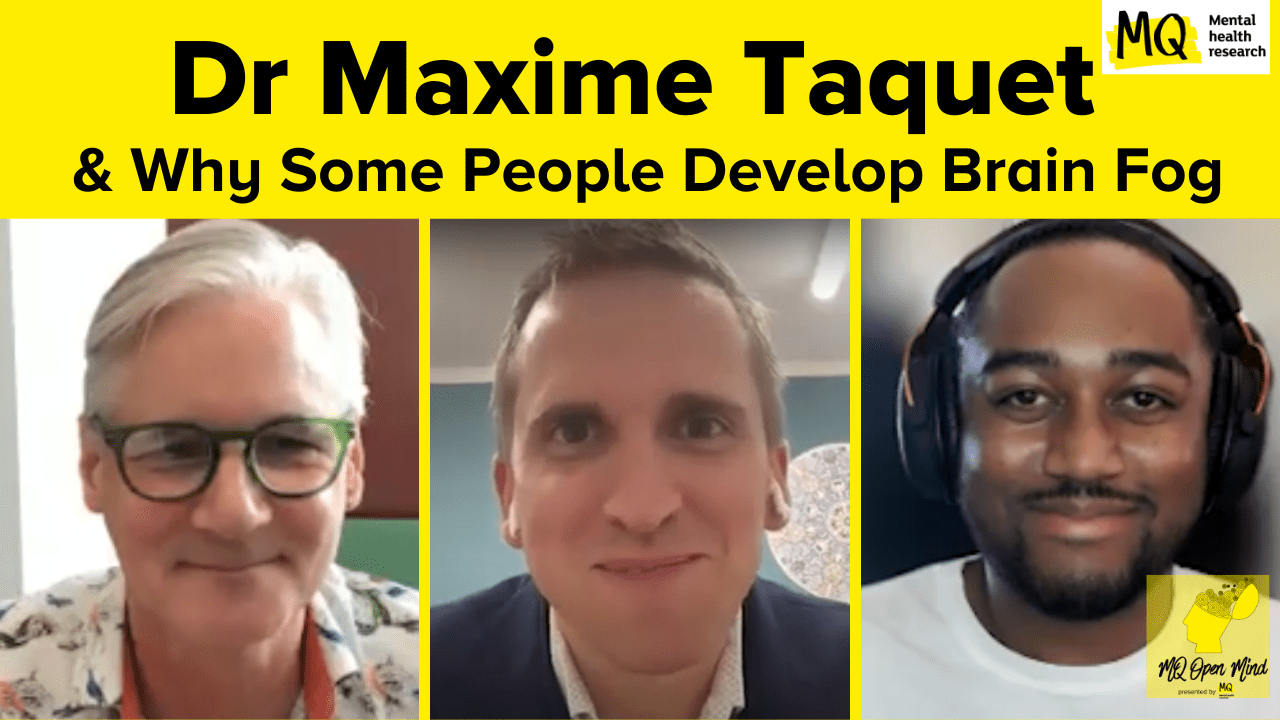
The effects of Covid-19 on brain function and mental health, as well as the reasons for flaws in the diagnosis of psychiatric illness, are all discussed in this episode of the MQ Open Mind podcast. MQ’s Professor Rory O’Connor and Craig Perryman spoke to MQ Researcher and Academic Clinical Fellow in the Department of Psychiatry, University of Oxford, Dr Maxime Taquet.
Originally an engineer, Dr. Maxime earned a PhD in brain imaging. During this time, he spent a lot of time at Boston Children’s Hospital in the US as part of Harvard Medical School developing brain imaging techniques. His medical studies brought him to the United Kingdom where he studied at Oxford.
Increasingly interested in the brain, behavior and how to measure both brain activity and individual experience, Max’s career turned to clinical psychiatry. Over the past decade, his work has helped make huge leaps forward in both remote sensing, mental health and more recently, the effect that Covid-19 can have on brain function in MQ-supported studies.
Misdiagnosis
Max began by talking to Professor Rory about a much more established problem in psychiatry, an area that Max is fascinated and motivated by, and that is defects in diagnosis.
“Diagnosis in Psychiatry is not based on tests, blood tests or even scans. They are based on a collection of symptoms. Unfortunately, this means that often the diagnoses we make are not necessarily reliable. By that, I don’t necessarily mean that what we tell patients is wrong or unhelpful. But the label we give can be different depending on which psychiatrist we are.”
As he explains in the episode to Professor Rory and Craig, diagnosing based on symptoms has significant implications. Not only in patients, but also in research.
“Where some psychiatrists might give a patient a diagnosis of depression, another might give them a diagnosis of anxiety, and a third might give them a diagnosis of mixed anxiety and depression. This doesn’t really matter in some respects, as the treatment is much the same both psychologically and medically. But for research, that can cause problems when we’re trying to find biomarkers of disease.”
Max applauds the wisdom of experience, saying that patients instinctively know that a label can be given, but the individual experience is unique. He notes that although patients can identify with a label, they know that their life, their experience, is much more complex than this simple diagnosis.
“With psychiatric illness {psychiatrists and researchers} tend to think that the diagnostic label is the ground truth, so we need to find a biomarker that fits perfectly. But it is rather unlikely that it will ever be {possible} if we rely on diagnoses that are themselves unreliable.”
Impact of Covid-19
Dr Max’s main area of recent research, supported by MQ, has focused on brain function and Covid-19. In the episode, the trio discuss the commonality of people who have been hospitalized with Covid-19 continuing to have symptoms and how some symptoms affect different parts of the body such as breathing, ability to exercise, fatigue, concentration and mood.
Early in the pandemic, Max conducted studies looking at large-scale electronic health data to see if people with Covid-19 were at increased risk of being diagnosed with brain disorders, including cognitive problems, depression, anxiety, psychosis and also strokes, brain bleeding and others. He and his colleagues found, he says “very clearly,” that having Covid-19 was associated with a much higher risk of brain disorders than having something like the flu.
This discovery led to greater interest in understanding why. Why could Covid-19, caused by a small virus, cause such effects? Why can this small virus cause such huge effects on the brain? This open question is one that Max and his team are beginning to find answers to.
Why can Covid-19 affect the brain?
There are some cases, Max states on the podcast, that are held by people who have expertise in infectious disease, neuroscience, neuro-inflammation, neurology and psychiatry. Cases covered in the episode include:
- Inflammation: The theory is that there may be a degree of inflammation that can affect the brain due to Covid-19. We know that neuro-inflammation, inflammation in the brain, can cause a variety of problems, including cognitive problems.
- Blood clots: People who have Covid-19 are at increased risk of developing blood clots in different parts of the body and that obviously includes the lungs, but it also includes the brain and that mirrors what we’ve seen in stroke epidemiology. After Covid-19 it may well be that clots in the brain are causing things like cognitive problems.
- Autoimmune response: our immune response may mean that the virus lies dormant in various parts of the body, perhaps even in the brain, and then various previous infections activate or reactivate.
These assumptions, which Max notes are valid, are now being explored further and thanks to his work now with evidence to support them.
Max also states how important it is to note how much one’s environment plays a role in the effects of the virus. Where you start before Covid-19 determines how your Covid-19 illness will affect how well you recover from it. Some people may start out with high reserves, either cognitive or physical, but may go on to have repeated experiences of Covid-19 and suffer the effects.
“Some patients I’ve seen, they used to run a very successful business and then they get Covid-19 and they have a really hard time recovering. Six months or 12 months later, they are still unable to do the simple tasks required of someone running a business, such as basic arithmetic or simple concentration. This is a very interesting, strange phenomenon and clearly has traumatic consequences.”
In Dr Max’s published work, Bidirectional, not only predicted the psychological or psychiatric outcome of Covid-19, but also looked at why people with pre-existing conditions or mental health problems may be at increased risk for Covid-19.
In 2022, Max won an award for this work, winning the Core Psychiatric Trainee of the Year award from the Royal College of Psychiatrists.
Mental health and Covid-19
In the episode, Max notes some key statistics from his studies on the effects of Covid-19 on mental health and the links between the two.
- People with a history of psychiatric problems or diagnosis are at increased risk of getting Covid-19 in the first place.
- Others have also found that these people have an increased risk of dying from Covid-19 or having serious consequences from Covid-19.
- In addition, Covid-19 itself may subsequently lead to increased risks of these disorders.
Max offers plausible explanations for the above, including biological causes such as inflammation or the impact of psychiatric disorders on the immune system, as well as psychological and social ones.
“Sometimes it can be harder for people with mental illness to isolate themselves. They may have been more at risk of contracting Covid-19 simply because the risk of being completely isolated was much greater than for most other people.”
Max’s understanding shows compassion for those for whom isolation can be psychologically dangerous if not life-threatening.
“Other people could probably isolate themselves safely for a few months without it having a negative impact on their health or mental health. For people with severe or diagnosed psychiatric disorders, the risks did not outweigh the benefits.”
Hope Application-lies
Max’s work also reveals possible solutions. Cognitive rehabilitation appears to be useful for those experiencing loss of brain function following Covid-19. Strenuous brain exercises may mean they regain much of their cognitive potential, according to Max. If this is true and indeed effective, as Professor Rory agrees on the podcast, this would be fantastic news for these patients.
Hope also comes in the form of more app-based treatments available for mental wellness, including mood-tracking apps of which Max is a bit of a pioneer.
Not only did Max gain a claim to fame through groundbreaking work in brain fog studies but also through app development. As an engineer, he developed a supported mental health app in 2012, over a decade ago before app development and mental health were as prevalent as they are now.
“We discussed the idea of developing an app that would allow us to measure people’s mood and behavior on a daily basis. We were young and ambitious and thought “let’s do it!” The idea turned out to be more successful than we imagined.”
The app was used on a reality TV show in France and helped collect 10 million data points among 60,000 people who reported their mood and behavior multiple times a day. The success of the app has helped many people and researchers, although Max has a small confession to make.
“Although I developed the app with friends in Boston in the US, we’re all Belgian, so there were more beers involved in the development of this app than perhaps those from developers like Zuckerberg!”
With all his awards and successes, MQ is proud to add to his list of achievements as one of our supported researchers.
We include Dr Maxime in our celebration of International Men’s Day (19 November 2023) as part of MQ’s list of supported researchers and look at his work in more detail in our 5 Amazing Men in Mental Health research article.
Watch or listen to the podcast episode by clicking on the video below.
