




As someone who doesn’t have children, my dog is my family.
After working with clients from all over the world for over 12+ years in my nutrition practice, a common finding I see in trials is that people are overdosing on vitamin A, a fat-soluble vitamin that is stored in the body and does not leave easily. if you take too much. It hangs around and sinks your liver. This is from eating too much dairy/liver/eggs, eating too many brightly colored vegetables (think sweet potatoes, carrots, red peppers, etc.), topical vitamin A products like anti-aging retinol creams, and taking supplements that contain the vitamin A such as multivitamins, prenatals and cod liver oil. Over several decades, the liver is overloaded resulting in sluggishness and toxicity.
This phenomenon is well documented in the literature:
“Vitamin A in high doses is a direct toxin. Excess vitamin A is stored in stellate cells in the liver, and accumulation can lead to their activation and hypertrophy, excessive collagen production, fibrosis, and liver damage. Toxicity is dose-dependent and can reproduced in animal models’. [1]
“The acute and chronic effects of vitamin A toxicity are well documented in the literature. Emerging evidence suggests that hypotoxicity without clinical signs of toxicity may be a growing concern because intakes from preformed sources of vitamin A often exceed the Recommended Dietary Allowances (RDA ) for adults, especially in developed countries’. [3]
Once you understand the epidemic of vitamin A hypotoxicity and toxicity in humans, it’s easy to see how it happens in dogs. This is because, unlike humans, dogs eat the same thing every day and these dog foods are packed with foods high in vitamin A (since when did dog diets high in orange vegetables and liver become so “normal”?).
It is important to note that vitamin A toxicity is a slow burn, meaning it can take decades to show up in humans and years to show up in dogs. This is because if you get “a little too much” of something every day, not much happens in the short term, but over the years, it can push your body (or your pet’s) to the breaking point and health problems can occur.
Signs of vitamin A toxicity in dogs and humans
In humans, vitamin A toxicity can look like:
- blurred vision or other changes in vision
- osteoporosis
- swelling of the bones
- bone pain
- poor appetite
- dizziness
- nausea and vomiting
- sensitivity to sunlight
- dry, rough skin
- itching or peeling of the skin
- cracked nails
- cracks in the skin at the corners of your mouth;
- mouth ulcers
- yellowed skin (jaundice)
- hair loss
- infection of the respiratory system
- confusion
- kidney damage
- headache
- irritable
- skin rash
- weight gain and obesity
In dogs, I would expect the symptoms to be similar, with a great emphasis on skin problems it’s on the front line since dogs can’t tell us what’s wrong.
Vitamin A basics and human requirements
Vitamin A is considered by nutrition science as one of the fat soluble vitamins along with vitamin D (actually a hormone), vitamin E and vitamin K. Excess fat-soluble vitamins such as vitamin A are transferred to the web for storagewhile the excess of water-soluble vitamins is excreted in the urine.
Vitamin A is known for its role in a healthy immune system, eye health, reproduction, hormone production, and growth and development. Some amount of vitamin A is found in almost all foods, but the most abundant sources are usually easy to identify by their bright colors (usually red, orange, and green from vitamin A carotenoids). Eating the rainbow is said to be an easy way to not only get optimal nutrition, but also to make sure you get plenty of vitamin A in your diet.
Vitamin A is found in plant foods in the form of proform A carotenoids and is also found in animal products (retinol – proform version). The plant version of vitamin A carotenoids requires conversion in your body to become usable vitamin A, a process whose effectiveness has a genetic component, meaning the conversion rate varies from person to person based on gene expression such as BCMO1 (rs11645428). Animal sources such as liver and egg yolks do not require conversion for use.
The RDA for humans is as follows:
- Men over 19: 900 mcg RAE for men (equivalent to 3,000 IU)
- Women over 19: 700 mcg RAE for women (equivalent to 2,333 IU)
Recommendations for dogs are not so simple (but very high in my opinion):
I contacted Acana (a popular brand of dog food), about their healthy grain, red meat recipe and they said it has a vitamin A content of 34,000 IU/kg in the food. Based on the example above, the same size dog would get significantly more vitamin A, 7,840-13,090 IU per day based on the same diet. Now note this compared to the adult recommendations above – a 50 pound dog would get 2-5 times more vitamin A than recommended for a human who is probably twice the dog’s body weight.
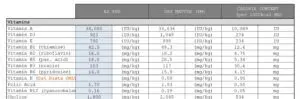
If hypotoxicity of vitamin A is a huge problem in humans that has not even been raised, surely no one cares about pets!
The Sins of Dog Food
Dog foods tend to be marginalized, ignored and filled with low quality, inferior ingredients resulting in a diet that is not evolutionarily consistent. Not to mention all the synthetic vitamins for the “health” of the dog.
Foods extremely high in vitamin A have now become mainstays in dog food, namely liver, sweet potato, pumpkin and carrots.
Amount of vitamin A in common foods with very high vitamin A content (often found in dog food):
- Beef liver, 1 oz: 5,099 IU*
- Sweet potato, ½ cup chopped: 10,692 IU*
- Carrots, ½ cup diced: 9,434 IU*
*note 2,333-3,000 IU is the RDA for adult males and females as there is no official RDA for dogs
Now let’s look at some popular high-quality dog foods:
- Acana Whole Grain Dog Food —Beef, porkbeef meal, oatmeal, whole sorghum, whole millet, pork meal, whole oats, beef fat, lamb, fish oil, ground miscanthus grass, natural pork flavor, beef liver, pork liver, pork kidneytripe, beef kidneyPotassium chloride, whole zucchini, whole pumpkinSalt, Taurine, Choline Chloride, Vitamin E Supplement, Dried Algae, Protein Zinc, Mixed Tocopherols (Preservative), Vitamin D3 Supplement, vitamin A acetateNiacin, Thiamin Mononitrate, Riboflavin, Calcium Pantothenate, Pyridoxine Hydrochloride, Folic Acid, Vitamin B12 Supplement, Dried Chicory Root, Turmeric, Sarsaparilla Root, Alder Root, Roses, Juniper Berries, Citric Acid (Preservative Bacterial Extract), Acidophilus Ferment, Dry Bifidobacterium animalis fermentation product, Lactobacillus casei dry fermentation product.
- ACANA Wholesome Grains, Red Meat Recipe has a vitamin A content of 34,000 IU/kg as fed
- Ollie Dog Food — Beef, carrots, beef kidneys, potatoes, peas, sweet potatoes, beef livers, Chickpeas, Spinach, Calcium Phosphate, Salmon Oil, Salt, Taurine, Zinc Gluconate, Vitamin E Supplement, Ferrous Sulfate, Copper Amino Acid Chelate, Manganese Amino Acid Chelate, Cholecalciferol Supplement (Vitamin D3), Riboflavin (Vitamin B2), Vitamin B1), Hydrochloride pyridoxine (vitamin B6), potassium iodide.
- Ollie has not responded to my request 2 weeks ago for vitamin A levels.
- Maev Dog Food (this one had so much liver in it my dog wouldn’t even touch it) – USDA Beef, USDA Beef Liver, USDA Sweet Bread, Potato (Blanched), Green Beans, Zucchini, Peanut Butter, Cabbage, Blueberries, Fish Oil, Flaxseed, Mineral Blend.
- When I asked Maev for the vitamin A content per serving, they answered “Thanks for getting in touch again. We cannot share specific percentages as it is proprietary information. I have attached our full nutrition panel for your review.”
So not only are dog foods loaded with foods that are very high in vitamin A, but some companies won’t even tell you how much vitamin A is in them. It is “proprietary information”.
Exacerbating the problem, most owners serve dog treats with or containing cheese further stacking up the vitamin A intake.
It is very possible that the dogs liver is overloaded with too much nutritional value from vitamin A which probably shortens their life span. Take a look at Bobby, the world’s oldest dog who lived to be 31 and ate what his people ate.
What to do
If you’re reading this and following my logic, there are a few simple next steps.
- Research the matter yourself. Don’t automatically agree with a well-meaning dog-loving nutritionist on the internet, but dive in for yourself and draw your own conclusions. Consider researching vitamin A toxicity in humans first and find out if you are overdosing on vitamin A in your own diet (there is a test for this). It is much easier to understand the problem with dogs if you first “understand” how it happens in humans.
- Contact your dog food company and find out how much vitamin A you are really giving your dog. It can be hard to get an answer, which is extremely discouraging, but be persistent!
- If you are not happy with your dog’s health with your current food, mix it up and consider reducing your current kibble by filling it with a high quality human grade food that is low in plant toxins and vitamin A (I personally do this by feeding my dog about ¾-1 kg of ground beef a day and some grain, usually oats or rice to reduce the amount of standard dog food I feed). You can also contact different dog food companies and see if you can find one that is on the lower end of the spectrum for vitamin A. (<---- if you do this, please report and I will add the levels of more of dog food in the article)
- If you disagree – start a discussion in the comments, but include your science and data!
I hope this helps give you some ideas on how to improve the health of yourself and your pet!
Recommended resources
PIN IT:


Bibliographical references:
