



From tickling monkeys to laughing children, a new study traces how the rhythm of laughter can reveal the deep evolutionary roots of human speech.
Study: Rhythm and timing in laughter reveal that human vocal plasticity falls on an anthropoid continuum. Image credit: Andrea Izzotti / Shutterstock
In a recent study published in the journal Communications Biology, researchers conducted a comparative analysis of laughter in representatives of all great living great ape lineages, including humans.
Because sounds do not fossilize, tracing the phonetic origins of language, speech, and song remains difficult. While the major branches of the Hominoid family have distinct call repertoires, one vocalization, laughter, has been conserved across species. Given the inherently cyclic and repetitive nature of laughter in humans and great apes, variations in its temporal organization and structure may provide a means to study evolutionary changes in vocal-respiratory coordination among hominids.
About the study
In the present study, the researchers compared laughter with orangutans, gorillas, bonobos, chimpanzees and humans. First, recordings of laughter bursts were collected from four nonhuman primate species and humans. Nonhuman primates included two gorillas, four orangutans, four chimpanzees and three bonobos. Human participants were four children, aged 6 months to 7 years, who were recorded during natural, playful interactions with their mothers. Because the dataset included few individuals per taxon, the findings are stronger as phylogenetic and behavioral patterns than as definitive species-level estimates.
Recordings of nonhuman primates, collected between 2004 and 2006 and mostly in ex situ settings, were obtained during controlled interactions with familiar humans, which elicited both play and tickle-induced vocalizations. Recordings were resampled at 22 kHz and a high-pass filter was applied to reduce electrical noise interference. Recordings with a signal-to-noise difference of less than two decibels were excluded. The duration and starting point of each call were annotated.
A call was a continuous sound element without an audio gap. Consecutive calls with an interval of less than eight milliseconds or the same audio function belonged to the same match. Two races with breaks of less than a second belonged to the same series. This study selected bouts with at least three calls, yielding 140 bouts, including 42 from bonobos, 34 from gorillas, 35 from chimpanzees, 16 from orangutans, and 13 from humans.
The duration of the intervals between the initiation times of the calls in the same match was calculated, with these intervals serving as a proxy for the laughing time. Linear mixed-effects models then assessed the rate of variation with phylogenetic distance. The researchers also calculated rhythm ratios, which compare successive time intervals, to assess the rhythmic structure of laughter. Generalized linear mixed models were used to analyze these proportions and test whether laughter was isochronous or variable.
Findings
The researchers found that laughter in the great apes sampled, including humans, showed isochrony, meaning it followed a regular timing between vocal bursts. Furthermore, the authors interpreted this pattern as suggesting that the isochronous laughter structure may have existed or developed before, in the last common ancestor of the great apes, about 15 million years ago. Notably, isochrony depended on the behavioral context of laughter: play laughter deviated significantly from normality, while tickle laughter exhibited high regularity.
Moreover, the rate of laughter is inferred to accelerate along the hominin phylogenetic sequence. Tickle laughter captured this acceleration better than toy laughter. Notably, only humans showed context-dependent pacing, eliciting faster laughter in response to tickling than to play. Nonhuman great apes did not show this context-sensitive shift.
Additionally, there was a gradual shift toward greater variability in laughter timing, with humans showing the highest variability. There was a decrease in this variability with increasing phylogenetic distance from humans, highlighting a gradual evolutionary trend in vocal flexibility in Hominids. However, the authors noted that the number of individuals per species was limited, meaning that larger samples will be needed to improve estimates of species-level variability.
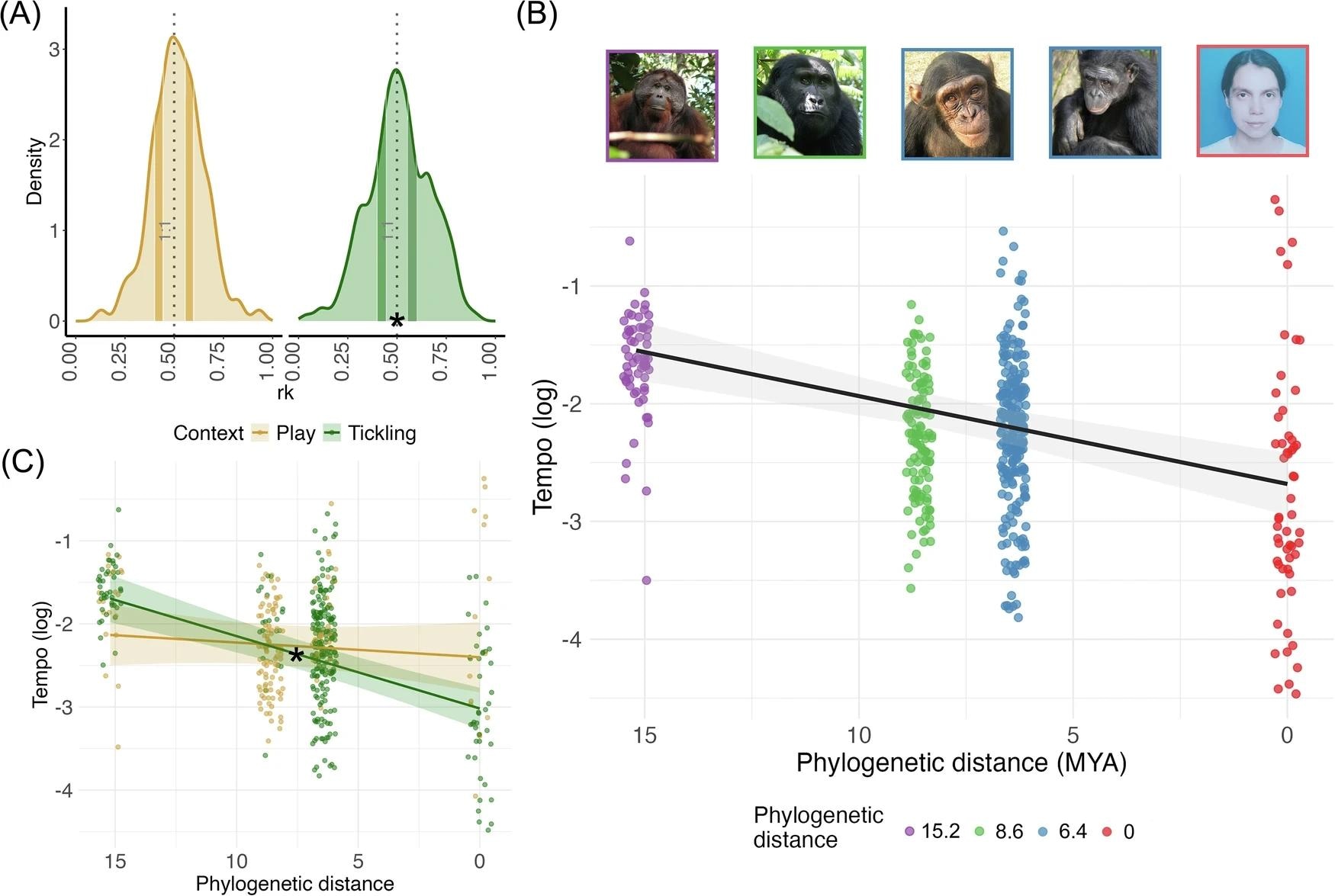
A Probability density function of rate ratios (rMr) in the two behavioral contexts (play, in yellow and tickling in green) derived from 140 laughter bouts in 17 subjects. White lines indicate integer (0.440 < rMr< 0.555, lighter shade) and out of integer (0.400
conclusions
Taken together, the results provide evidence for a shift toward more variable, context-sensitive, and faster rates in humans, which may reflect evolutionary changes in vocal control abilities associated with the later emergence of language and speech. By illustrating both derived and conserved rhythmic features of laughter, the findings map an evolutionary path toward greater vocal flexibility in a behavior that has been conserved for millions of years.
