


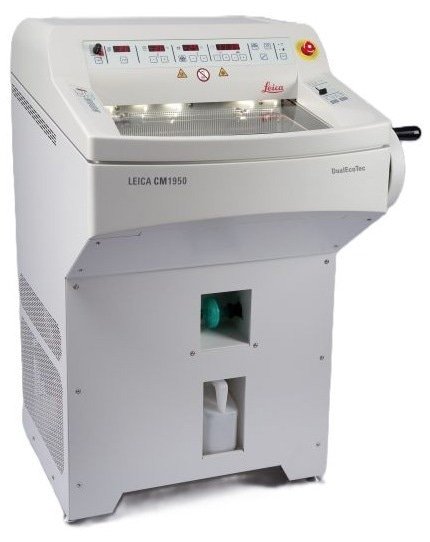
Leica Biosystems, a Danaher company and global leader in anatomic pathology solutions, is redefining histology workflows with the global launch of the Leica CM1950 Cryostat with DualEcoTec cooling system. This next-generation solution offers superior performance, sustainability and improved technician comfort – setting a new standard for cryostat technology.
With up to 3x faster sample cooling and up to 2x faster chamber cooling, the system significantly reduces setup time and case life while ensuring reliable cutting, even during extended cutting sessions. The system accelerates workflows by providing rapid cooling for complex samples and ultra-low temperatures down to -50 °C for critical samples in surgical settings.
As the first cryostat in its class to use a next-generation refrigerant with near-zero global warming potential, the Leica CM1950 cryostat with DualEcoTec cooling system is at the forefront of sustainability-focused innovation. With up to 50% lower energy consumption compared to previous models, laboratories benefit from operational cost savings and reduced environmental impact – reinforcing Leica Biosystems’ commitment to sustainable solutions without compromising precision or performance.
Laboratory needs continue to evolve and we are committed to listening to our customers and delivering innovations that truly advance the field,
This breakthrough significantly reduces wait times by ensuring consistent temperature control and reliable, high-quality parts – even during extended cutting sessions. The result is faster turnaround, greater confidence in results and more efficient workflows. Beyond performance, it lowers total cost of ownership, helping labs operate more sustainably without compromising standards of care. We are proud to lead the advancement of technologies that empower histology professionals and improve patient outcomes.”
Naveen Chandra, Vice President and General Manager of Digital Pathology & Innovation, Leica Biosystems
The Leica CM1950 Cryostat with DualEcoTec Cooling System, for in vitro diagnostic use, prioritizes the well-being of technicians by reducing heat emission by 33% and noise levels by 50% to create a cooler, quieter and more comfortable working environment. Combined with ergonomic design improvements that support long sectioning sessions, these enhancements help reduce fatigue, improve focus, and support technician comfort—ultimately contributing to both productivity and consistent diagnostic results in busy histology labs.
