

Close Menu
Healthtost
  • News
  • Mental Health
  • Men’s Health
  • Women’s Health
  • Skin Care
  • Sexual Health
  • Pregnancy
  • Nutrition
  • Fitness
  • Recommended Essentials
What's Hot

What is your skin’s pH and why is it important?

March 3, 2026

Kegels Wrong? The top mistakes pregnant women make

March 3, 2026

How to support your hormones, gut health and metabolism the right way

March 3, 2026
Facebook X (Twitter) Instagram
  • About Us
  • Contact Us
  • Privacy Policy
  • Terms and Conditions
  • Disclaimer
Facebook X (Twitter) Instagram
Healthtost
SUBSCRIBE
  • News

    Penn State study links family structure to lower ADHD symptoms

    March 3, 2026

    Scientists have proposed a new theory of brain development

    March 2, 2026

    Prediction of disease intensity through genomic risk

    March 2, 2026

    Continued NIH investment fuels TMJ pain research

    March 1, 2026

    NIH Grants Evaluation of Expanded Medicare Advantage Benefits

    March 1, 2026
  • Mental Health

    Is It Sadness or Depression? Understand it…

    March 1, 2026

    Teen anxiety linked to sugary drinks – new research

    February 28, 2026

    Self-Care Guided Journal For Moms

    February 26, 2026

    Forgiveness isn’t always easy, but studies show it can help you flourish

    February 24, 2026

    50 Inspirational Ways to Navigate Your Life by Susie Hall

    February 22, 2026
  • Men’s Health

    How to find the right deodorant for smelly armpits

    March 3, 2026

    The Case for Weightlifting Shoes

    March 2, 2026

    The Secret to Saving Humanity: What We Must Do Now

    March 2, 2026

    40 Minute Lower Body Workout: A leg muscle building session

    February 26, 2026

    Colonoscopy and FIT at age 60 catch colon cancer earlier

    February 24, 2026
  • Women’s Health

    How to protect face from Holi colors safely

    March 3, 2026

    Jocelyn Elders: A Legacy Better Than the Title

    March 1, 2026

    10 Ways to Calm Your Cortisol and Get Your Energy Back as a Busy Woman

    February 27, 2026

    Is trauma therapy right for you? Signs that you may benefit from specialized care

    February 27, 2026

    The connection between mental health and heart health

    February 25, 2026
  • Skin Care

    What is your skin’s pH and why is it important?

    March 3, 2026

    6 Marketing Myths About Caffeine’s Skin Benefits

    March 3, 2026

    Polydioxanone (PDO) Histological Analysis Threads: Differentiating neocollagenesis from the fibrous foreign body response

    February 28, 2026

    The Pharmacist’s Guide to Reversing Cellular

    February 26, 2026

    Sudoku skin care device ⭐️

    February 26, 2026
  • Sexual Health

    The discussion of the Epstein files is mistaken for pedophilia and power

    March 2, 2026

    Survival strategies and health effects in forced displacement

    March 1, 2026

    How Intense Competition and Intimacy Tuning Are Elevating Modern TV Romance — Alliance for Sexual Health

    February 28, 2026

    New type of Mpox diagnosed in England

    February 25, 2026

    Jesse Jackson opened the doors for black women in politics

    February 22, 2026
  • Pregnancy

    Kegels Wrong? The top mistakes pregnant women make

    March 3, 2026

    Endy Mattress Review: An Honest Look After 4 Months

    March 1, 2026

    Does bed rest prevent premature labor? New research says no

    March 1, 2026

    Is cervical cancer curable if caught early? Know the Facts

    February 27, 2026

    Management of abdominal problems during pregnancy

    February 26, 2026
  • Nutrition

    How to support your hormones, gut health and metabolism the right way

    March 3, 2026

    How the microbiome drives symptoms

    March 2, 2026

    Because cutting back on sugar actually makes you crave it more

    March 1, 2026

    5-ingredient skillet dinner recipe

    February 26, 2026

    Slow Cooker Gochujang Chicken Sandwich (Mild and Family Friendly)

    February 26, 2026
  • Fitness

    200: Autoimmune Healing, Nervous System Safety, and the Biggest Mistakes I Made on My Health Journey

    March 1, 2026

    10 Powerful Emotional Benefits of Weight Training

    February 28, 2026

    7 simple strength exercises that protect your back and improve balance after 40

    February 28, 2026

    Inside the OPEX Method Week 5: Anaerobic training, “pain” and when it really makes sense

    February 26, 2026

    Exercise, prevention and modern therapy for healthy circulation

    February 26, 2026
  • Recommended Essentials
Healthtost
Home»Mental Health»Do you have a mental illness? Because some people answer “yes”, even if they have not been diagnosed
Mental Health

Do you have a mental illness? Because some people answer “yes”, even if they have not been diagnosed

healthtostBy healthtostJune 20, 2024No Comments5 Mins Read
Facebook Twitter Pinterest LinkedIn Tumblr Reddit WhatsApp Email
Do You Have A Mental Illness? Because Some People Answer
Share
Facebook Twitter LinkedIn Pinterest WhatsApp Email

Mental illnesses such as depression and anxiety disorders have become more prevalent, especially among young people. The demand for treatment is increasing and the prescriptions of some psychiatric drugs they have climbed.

These upward trends in prevalence parallel increasing public attention to mental illness. Mental health messages permeate traditional and social media. Organizations and governments are developing awareness, prevention and treatment initiatives with increasing urgency.

The growing cultural focus on mental health has obvious benefits. It raises awareness, reduces stigma and promotes help-seeking.

However, it can also come at a cost. Critics are worried social media locations incubate mental illness and that ordinary unhappiness is pathologized by the overuse of diagnostic concepts and “treatment talk“.

British psychologist Lucy Fulks argues that trends for increasing attention and prevalence are linked. her”Prevalence of inflation hypothesis” suggests that increasing awareness of mental illness may lead some people to be misdiagnosed when they experience relatively mild or transient problems.

Foulkes’ hypothesis implies that some people develop overly broad concepts of mental illness. Our research supports this view. In a new study, we show that concepts of mental illness have broadened in recent years – a phenomenon we call “Creep concept” – that too people differ in the range of their concepts of mental illness.

Why do people self-diagnose mental illnesses?

In our news studywe examined whether people with broad concepts of mental illness are, in fact, more likely to self-diagnose.

We defined self-diagnosis as a person’s belief that they have an illness, whether or not they have received the diagnosis from a professional. We assessed people as having a “broad concept of mental illness” if they judged a wide variety of experiences and behaviors to be disorders, including relatively mild conditions.

We asked a nationally representative sample of 474 US adults whether they believed they had a mental disorder and whether they had received a diagnosis from a health care professional. We also asked about other possible contributing factors and demographics.

Mental illness was common in our sample: 42% reported having a current self-diagnosed condition, the majority of whom had received it from a health professional.

Individuals with greater mental health literacy and less stigmatizing attitudes were more likely to report a diagnosis.
Mental Health America/Pexels

As expected, the strongest predictor of reporting a diagnosis was experiencing relatively severe distress.

The second most important factor after distress was the broad concept of mental illness. When their levels of distress were the same, people with broad concepts were significantly more likely to report a current diagnosis.

The graph below illustrates this result. It divides the sample by levels of distress and shows the percentage of people at each level who report a current diagnosis. People with broad concepts of mental illness (the highest quarter of the sample) are represented by the dark blue line. Individuals with narrow concepts of mental illness (the lowest quarter of the sample) are represented by the light blue line. People with broad concepts were significantly more likely to report having a mental illness, especially when their distress was relatively high.
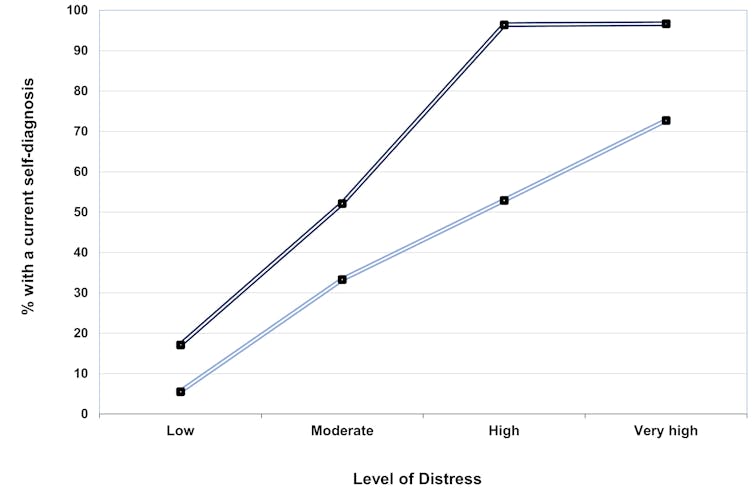
Percentage of participants with broad (dark blue) or narrow (light blue) self-diagnosed mental illness concepts at different levels of distress.
Provided by the authors

Individuals with greater mental health literacy and less stigmatizing attitudes were also more likely to report a diagnosis.

Two interesting further findings emerged from our study. People who self-diagnosed but had not received a professional diagnosis tended to have broader concepts of illness than those who had.

In addition, younger and politically progressive people were more likely to report a diagnosis, according to some previous research, and had broader concepts of mental illness. Their tendency to retain these more expansive concepts partly explained their higher diagnosis rates.

Why does it matter?

Our findings support the idea that extended concepts of mental illness promote self-diagnosis and may thus increase the apparent prevalence of mental illness. People who have a lower threshold for defining distress as a disorder are more likely to self-identify as suffering from a mental illness.

Our findings do not directly indicate that people with broad concepts are overdiagnosing or those with narrow concepts are underdiagnosing. Nor do they prove that they have broad meanings causes self-diagnosis or results in real increases mental illness. However, the findings raise significant concerns.

First, they suggest that increasing mental health awareness can they have costs. As well as enhancing mental health literacy, it can increase the likelihood that people will misidentify their problems as pathologies.

Improper self-diagnosis can have adverse effects. Diagnostic labels can be self-defining and self-limiting, as people believe that their problems are permanent; difficult to control aspects of who they are.

The woman is crying
Some people may misidentify their problems as mental illness.
Karolina Grabowska/Pexels

Second, unwarranted self-diagnosis can lead people experiencing relatively mild levels of distress to seek help that is unnecessary, inappropriate, and ineffective. Recently Australian research found that people with relatively mild distress who received psychotherapy worsened more often than improved.

Third, these effects can be particularly problematic for young people. They are more likely to have broad definitions of mental illness, in part because social media consumption, and face mental health problems at relatively high and increasing rates. Whether extended concepts of illness play a role in youth mental health crisis remains to be seen.

Ongoing cultural changes encourage ever more expansive definitions of mental illness. These changes are likely to have mixed blessings. By normalizing mental illness they can help de-stigmatize it. However, by pathologizing certain forms of everyday discomfort, they may have an unintended disadvantage.

As we grapple with the mental health crisis, it’s important to find ways to raise awareness of mental illness without inadvertently inflating it.

Answer diagnosed illness mental People
bhanuprakash.cg
healthtost
  • Website

Related Posts

Is It Sadness or Depression? Understand it…

March 1, 2026

Teen anxiety linked to sugary drinks – new research

February 28, 2026

Self-Care Guided Journal For Moms

February 26, 2026

Leave A Reply Cancel Reply

Don't Miss
Skin Care

What is your skin’s pH and why is it important?

By healthtostMarch 3, 20260

Reading: 4 minutes You may have seen it printed on a bottle of cleaner. You…

Kegels Wrong? The top mistakes pregnant women make

March 3, 2026

How to support your hormones, gut health and metabolism the right way

March 3, 2026

Penn State study links family structure to lower ADHD symptoms

March 3, 2026
Stay In Touch
  • Facebook
  • Twitter
  • Pinterest
  • Instagram
  • YouTube
  • Vimeo
TAGS
Baby benefits body brain cancer care Day Diet disease exercise finds Fitness food Guide health healthy heart Improve Life Loss Men mental Natural Nutrition Patients People Pregnancy protein research reveals risk routine sex sexual Skin study Therapy Tips Top Training Treatment ways weight women Workout
About Us
About Us

Welcome to HealthTost, your trusted source for breaking health news, expert insights, and wellness inspiration. At HealthTost, we are committed to delivering accurate, timely, and empowering information to help you make informed decisions about your health and well-being.

Latest Articles

What is your skin’s pH and why is it important?

March 3, 2026

Kegels Wrong? The top mistakes pregnant women make

March 3, 2026

How to support your hormones, gut health and metabolism the right way

March 3, 2026
New Comments
    Facebook X (Twitter) Instagram Pinterest
    • About Us
    • Contact Us
    • Privacy Policy
    • Terms and Conditions
    • Disclaimer
    © 2026 HealthTost. All Rights Reserved.

    Type above and press Enter to search. Press Esc to cancel.