



Plantar fasciitis can be a particularly dangerous injury. Anti-inflammatories don’t do much. ice doesn’t help. And if you let it linger, you could be waiting over a year to find relief from chronic pain — and not just in your leg. “If you let it [plantar fasciitis] go for too long, it can lead to other problems, such as knee pain or hip pain,” says the physiotherapist Jacob VanDenMeerendonk, DPT.
The good news: Catch a flare-up early and start doing some plantar fasciitis exercises as soon as possible, and you may start feeling better in a few days. “It’s very effective to go see a physical therapist and treat it,” says Dr. VanDenMeerendonk. The key is to treat whatever is causing your plantar fasciitis and get the strength and mobility you need right away so other parts of the body don’t start compensating for the pain.
If you’re ready to get rid of your heel pain, read on to learn more about what plantar fasciitis is—including how to tell if you have it—and learn some plantar fasciitis exercises you can do at home to help your foot you heal quickly.
Why does plantar fasciitis happen?
We get plantar fasciitis when the bottom of our foot is too weak to handle the stress we put on it and the tissue becomes irritated. “It’s actually not an inflammatory condition. it’s more of a hypersensitivity state,” explains Dr. VanDenMeerendonk.
There are two main groups of people who usually end up with plantar fasciitis: Athletes (especially runners) who increase their workouts too quickly, and people who are not very active and whose feet can’t handle the stress of their body weight when just walking or standing —especially if they’re wearing shoes that aren’t ideal.
Unfortunately, this injury is quite common. Daniel Supple, DPT, CSCS, a physical therapist at the Hospital for Special Surgery in New York, says that approx 10 percent of all people1 they will get plantar fasciitis at some point in their lives. The ones he sees most often for this are women between the ages of 40 and 60.
How to tell if you have plantar fasciitis
Just because the bottom of your foot hurts doesn’t necessarily mean you have plantar fasciitis. True plantar fasciitis will present as pain on the bottom of the foot toward the inside of the heel, especially during the first few steps in the morning or if you press on that area with your toes, says Dr. Supple.
You can also check for plantar fasciitis by bending your foot and stretching your big toe back toward your shin. “If you have pain in the middle of the foot or in that area of the heel, that’s a positive test,” says Dr. Shaple. Of course, it’s best to see a doctor for an actual diagnosis, but these signs can point you in the right direction.
Plantar fasciitis exercises and stretches
If you have been diagnosed with plantar fasciitis, there are two types of exercises that a physical therapist may prescribe. “We can do things that do touch better and then things that do actually better,” says Dr. VanDenMeerendonk.
Fortunately, you can do both types of exercises for plantar fasciitis every day, Dr. Shaple says. “They’re not too aggressive or too strenuous,” he says.
1. For pain relief: Foot arch massage
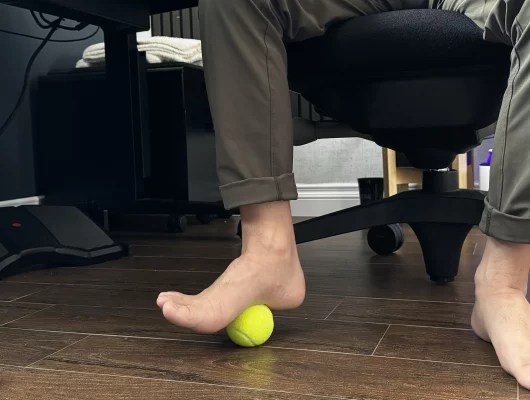
Just like you can lather up stiff muscles, stretching the bottom of your legs can provide immediate relief, says Dr. VanDenMeerendonk.
- Either sitting or standing, place your foot on top of a small ball such as a lacrosse or tennis ball, or even an ice-cold water bottle.
- Roll back and forth from the heel to the ball of your foot, applying enough pressure to massage the tissue.
2. For pain relief: Plantar aponeurosis stretching
Stretching the fascia can help calm tissue hypersensitivity.
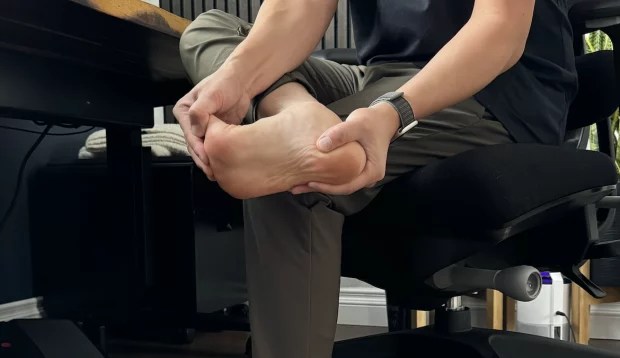
- Sit in a chair with one ankle placed on the opposite knee in a figure-four position.
- Use your hands to stretch the toes—either the big toe or all five toes, whichever feels best—back toward the shin until you feel a stretch in the bottom of your foot.
- Hold for about 10 seconds and aim for 10 reps.
3. To prevent and relieve pain: Stretch the calf against the wall
Stretching your calf can help keep plantar fasciitis at bay. “If the calf muscle is too tight, this can lead to plantar fasciitis,” says Dr. VanDenMeerendonk. It is also helpful in reducing your discomfort. “There is some evidence that the calf stretch can calm down [pain] receptors in that area and make the body a little less irritated,” says Dr. Shaple. This movement stretches both the calf and the plantar fascia.
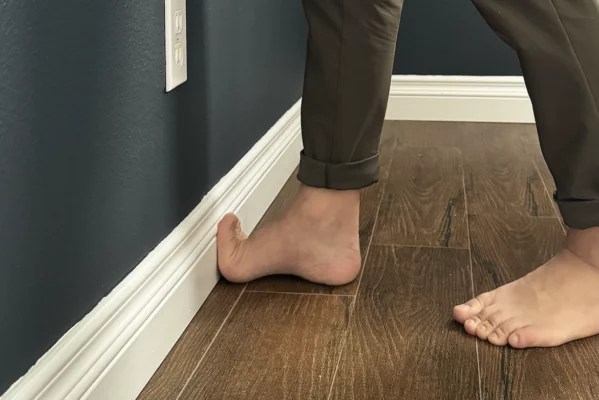
- Place one bare foot up against a wall with the toes extending up the wall.
- Lean your hips forward against the wall to simultaneously stretch your calf muscle and plantar fascia.
- Hold for 10 seconds and then release. Repeat a total of 10 times.
4. For stronger plantar denervation: Calf raises on a towel
Doing these calf raises can strengthen your lower legs.
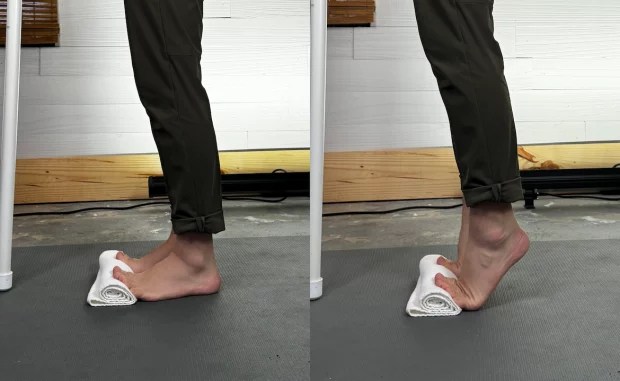
- Standing with both feet parallel and your knees straight, place a rolled-up towel under your toes.
- Lift your heels, then lower slowly.
- Aim for 12 to 20 repetitions and do two or three sets.
Once this is comfortable, you can also try lifting one leg at a time to do single-leg calf raises (holding onto something stable, like a bench, for balance).
5. For stronger plantar denervation: Barefoot balance exercises
Doing balancing exercises without shoes requires the foot to manipulate the ground to keep you upright, reinforcing plantar aponeurosis, says Dr. VanDenMeerendonk.
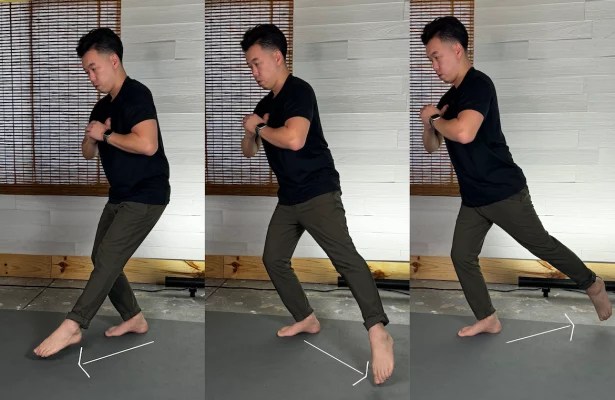
- Start by balancing on one foot without shoes or socks, seeing how long you can hold the position without falling.
- If you want more of a challenge, try turning your head left and right or closing your eyes while balancing.
- Then proceed to the three-point star: Swing the leg you’re not standing on forward, then to the side, then back, keeping your balance.
6. For stronger intrinsic leg muscles: Toe Yoga
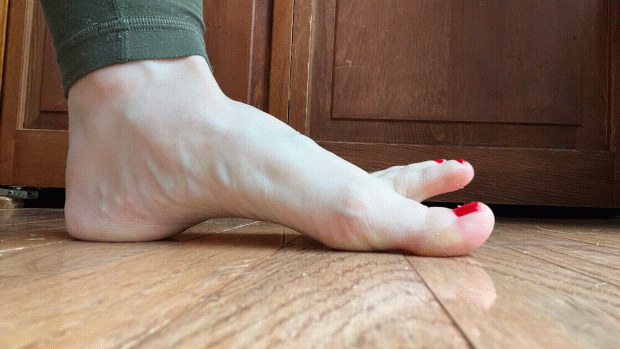
Developing motor control of the intrinsic leg muscles can go a long way in keeping them healthy. This exercise can help keep plantar fasciitis from coming back. “A lot of people haven’t [the] ability to move individual toes,” says Dr. Shaple. Finger yoga challenges this coordination and strength.
- Start with your feet flat on the floor, either sitting or standing.
- On the injured foot, keeping your four smallest toes on the ground, lift only the big toe. Then place it back down and repeat 10 to 20 times.
- Keeping your big toe on the ground, lift only the little toes, then place them back down, 10 to 20 times.
- Then lift all your toes, spreading them wide, and place them down one after the other, in a wave-like pattern. Try going in both directions 10 to 20 times.
7. For a stronger arch: Doming
This move builds the muscles in your arch.
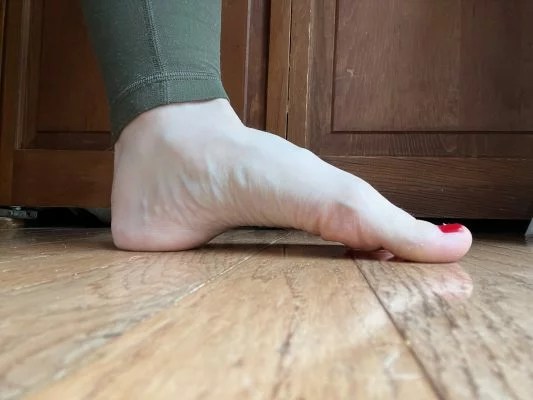
- Start with your feet flat on the floor, either sitting or standing.
- Press the ball of your injured foot toward your heel to pop your arch, keeping your toes apart.
- Hold for a few seconds.
- Relax to straighten your leg again.
- Repeat 3 or 4 times.
Other steps you need to take
Controlling the pain by doing these plantar fasciitis exercises is just the first step. you also want to make sure it doesn’t flare up again.
If you’re a runner, “after you reduce that pain, you want to make sure you’re getting a good evaluation of how you’re running,” says Dr. Spl. Most physical therapists or running coaches are able to monitor your gait and make suggestions on how to improve your biomechanics.
Whether you’re walking or running, you also want to make sure your shoes have the proper cushioning and support to keep your feet healthy. Dr. VanDenMeerendonk also has some runners use dropless barefoot shoes strategically to strengthen their feet. “They don’t use these shoes to run their marathons, they use it as a training mechanism [on] light jogging to strengthen their legs,” he says.
And don’t forget to take care of the rest of your body. Dr. Supple says there’s evidence to suggest that stronger glutes in particular can reduce your risk of developing plantar fasciitis by improving your walking pattern. So continue those squats, deadlifts and glute bridges to strengthen your back along with these plantar fasciitis exercises to maintain your foot strength and mobility.
How quickly you can expect results
These plantar fasciitis exercises should start to help the pain within a few weeks at least. If you feel no improvement by then, seek out an orthopedic clinical specialist or sports clinical specialist experienced in treating plantar fasciitis.
“You can do these stretches and things at home, but it will start to improve within a few days. And if it’s not, go see a PT,” says Dr. VanDenMeerendonk. “Interact now before it turns into something else.”
Well+Good articles refer to scientific, credible, recent, robust studies to support the information we share. You can trust us on your wellness journey.
Buchanan BK, Sina RE, Kushner D. Plantar Fasciitis. [Updated 2024 Jan 7]. In: StatPearls [Internet]. Treasure Island (FL): StatPearls Publishing; 2024 Jan-. Available from:
