


Last updated on July 23, 2026 at 8:35 pm
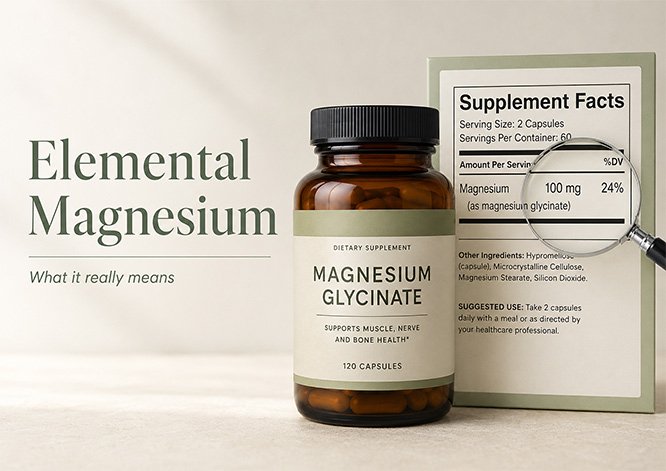
When I started buying magnesium supplements, I realized how confusing labels can be. One number appeared on the front, another on the back, and most of the time you needed several capsules to get the advertised amount.
That’s when I learned how important elemental magnesium is. So what does it actually mean, how do you find it on the label, and why does it matter?
What does elemental magnesium actually mean?
Magnesium in a supplement usually doesn’t come on its own. It binds to another substance, such as glycine to magnesium glycinate or citric acid to magnesium citrate.
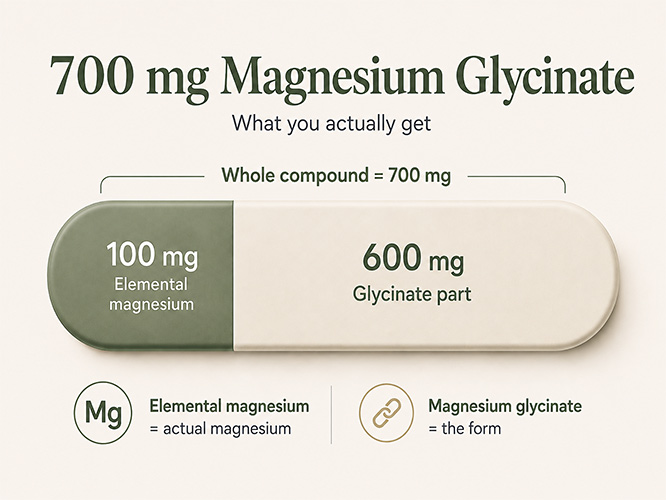
This means that the total weight of the magnesium compound is not the same as the amount of actual magnesium it contains. The actual magnesium within the compound is known as elemental magnesium.
A simple example of using magnesium glycinate
About 700 mg of magnesium glycinate can provide about 100 mg of elemental magnesium. The remaining compound is the glycinate moiety attached to it.
So magnesium glycinate tells you which form you’re taking, while 100mg tells you how much actual magnesium it provides.
Does elemental magnesium have its own benefits?
No, it has no particular advantages. It has the same benefits that magnesium is known for, such as supporting healthy bones, energy production, and the normal functioning of your muscles and nerves.
If you are deficient, getting enough magnesium can also help improve symptoms such as fatigue, weakness and muscle cramps.
But remember, the effect of a supplement still depends on the dose, the form, how well you absorb it, and whether you need extra magnesium.
How to find elemental magnesium on the label
Unfortunately, magnesium labels are not all written the same. Some clearly say “elemental magnesium,” while others simply say “magnesium.” The form can appear next to it, elsewhere on the label, or in the ingredients list.
For example, you might see:
Magnesium: 100 mg
From magnesium glycinate
OR:
Magnesium: 100 mg
As magnesium glycinate
In both cases, 100 mg is the elemental amount of magnesium. In a Supplement Facts context, the magnesium number refers to elemental magnesium, not the weight of the entire magnesium compound.
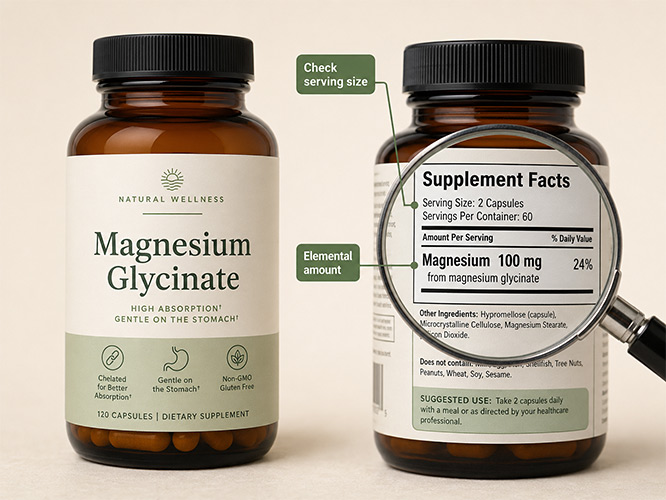
Always check the portion size as well. This 100 mg can come from one capsule, but it can also be the amount provided by two, three or even four capsules.
I would be wary if you can’t find the magnesium form anywhere on the packaging or product page. A label that simply says “magnesium” doesn’t give you enough information to properly compare the supplement.
How much elemental magnesium exists in different forms?
Different forms of magnesium contain different percentages of elemental magnesium because the substances that bind to magnesium have different weights.
For example, oxygen is very light, so magnesium makes up a large part of magnesium oxide. Glycine, citrate, and malate are heavier, so magnesium makes up a smaller portion of these compounds.
Related: Comparison of magnesium oxide versus glycinate
This becomes easier to understand when you compare the same amount of each form. In 100 mg of magnesium oxide, about 60 mg is elemental magnesium. In 100 mg of magnesium glycinate, only about 14 mg is elemental magnesium.
Elemental magnesium by form
| Form of magnesium | Approximate elemental magnesium | What does this mean |
|---|---|---|
| Magnesium glycinate | About 12% to 14% | About 12 to 14 mg in every 100 mg of the compound |
| Magnesium citrate | About 12% to 16% | The percentage depends on the specific version of magnesium citrate |
| Magnesium oxide | about 60% | About 60 mg in every 100 mg of the compound |
| Magnesium malate | About 15% (some dimagnesium malate ingredients provide more) | The percentage depends on whether it is magnesium malate or dimagnesium malate |
Why are these numbers only approximate?
Magnesium glycinate, citrate and malate may come in slightly different chemical versions. Some also contain water molecules as part of their structure. This adds to the overall weight of the compound without adding more magnesium, so the percentage of elemental magnesium becomes lower.
Why can two supplements using the same form provide different amounts?
You may find two magnesium glycinate supplements that provide very different amounts of elemental magnesium. One brand may simply use more magnesium glycinate than another.
The serving size may also be different. One product may provide its stated amount in one capsule, while another may require three or four.
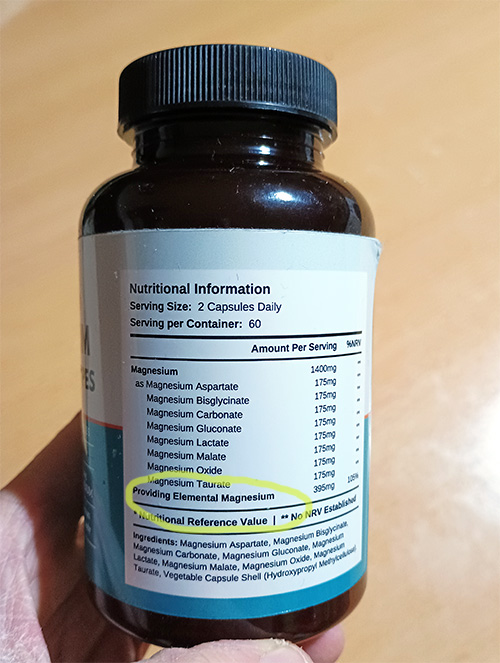
Some products also contain a mixture of magnesium forms. For example, a supplement sold as magnesium glycinate may also contain magnesium oxide, which can increase the amount of elemental magnesium it provides.
This is why you cannot judge the amount of magnesium by the form alone. You still need to check the elemental magnesium listed on the label.
A higher elemental percentage does not automatically mean that a form is better or that your body will absorb more of it. Next we will look at absorption.
Does more elemental magnesium mean your body absorbs more?
No. A higher elemental amount means the supplement contains more magnesium, but it doesn’t tell you how much of it your body will absorb.
Form matters
In order for magnesium to be absorbed, it must be dissolved in your digestive system. Forms that dissolve more easily tend to be absorbed better than forms that do not dissolve as well.
Magnesium oxide is a good example. It contains a high percentage of elemental magnesium, but is not highly soluble. Studies have found that magnesium citrate is more easily absorbed than magnesium oxide, even though citrate contains a much lower percentage of elemental magnesium.
This means that a supplement with a higher elemental magnesium number is not always the one that gives your body the most usable magnesium.
Your digestion is also important
The amount you take and how well you tolerate it can also make a difference. When some magnesium remains unabsorbed in your gut, it draws in water and can cause loose stools or diarrhea.
Certain digestive conditions can also reduce magnesium absorption. Age may also play a role, as absorption from the gut can decrease as we age.
So when comparing supplements, look at both the elemental amount and form of magnesium rather than choosing the product with the highest number.
How much magnesium do you need each day?
Once you know how much elemental magnesium a supplement provides, the next question is how much magnesium you really need.
Recommended amounts differ slightly between the UK and the US.
UK recommendations
| Adults aged 19 to 64 | Magnesium per day |
|---|---|
| Men | 300 mg |
| Women | 270 mg |
US recommendations
| Adults | Magnesium per day |
|---|---|
| Men aged 19 to 30 | 400 mg |
| Men 31 years and older | 420 mg |
| Women aged 19 to 30 | 310 mg |
| Women 31 and older | 320 mg |
The UK and US use different methods to set their recommendations, so the figures are not the same. Magnesium needs may also change during pregnancy and at other stages of life.
Your daily requirement is not your supplement dose
These recommendations refer to your total magnesium intake, including magnesium from food and any supplements you take. They don’t mean you should get the entire amount from a supplement.
Foods like nuts, seeds, beans, whole grains and leafy green vegetables already contribute to your daily intake. A supplement simply adds to the magnesium you get from your diet.
For example, if you get about 220 mg from food and take a supplement that provides 100 mg of elemental magnesium, your total intake would be about 320 mg.
How much elemental magnesium should you be getting?
There is no one-size-fits-all dose. If you just want to supplement the magnesium you get from food, around 100 to 200 mg of elemental magnesium per day may be a reasonable starting range for many adults. This is not a firm recommendation and you may need more, less or no supplement.
The right amount depends on how much magnesium you get from food, why you’re taking it, your age, your health, and how well you tolerate the supplement.
Form is also important. Two supplements may both provide 200 mg of elemental magnesium, but one may be better absorbed or tolerated than the other. This is why you shouldn’t choose a supplement based on elemental content alone.
Higher or more specific doses may be used for diagnosed deficiency, migraine, constipation or other medical reason, but these should be considered separately and advice from a doctor or pharmacist may be required.
How much elemental magnesium is too much?
There is no single maximum dose that is right for everyone, but official guidelines give us useful safety limits for magnesium from supplements.
In the US, the upper limit for adults is 350 mg of elemental magnesium per day from supplements and medications. In the UK, the NHS says this 400 mg or less per day from supplements unlikely to cause harm. These amounts do not include magnesium found naturally in foods.
These figures refer to the actual magnesium shown on the label. For example, if a supplement provides 200 mg of magnesium from magnesium glycinate, that counts as 200 mg toward the limit, not the total weight of the magnesium glycinate compound.
These limits are not recommended doses or an exact point at which magnesium suddenly becomes dangerous. They are general safety guidelines and sometimes higher doses are used for a specific medical reason under professional advice.
Taking more magnesium than your body can tolerate usually causes diarrhea, nausea and stomach cramps. People with kidney problems should be especially careful because their bodies may not effectively remove excess magnesium.
Final takeaway
The main thing I want you to remember is don’t be impressed by the bigger number on the front of the bottle. Turn it over and check how much magnesium the supplement actually provides and how many capsules you need to take to get it.
Once you understand elemental magnesium, labels become much easier to compare and you’re less likely to buy a supplement that isn’t quite what it first appears.
