


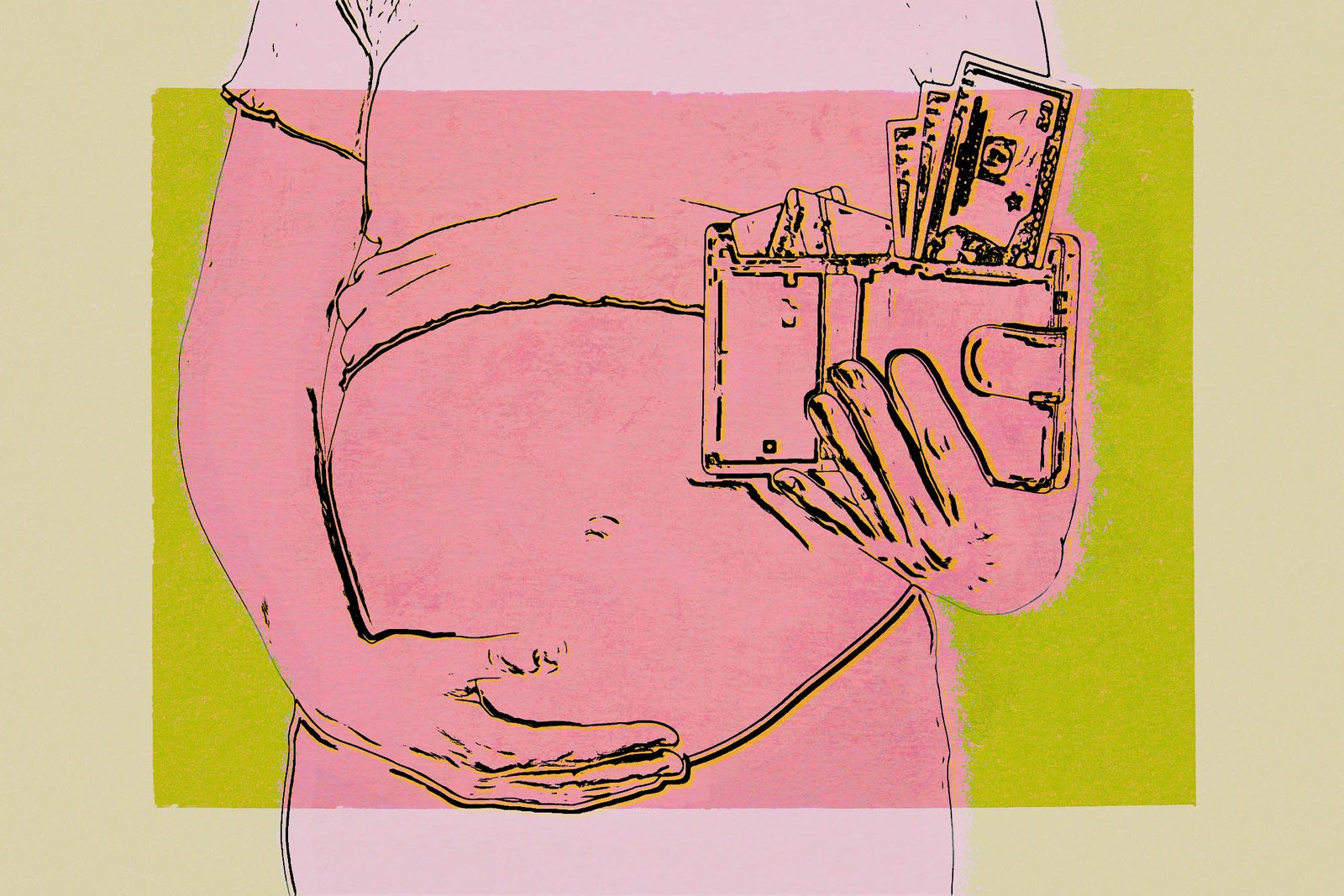
State restrictions and bans on abortion have caused significant damage to the US economy after the Supreme Court overturned Roe v. Wade on June 24, 2022.
A new report from the Institute for Women’s Policy Researcha national think tank focused on economic equality and breaking down barriers for women, estimates that the 16 states with the most restrictive abortion policies are responsible for more than $68 billion in annual lost earnings. In places like Alabama, Louisiana and West Virginia, abortion bans have pushed women out of the workforce, reduced earnings and limited job growth, the report found.
Removing barriers to reproductive health could result in about 325,000 more women aged 15-44 joining the workforce each year, the report shows. This could boost the entire country’s national gross domestic product by 0.5 percent.
“Abortion bans burden the economy by affecting women’s career choices,” said Melissa Holly Mahoney, co-author of the report. Rewire News Group. “When women are unable to make choices about when or whether to have a family, they are less willing to change jobs, to take time out of employment for education or training, which could then lead to higher paying jobs.”
Without family planning options, Mahoney said, other women may end up “dropping out of the workforce altogether.”
The report was published on June 16, 2026 and Rewire News Group gained timely access to data. When considering the effects of all state-level abortion restrictions nationwide—not just the 16 most restrictive laws—combined with federal policy changes, it is estimated that the economic cost to the U.S. economy could average $140 billion annually.
“Whether I’m paying our bills, buying diapers or formula”
The health harms of abortion bans imposed from 2022 have been well documented.
Women living under abortion bans are almost twice as likely to die during pregnancychildbirth or postpartum as individuals with full access to reproductive health care. Babies are too more likely to die in states with abortion bans.
Now, economic research is increasingly demonstrating how far beyond health care these prohibitions are.
Kayla, 26, who lives in the Rio Grande Valley of Texas, was going to college to study criminal justice in hopes of becoming a probation officer. That dream was derailed when she became pregnant with her second child after his fall Roe.
“I’m the only financial support in my house,” Kayla said. “I knew that if I continued with my pregnancy, I wouldn’t be able to finish my degree and work full-time.”
He was two years away from graduation.
But Texas has almost total abortionn. And Kayla — who uses her first name only to protect her privacy — couldn’t afford childcare and the cost of traveling out of state for an abortion.
(Reading: Abortion Doula provides cooking, clinics and childcare for pregnant patients)
“I had to continue my forced pregnancy and I lost everything,” Kayla said. “I lost my job”—he was working as a cashier—“and I lost my career. Now I have two children and I can only work part-time because I can’t afford the daycare.’
The minimum wage in Texas is only $7.25 an hour.
“So whether I pay our bills, [or] to buy diapers or formula,” she said. “How can I decide whether to eat or pay my bills?”
The financial hardship of an forced pregnancy can have lingering consequences.
Pregnant women who, like Kayla, refuse an abortion are more likely to struggle with everyday living expenses like food, housing and transportation, leading to increased debt and lower credit scores. The Turnaway study, which looked at the long-term effects of unintended pregnancy, found that this is Denial of an abortion can lead to household poverty lasting at least four years.
“When people get pregnant without financial stability, or just get pregnant and then have another pregnancy, it sets them up for further financial instability,” said Dr. DeShawn Taylor, founder and CEO of the Desert Star Institute for Family Planning in Phoenix, Arizona. Rewire News Group.
These kinds of difficulties are not evenly distributed. Women of color are more financially affected by abortion restrictions than white women, according to a report by the Institute for Women’s Policy Research.
(Reading: The future of the abortion fight is black women)
Labor force losses were also skewed against women of color. Black and Latina women ages 15-44 saw an estimated decline of 0.8 percent, compared to 0.7 percent among white women. Black women in this age group saw a greater rate of loss of earnings growth: 9.9 percent compared to 8.7 percent for white women.
“Banning deepens existing inequality,” Taylor said. “People with money, transportation, flexible jobs, childcare, documentation, [have] the ability to travel to have the desired abortion. People who don’t have all these resources are the ones most likely to be forced to continue the pregnancy.”
Together, we make reproductive justice visible.
Rewire News Group is an independent, non-profit, reader-supported newsroom. Membership keeps this report accessible to everyone.
Bans imposed in the ‘hardest way’
The Chicago Abortion Fund, in Illinois, is the nation’s largest abortion fund, serving patients from 44 states as of June 2022. Abortion funds raise money and resources to help people access abortion care. But many report they can’t keep up with the growing need.
“We’ve seen a really significant increase in the amounts that people need to fully support themselves, even to pay for their abortion,” said Megan Jeifo, the fund’s executive director. “People making decisions have to make decisions about whether to start a family — there’s a lot more at stake when you don’t have SNAP” or food stamps, “when your rent goes up…when the cost of food goes up.”
Direct-to-patient telehealth abortion care, which includes a provider prescribing abortion medications filled by a mail-order pharmacy, especially useful for pregnant women who are younger, live in rural areasor face food insecurity, according to a 2023 study published in the journal JMIR Public Health and Surveillance.
But even telehealth is not necessarily everywhere.
“People who live in abortion-free states have to consider many factors” when making reproductive health choices, said Ushma Upadhyay, a professor at the University of California, San Francisco who co-authored the study and a 2026 report on telehealth abortions;—”including the risk of criminalization.”
In 2025, a Kentucky woman was arrested for allegedly ordering abortion drugs online.
Abortion bans have been enforced “in the harshest way,” said Diana Green Foster, the UCSF professor who led the Turnaway study. It’s “like we don’t care about fatherhood or babies at all. We just care about making pregnancy a punishment.”
Forced pregnancies, family-unfriendly policies
states with abortion bans they have not provided government assistance programs to help families after the birth of a new baby.
“It’s not that poor people shouldn’t have children,” Foster said. “We need to support people … We should be much more generous with families than we are.”
Abortion bans simply “have not kept up with the difficulties of motherhood and parenthood and health insurance and child care,” he added.
For example, the ten states that refused to adopt the 2014 Medicaid expansion to cover more residents using federal dollars — leaving an estimated 1.4 million people who cannot afford health insurance— have now imposed bans and restrictions on abortion.
Republican politicians often state that their values and their party are pro-family. However, many federal policies passed under the Trump administration have hurt households with children.
Last year’s “big, beautiful bill” made huge cuts to the Supplemental Nutrition Assistance Program, or food stamps, and added new restrictions on who qualifies for the program. This has put a burden on low-income individuals and families, including parents who are struggling financially and cannot afford another mouth to feed.
Abortion bans are it also exacerbates maternity care deserts.
States with abortion bans struggle to attract practitioners, with some “retiring early or moving,” Mahoney said. There is also evidence that medical residents do not “go to these states in the first place.”
Mahoney expects the medical flight to have a “huge impact” on health care in states with the most restrictive policies, including Texas, Idaho, Tennessee, South Carolina and Georgia.
Abortion bans “don’t just hurt women, they’re a drain on the U.S. economy,” Mahoney said. “And that hurts us all.”
The post Abortion bans, restrictions could cost US economy $140 billion: New report appeared first on Rewire News Group.
