


With Dr. LeahPharmD & Cancer Researcher — Founder, EpiLynx by Dr. Lia | June 15, 2026 | 6 minutes reading
If you’ve tried eyeliner after eyeliner and they all make your eyes water, sting, or leave your lids red and irritated by noon – you’re not imagining it. The periorbital area has the thinnest skin on your entire body, is within millimeters of mucosal tissue, and has the highest density of mast cells of any part of the face. Most eyeliners were never formulated with this anatomy in mind. Here’s a pharmacist’s explanation of why your eyes are reacting and what to look for.
Because the Lash Line is the most reactive application point on the face
The margin of the eyelids where the eyeliner is applied is not the usual skin of the face. It is a transition zone between the outer surface of the skin and the conjunctival mucosa – the fluid, highly vascularized tissue that lines the inside of the eyelid. Products applied to the lash line migrate toward this mucosal border with each blink, and the tear film can transport dissolved product ingredients directly to the conjunctival surface.
The periorbital skin itself is about 0.5 mm thick — compared to 2 mm on the cheek and 3–4 mm on the forehead. This means that the allergens in eyeliner formulas penetrate the immune-competent Langerhans cells and mast cells at a fraction of the concentration required to cause a reaction elsewhere on the face. An aromatic compound at 0.01% that is completely subthreshold on cheek skin can cross the sensitization threshold on periorbital skin—which is why eyeliner is disproportionately associated with periorbital contact dermatitis compared to other categories of facial makeup.
For people with food allergies, celiac disease, or eczema: systemic IL-4/IL-13 that suppresses filaggrin and tight junction proteins throughout the body also works at the periorbital barrier. This already thin barrier becomes even more permeable – reducing the allergen threshold at the most anatomically vulnerable point of application.
The three ingredients that cause the most reactions in eyeliner
1. Fragrance in eyeliner formulas
Fragrance is present in more eyeliners than most people realize – especially pencil eyeliners where the wax base can carry scented notes that are only detectable close to the eye. At the lash line, aromatic compounds reach the conjunctival mucosa via tear film migration within minutes of application. The result: stinging, tearing, redness and — with repeated use — progressive contact sensitization to aromatic compounds that eventually causes chronic periorbital dermatitis.
2. Preservatives that release formaldehyde
DMDM hydantoin, imidazolidinylurea, and quaternium-15—slow formaldehyde-releasing preservatives—are used in many liquid eyeliner formulas for their broad-spectrum antimicrobial activity. Formaldehyde is a potent contact allergen at extremely low concentrations. Applied to the 0.5 mm periorbital barrier, it rapidly reaches sensitization thresholds. The release is continuous — the concentration of formaldehyde at the application site increases with the hours you wear the eyeliner.
3. Trace elements in pigments
Some black and colored eyeliner pigments contain traces of nickel, cobalt or chromium – common contact allergens. While regulated for maximum cosmetic content, the extreme delicacy of the periorbital area means that tolerable concentrations of metals elsewhere on the skin may cause reactions in the lash line. This is especially important for people with an established contact allergy to nickel (one of the most common contact allergies worldwide).
What a pharmacist looks for in an eyeliner for reactive eyes
The non-negotiable criteria for eyeliner on sensitive, allergic and eczema-prone eyes:
- No fragrance — zero fragrance compounds, including “natural fragrances” and essential oils
- Preservative system without formaldehyde — DMDM hydantoin free, imidazolidinylurea free, quaternium-15 free
- No MI/MCI — Methylisothiazolinone is used in some liquid eyeliners and is one of the most powerful contact sensitizers known
- Verified allergen-free food — no wheat starch, nut waxes or soy-based emulsifiers in the formula
- Gluten free — for patients with celiac disease, the nasolacrimal duct drainage route (tears → nose → throat) represents mucosal exposure
- Waterproof through safe film-forming agents — not through highly irritating volatile solvents that flash and sting the rim of the eyes
🌿 EpiLynx Waterproof Liquid Eye Pen — Made for the most reactive eyes:
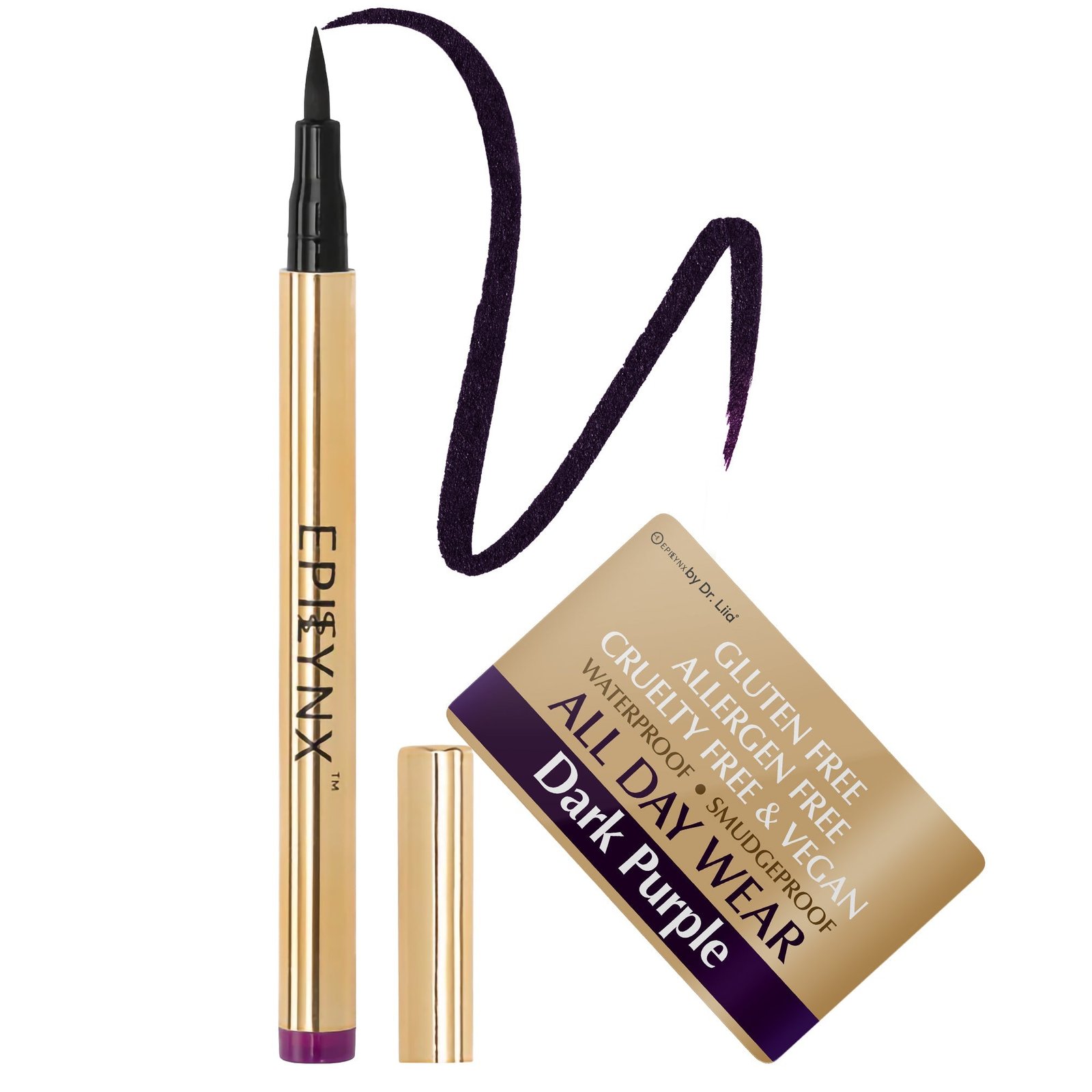
Waterproof Liquid Eyeliner – Matte Black – Pharmacist Verified, Allergen Free, Gluten Free, Fragrance Free, MI Free, Formaldehyde Free. Precision with smudge protection that lasts all day without periorbital irritation.
- Available in matte and shimmer finishes
- Paired with: Allergen Free Eye Cream — applied before eyeliner for peptide barrier support in the application zone
- Paired with: Mega Volume Mascara — the complete allergen-free eye makeup system
Use a password EpiLynxglow25 25% off · Free shipping on orders $54+
How to apply eyeliner for maximum comfort on sensitive eyes
- Apply eye cream first. A thin layer of allergen-free eye cream creates a peptide-enriched, ceramide-supported buffer between the eyeliner pigment and raw periorbital skin—reducing direct allergen contact.
- Line the outer lash line, not the waterline. The waterline (inner lash line) is mucous tissue — any eyeliner applied directly to the waterline has direct mucosal exposure. Lining the outer lash line keeps the pigment on the skin and not on the mucous membrane.
- Allow 60 seconds for the trim to stabilize before flashing normally. This allows the film-forming polymer to dry completely, reducing migration into the inner eye with gaze.
- Remove with a gentle, allergen-free micellar water or cleansing oil — not with rubbing or cotton pads that create mechanical micro-friction on the periorbital skin. Soak, hold, then wipe gently in one direction.
Frequently Asked Questions
Why do most waterproof eyeliners irritate sensitive eyes?
Fragrance that reaches the conjunctival mucosa through tear film migration, formaldehyde-releasing preservatives that continuously irritate the 0.5 mm periorbital barrier, and trace metal contact allergens (nickel, cobalt) in pigments that penetrate the unique stratum corneum of the periorbital region. All three mechanisms operate in lower concentrations here than elsewhere on the face.
What makes an eyeliner really safe for allergic and eczema-prone eyes?
Fragrance Free, Formaldehyde Free, MI/MCI Free, Food Allergen Free (Wheat Starch, Nut Wax Free), Celiac Gluten Free, and Waterproof through safe film formers and no volatile irritant solvents. EpiLynx Waterproof Eyeliner meets all six criteria. Buy now →
Is EpiLynx Waterproof Eyeliner safe for celiac disease?
Yes — pharmacist-verified gluten-free, wheat-starch-free, and wheat-derived tocopherol-free. Treats the nasolacrimal duct mucosa with the same gluten-free standard applied to lip products.
