


updated on 06/12/2026
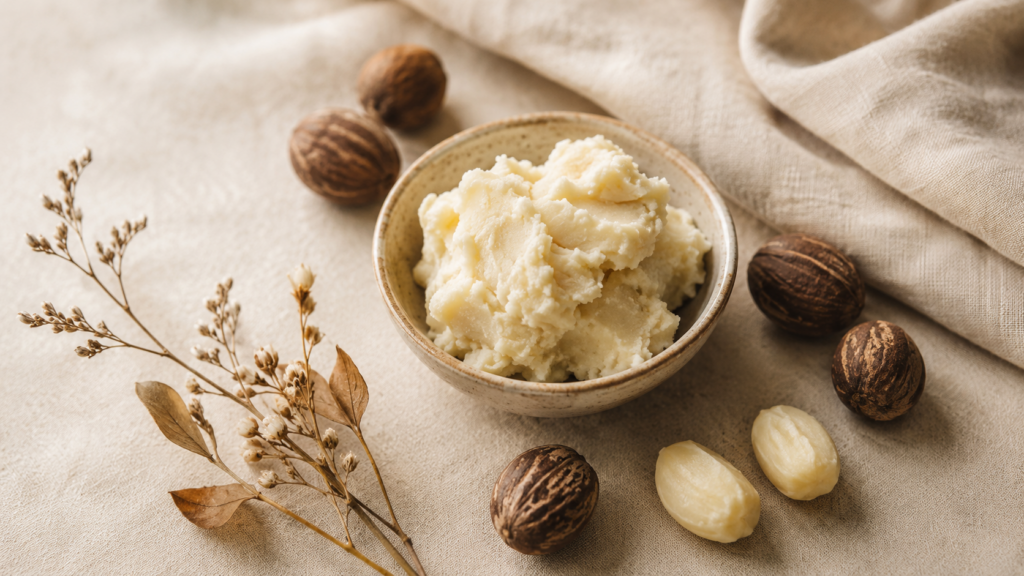
Shea butter is a natural fat extracted from the kernels of the Vitellaria paradoxa tree, a wild-growing tree found in the sub-Saharan shea belt of West Africa. Packed with fatty acids, vitamins and anti-inflammatory compounds, it has been used for centuries to protect, hydrate and heal the skin. Today, it is one of the most studied natural skin care ingredients out there, and clinical research supports what West African communities have known for generations.
Where does shea butter come from?
Shea (Vitellaria paradoxa) is remarkable in its own right. These trees live up to 300 years and do not produce fruit until 15 to 20 years after they begin to grow. In much of West Africa, they are considered sacred and are never intentionally cut. The fruit, which looks like a small plum, ripens and falls between May and July. The women pick the fallen fruits by hand, open the outer shell and extract the inner kernel. These kernels are dried, roasted, ground and churned using traditional methods to separate the fat.
The result is raw, raw shea butter in its most natural state. Most of the shea butter sold in the United States comes from Ghana, Burkina Faso, Mali, and Nigeria. The industry supports hundreds of thousands of women across the shea belt, making it one of the most economically important agricultural products in sub-Saharan Africa.
What’s in Shea Butter?
The reason shea butter works so well on the skin is because of its chemistry. Its fatty acid profile closely mirrors the lipid structure of healthy human skin, so it is easily absorbed without disturbing the skin’s natural balance.
Nutrient Composition Table
| Compound | Type | About Composition | Primary benefit for the skin |
| Oleic acid | Monounsaturated fatty acids | 40–60% | Softens the skin, supports moisture retention |
| Stearic acid | Saturated fatty acids | 20–50% | It restores the skin barrier, gives the butter its solid texture |
| Linoleic acid | Essential Fatty Acids (Omega-6) | 3–8% | Supports cell regeneration, calms inflammation |
| Vitamin A | Fat soluble vitamin | Of course they arise | Promotes cell cycle, supports skin repair |
| Vitamin E | Fat-soluble antioxidant | Of course they arise | Protects against oxidative damage, aids in healing |
| Vitamin F | Essential fatty acids (linoleic + alpha-linolenic acid) | Of course they arise | Maintains the function of the skin barrier |
| Triterpene esters | Bioactive saponifiables | 7–12% of unsaponified | Anti-inflammatory, can reduce skin stress from environmental exposure |
| Esters of cinnamic acid | Phenolic compounds | Of course they arise | Mild UV protection, wound healing support |
| Tiles | Lipids same as skin | Of course they arise | Barrier seal, moisture retention |
These compounds do not work in isolation. Fatty acids transport vitamins to the skin, triterpenes soothe any inflammatory reaction, and ceramides help seal in moisture once it’s there.
What Does Science Say?
The anecdotal case for shea butter stretches back centuries. The clinical case is steadily developing, and the recent results are sufficiently specific to merit immediate mention.
A 2025 study published in International Journal of Pharmaceutical and Organic Chemistry measured the effects of shea butter on skin barrier function using standardized methods such as Trans-Epithelial Water Loss (TEWL) measurement, keratometry, and impedance spectroscopy. Results showed that TEWL decreased by 37.8% after 24 hours, skin hydration increased by 58% after 24 hours, and impedance spectroscopy showed a 33% increase in skin resistance, indicating improved barrier function. The same analysis confirmed six subclasses of ceramides present in shea butter, with Ceramide 1 and 2 being the most abundant. These are the same lipids that the skin uses to seal and repair its protective layer.
Separate research in the triterpene ester fraction supports the anti-inflammatory effect of shea butter. The anti-inflammatory and protease inhibitory activity of triterpene esters has been reported and reviewed in the literature, indicating the potential to reduce skin stress caused by environmental factors.
This is part of why shea butter is consistently recommended for eczema and psoriasis. Both conditions involve a disrupted skin barrier and persistent inflammation. Shea butter addresses both at the same time.
Unrefined vs. Refined Shea Butter
Not all shea butter is the same. The processing method determines how much of this nutrient profile actually reaches your skin.
Unprocessed vs. Enhanced Comparison Table
| Property | Unrefined shea butter | Refined shea butter |
| Color | Ivory to light yellow (or grey/green depending on harvest season) | Bright white |
| Smell | Mild, dry, slightly earthy | Odorless |
| Texture | Thick, sometimes slightly grainy | Smooth, consistent |
| Retention of nutrients | 90%+ of vitamins, fatty acids and bioactive compounds | Up to 75% of bioactive compounds are lost during processing |
| Processing method | Cold pressed or traditional extraction by hand, without chemical solvents | Bleaching, deodorization, often extraction with hexane solvent |
| Lifetime | 18 to 24 months | Up to 3 years |
| The best for | Direct skin care, therapeutic use, DIY preparations | Mass production of cosmetics where fragrance and consistency of appearance matter |
Raw shea butter is processed without chemical solvents or high heat, maintaining its full nutritional profile. Unprocessed shea retains over 90% of its natural nutrients, including vitamins A and E, essential fatty acids, and therapeutic compounds such as cinnamic acid esters that provide anti-inflammatory benefits.
Refined shea butter goes through additional steps to create a white, odorless product more practical for large-scale cosmetic production. The refining process (if not naturally refined), can often include hexane and bleach to remove color and odor, can result in the loss of up to 75% of the bioactive compounds that make shea butter valuable for skin care.
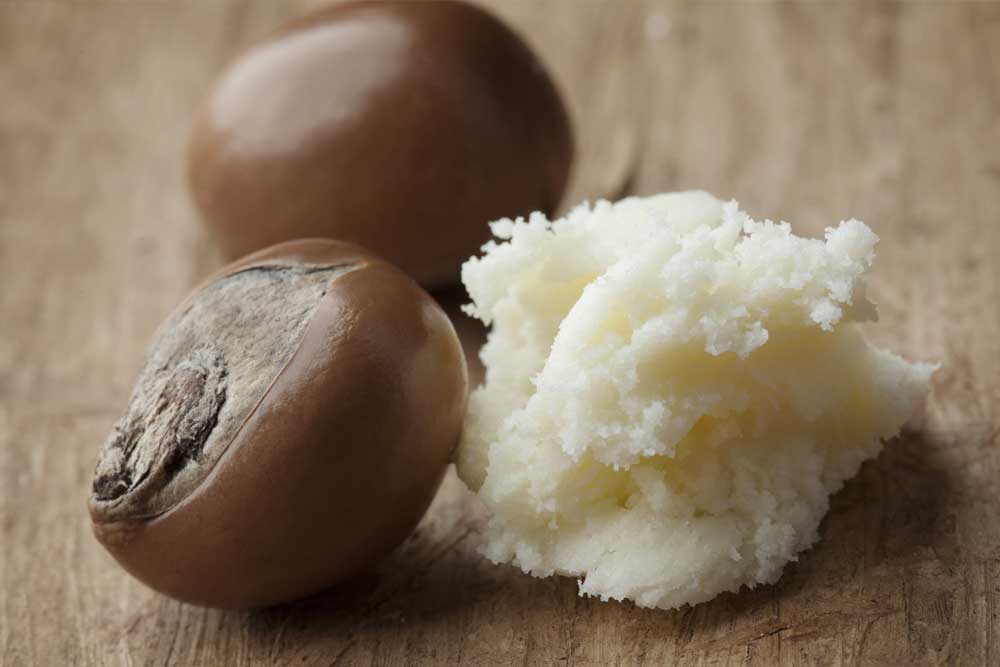
Note on Labeling: “Raw” and “unprocessed” mean the same thing in this context. If a product is authentically raw, it will have a natural ivory or pale yellow color and a mild aroma. Bright white and odorless means it has been refined, regardless of what the label claims.
Better Shea Butter sells 100% unprocessed organic shea butter, sourced and processed to maintain full nutrient content.
What skin benefits does shea butter offer?
Because its fatty acid profile mirrors the lipid structure of the skin, shea butter works on a wide range of problems rather than targeting one. Regular use supports moisture retention, barrier repair and inflammation reduction. Commonly used for eczema, psoriasis, acne-prone skin, stretch marks, minimal wound healing and signs of aging. It also works on the hair and scalp.
For a full breakdown of each benefit, the mechanisms behind them, and who each is best suited for, see our full guide: Shea Butter Benefits: What It Does and Why It Works.
How to choose quality shea butter
Color one thing to look for. True raw shea is ivory to pale yellow. Green or gray tones indicate early season harvest, which is nice and still rich in nutrients. Bright white indicates chemical treatment.
The aroma confirms it. Unprocessed shea has a mild, slightly smoky, nutty smell. No fragrance at all means it has been deodorized.
The texture should be solid at room temperature and melt quickly on contact with the skin. Granules can develop if the butter melted and resolidified during shipping. This does not affect the quality. Gently melting the butter in a double boiler over low heat and quickly chilling it in the refrigerator or freezer usually restores softness.
Third-party certifications provide an additional level of trust. USDA Organic certification means the trees and processing meet both certified organic standards.
Frequently Asked Questions
Shea butter is a natural fat from the shea tree, used in skin care as a moisturizer, barrier repair ingredient and anti-inflammatory agent. The word “meaning” in this context refers to its functional role: it works with the lipid structure of the skin rather than sitting on top of it.
Yes. Shea butter has a causative rating of 0 to 2, meaning it is unlikely to clog pores. Its fatty acid profile is compatible with dry, oily, sensitive and combination skin types.
Yes. Shea butter is non-food and safe for daily use on the face. Works well as a moisturizer, under eye treatment and lip balm. For oily skin, a small amount applied at night is usually enough.
Raw shea butter is extracted without chemicals or high heat, retaining 90%+ of its vitamins and bioactive compounds. Refined shea butter is bleached and deodorized, which can remove up to 75% of these compounds. See the full comparison: Processed vs Raw Shea Butter.
Quality unprocessed shea butter stored in a cool, dark place lasts about 18 to 24 months. Exposure to heat or direct sunlight accelerates oxidation. Storing it away from moisture and with the lid open maintains its quality.
