

Close Menu
Healthtost
  • News
  • Mental Health
  • Men’s Health
  • Women’s Health
  • Skin Care
  • Sexual Health
  • Pregnancy
  • Nutrition
  • Fitness
  • Recommended Essentials
What's Hot

Where to eat in London

April 27, 2026

Can a 10-minute workout really change your health?

April 27, 2026

Scientists map 239 human-infecting RNA viruses to monitor future epidemic risks

April 27, 2026
Facebook X (Twitter) Instagram
  • About Us
  • Contact Us
  • Privacy Policy
  • Terms and Conditions
  • Disclaimer
Facebook X (Twitter) Instagram
Healthtost
SUBSCRIBE
  • News

    Scientists map 239 human-infecting RNA viruses to monitor future epidemic risks

    April 27, 2026

    Experts debate the benefits and costs of robotic lung transplants

    April 26, 2026

    Study finds different types of crystalloid fluids equally effective for pediatric sepsis

    April 26, 2026

    Brain-Gut Health Initiative supports AI-assisted diagnosis of psychiatric disorders

    April 25, 2026

    Researchers uncover new mechanism linking metabolism, immunity and skeletal health

    April 25, 2026
  • Mental Health

    What animal studies teach us about toxic work environments

    April 27, 2026

    I hate hope: How to manage hope when you have treatment-resistant bipolar disorder

    April 19, 2026

    Rose Byrne is raw, magnetic and unfiltered as a woman in crisis

    April 18, 2026

    Can a single mother change her child’s surname in India?

    April 16, 2026

    Is it anxiety or OCD? 2 psychology experts explain the difference

    April 14, 2026
  • Men’s Health

    Sex Secrets for Men Over 40: Surviving Male Menopause

    April 27, 2026

    45-Minute No-Equipment Home Workout (Full Body)

    April 23, 2026

    Study finds many UK adults want to avoid ultra-processed foods but can’t clearly define them

    April 21, 2026

    How can you get the best sleep?

    April 21, 2026

    The Crazy Hard Standards of the Hardest PE Program in History

    April 20, 2026
  • Women’s Health

    Why 24-hour gut support is essential in a probiotic | The Wellness Blog

    April 27, 2026

    Yeong Kim (Rian) – The Structural Elegance of Intellect and Honor

    April 25, 2026

    I felt ashamed of my dad’s illness

    April 25, 2026

    What are the different stages of puberty?

    April 24, 2026

    Understanding Hot Flashes – HealthyWomen

    April 24, 2026
  • Skin Care

    Our strongest retina serum yet – Tropic Skincare

    April 27, 2026

    What it is and how to do it right – Lifeline Skin Care

    April 21, 2026

    Best Face Mask Set: What to Use for Your Skin Goals

    April 21, 2026

    Earth Day Activities: A Fun Guide to Plogging and More

    April 20, 2026

    Calm & Correct: The 4-in-1 color correcting treatment

    April 19, 2026
  • Sexual Health

    How accurate are herpes blood tests?

    April 22, 2026

    Understanding the Asexual Spectrum — Sexual Health Alliance

    April 21, 2026

    The importance of sex and intimacy in the elderly

    April 18, 2026

    Judicial reform is the only real way out of today’s political hell

    April 15, 2026

    Personal and Professional considerations between generations

    April 15, 2026
  • Pregnancy

    Epidural and unmedicated delivery with two different deliveries

    April 26, 2026

    Researchers identify new genetic links to Hyperemesis Gravidarum

    April 25, 2026

    Loss of Appetite During Pregnancy: A Third Trimester Guide

    April 24, 2026

    Cameron Rodgers wants you to know you’re not the only one Googling “WTF is going on in my body” at 2 a.m.

    April 22, 2026

    A gentle space to navigate the becoming of motherhood

    April 21, 2026
  • Nutrition

    Where to eat in London

    April 27, 2026

    Dr. Will Cole on Why Hire FDN Professionals

    April 26, 2026

    Doing the work in the face of fear

    April 25, 2026

    Can the “dark shower” reduce stress and improve sleep?

    April 24, 2026

    High Fiber Smoothie Recipe • Kath Eats

    April 23, 2026
  • Fitness

    Can a 10-minute workout really change your health?

    April 27, 2026

    4.24 Friday Faves – The Fitnessista

    April 25, 2026

    The workout we forgot (it’s time to bring it back 💪 )

    April 24, 2026

    Cardio or weightlifting? – Tony Gentilcore

    April 24, 2026

    7 super healthy ways to take care of yourself

    April 23, 2026
  • Recommended Essentials
Healthtost
Home»News»Scientists map 239 human-infecting RNA viruses to monitor future epidemic risks
News

Scientists map 239 human-infecting RNA viruses to monitor future epidemic risks

healthtostBy healthtostApril 27, 2026No Comments6 Mins Read
Facebook Twitter Pinterest LinkedIn Tumblr Reddit WhatsApp Email
Scientists Map 239 Human Infecting Rna Viruses To Monitor Future Epidemic
Share
Facebook Twitter LinkedIn Pinterest WhatsApp Email

A new global dataset of 239 human-infecting RNA viruses shows how animal hosts, vector transmission, surveillance gaps, and viral traits shape the pathway from dispersal to epidemic threat.

Study: Complete catalog of human infectious RNA viruses. Image credit: Andrzej Rostek / Shutterstock

A recent review published in the magazine Scientific Data presents an updated global catalog that brings the number of ribonucleic acid (RNA) viruses known to infect humans in 239 species, 25 more than in 2018, offering new insight into emergence and spread.

Rather than appearing randomly, most viruses cluster in a few families, are associated with non-human hosts, particularly mammals, and are identified at varying rates over time as taxonomy, reporting, surveillance, and sequencing technologies evolve.

While spillover to humans is common worldwide, only a minority of species reach epidemic or endemic levels in humans, highlighting a critical bottleneck between exposure and epidemic spread.

RNA Viruses remain a growing threat to global health today, driving diseases such as measles, influenza and AIDS caused by HIV and causing new outbreaks. Recent events involving Oropouche virus and severe acute respiratory syndrome coronavirus 2 (SARS-CoV-2) highlight the epidemic potential of these viruses. However, the viral landscape continues to change rapidly.

Researchers identify new species that infect humans almost every year, revise classifications, and expand genomic and ecological data. As evidence accumulates about transmission, host range, and dissemination, the need for an updated inventory becomes critical for tracking known and predicting future risks.

Human RNA virus catalog methods

In this paper, the researchers developed an updated, expanded dataset of it RNA viruses known to infect humans, capturing current knowledge through December 2024.

Based on older catalogs from 2001 and 2018, they conducted systematic literature searches every 1–3 years using databases such as Web of Science, PubMed, Scopus and Google Scholar, supplemented by sources including the World Health Organization (WHERE), Centers for Disease Control and Prevention (CDC), ProMed and genome archives from the National Center for Biotechnology Information (NCBI).

The dataset included only peer-reviewed primary reports that provided reliable evidence RNA viruses recognized by the International Committee on the Taxonomy of Viruses (ICTV) infects humans under natural or actual conditions, excluding intentional experimental inoculation or in vitro evidence.

The team resolved ambiguities through independent reviews and consensus, and in some cases inferred features missing from closely related viruses. They compiled species-level data incorporating information on known subtypes and linked each virus to its first reported human case, genome sequence and geographic origin.

The researchers recorded key characteristics, including transmissibility, host range and routes of transmission, using standardized criteria. They classified transmissibility into Levels 2, 3 and 4, ranging from zoonotic infections without human spread to viruses capable of epidemic or endemic spread in humans.

Finally, the team mapped discovery dates and locations, allowing for temporal and spatial analyzes of the virus’s emergence. By integrating genomic, ecological, and epidemiological data into a single framework, the updated dataset provides a robust foundation for the study of viral diversity, evolution, and public health risk.
The annual number of new and (currently) ICTV-recognized, human-infectious RNA virus species is shown in Figure 2a. Figure 2b illustrates the accumulation of species over time, as well as the accumulation of genera and families containing one or more human-infecting RNA virus species. The first human RNA virus – the yellow fever virus – was reported in 1901. The number of species increased slowly until the mid-1950s and somewhat more rapidly thereafter. By the end of the 20th century, 178 species had been identified, and in the 21st century so far another 61 have been added. By decade, the 1960s contributed the largest number of new species (42). Next was the 2000s (31), but the percentage dropped again in the 2010s.

The annual number of new and (currently) ICTV-recognized, human-infectious RNA virus species is shown in Figure 2a. Figure 2b illustrates the accumulation of species over time, as well as the accumulation of genera and families containing one or more human-infecting RNA virus species. The first human RNA virus – the yellow fever virus – was reported in 1901. The number of species increased slowly until the mid-1950s and somewhat more rapidly thereafter. By the end of the 20th century, 178 species had been identified, and in the 21st century so far another 61 have been added. By decade, the 1960s contributed the largest number of new species (42). Next was the 2000s (31), but the percentage dropped again in the 2010s.

Global RNA virus discovery standards

The updated data set includes 239 RNA viruses known to infect humans, as classified by ICTV. Compared to 2018, this reflects 25 additional species identified through new discoveries and taxonomic updates.

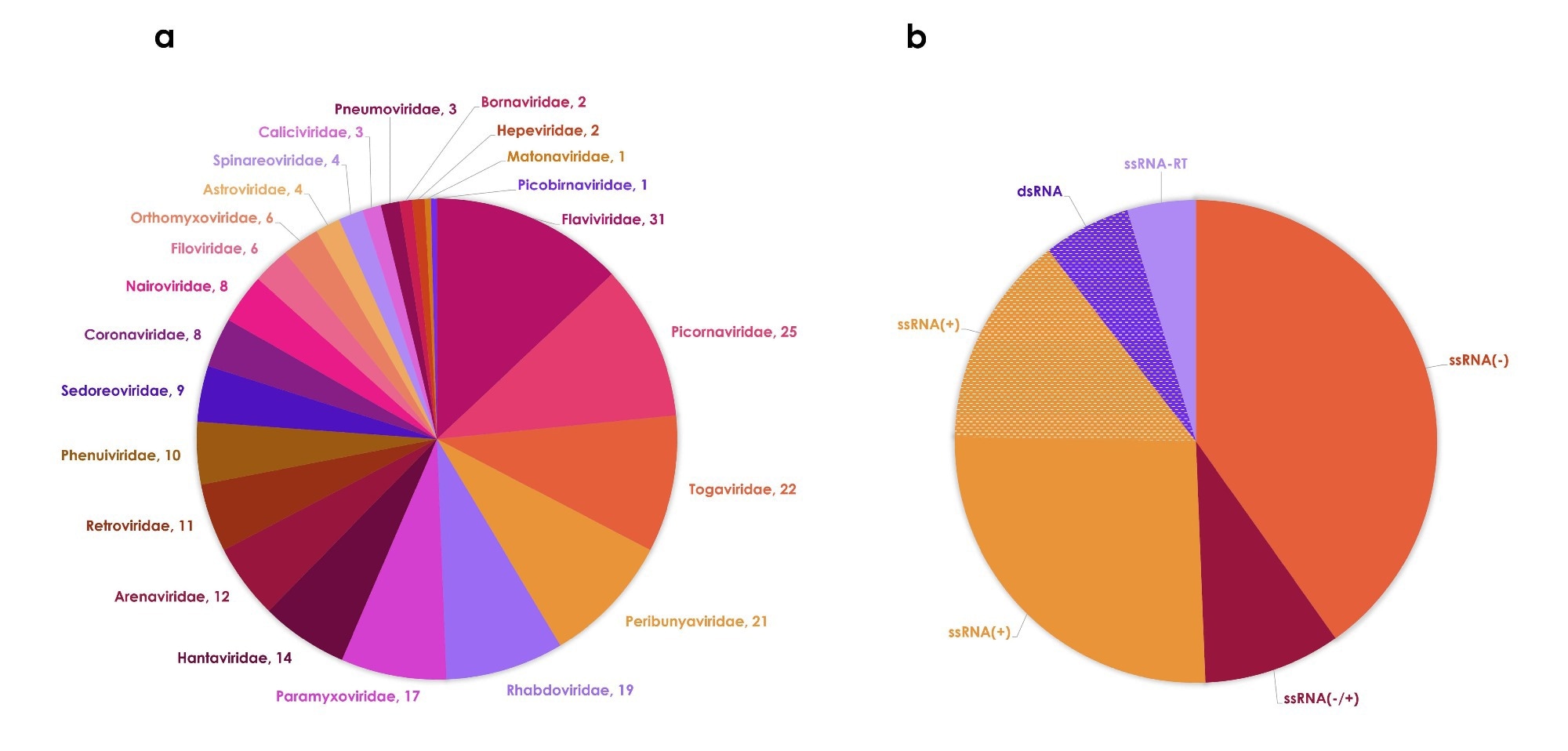
These species span 61 genera and 23 families, although diversity remains concentrated in a few families and most viruses share common genomic features, particularly single-stranded RNA genomes.

Over time, discoveries have increased since the mid-20th century, although the authors note that a formal analysis is needed to determine whether discovery rates are increasing or decreasing overall.

After minimal growth in the early 20th century, recognition rates rose sharply from the mid-1900s, with notable peaks in the 1960s and early 2000s. However, most newly identified species expand existing genera and families rather than introducing entirely new taxonomic groups.

Geographically, the first reported human cases have occurred on all inhabited continents, with clusters in areas with stronger surveillance systems. This pattern highlights both the global nature of viral diffusion and the effect of detectability on discovery.

Spread, Transmission and Epidemic Potential

Ecologically, the majority of viruses (62%) are strictly zoonotic (Level 2) and do not sustain human-to-human transmission. Only 60 species reach level 4, meaning they are endemic to humans or can spread epidemically, and many of these still maintain animal reservoirs.

Most viruses are associated with nonhuman mammalian hosts, reinforcing their central role in emergence. Transmission routes are varied, but vector-borne spread, mainly through mosquitoes and ticks, predominates, followed by inhalation and direct contact.

In particular, the transmission routes of a subset of viruses remain uncertain, reflecting persistent knowledge gaps. Together, these findings clearly highlight a landscape defined by repeated documented spills, expanding discovery, and limited adaptation to sustained human transmission.

RNA virus surveillance and risk prediction

These findings suggest a more targeted and proactive approach to emerging viral threats. Rather than searching broadly for entirely new pathogens, future efforts could use this data set to examine high-risk virus families, mammalian reservoirs, and areas with limited surveillance, where undetected spillover is most likely to occur.

Expanding genomic sequencing, metagenomics and real-time surveillance will be critical to closing persistent knowledge gaps, particularly around transmission routes and host range.

At the same time, the dataset provides a valuable basis for modeling trends in the discovery and identification of traits associated with outbreak potential. As it continues to evolve, it can help improve risk prediction and guide early warning systems.

Ultimately, the challenge is not just to discover new viruses, but to understand which ones are most likely to adapt, spread and become the next global health threat.

epidemic future humaninfecting map Monitor Risks RNA Scientists Viruses
bhanuprakash.cg
healthtost
  • Website

Related Posts

Experts debate the benefits and costs of robotic lung transplants

April 26, 2026

Study finds different types of crystalloid fluids equally effective for pediatric sepsis

April 26, 2026

Brain-Gut Health Initiative supports AI-assisted diagnosis of psychiatric disorders

April 25, 2026

Leave A Reply Cancel Reply

Don't Miss
Nutrition

Where to eat in London

By healthtostApril 27, 20260

Casual to elevated London Dining Gems Franco Manca: Sourdough Pizza Perfection With locations across London,…

Can a 10-minute workout really change your health?

April 27, 2026

Scientists map 239 human-infecting RNA viruses to monitor future epidemic risks

April 27, 2026

What animal studies teach us about toxic work environments

April 27, 2026
Stay In Touch
  • Facebook
  • Twitter
  • Pinterest
  • Instagram
  • YouTube
  • Vimeo
TAGS
Baby benefits body brain cancer care Day Diet disease exercise finds Fitness food Guide health healthy heart Improve Life Loss Men mental Natural Nutrition Patients Pregnancy research reveals risk routine sex sexual Skin Skincare study Therapy Tips Top Training Treatment Understanding ways weight women Workout
About Us
About Us

Welcome to HealthTost, your trusted source for breaking health news, expert insights, and wellness inspiration. At HealthTost, we are committed to delivering accurate, timely, and empowering information to help you make informed decisions about your health and well-being.

Latest Articles

Where to eat in London

April 27, 2026

Can a 10-minute workout really change your health?

April 27, 2026

Scientists map 239 human-infecting RNA viruses to monitor future epidemic risks

April 27, 2026
New Comments
    Facebook X (Twitter) Instagram Pinterest
    • About Us
    • Contact Us
    • Privacy Policy
    • Terms and Conditions
    • Disclaimer
    © 2026 HealthTost. All Rights Reserved.

    Type above and press Enter to search. Press Esc to cancel.