


Close Menu
Healthtost
  • News
  • Mental Health
  • Men’s Health
  • Women’s Health
  • Skin Care
  • Sexual Health
  • Pregnancy
  • Nutrition
  • Fitness
  • Recommended Essentials
What's Hot

Genetics play a bigger role than pregnancy in childhood obesity risk

July 1, 2026

Obesity may account for up to one in four cases of polypharmacy

July 1, 2026

A link between e-cigarettes and oral cancer

July 1, 2026
Facebook X (Twitter) Instagram
  • About Us
  • Contact Us
  • Privacy Policy
  • Terms and Conditions
  • Disclaimer
Facebook X (Twitter) Instagram
Healthtost
SUBSCRIBE
  • News

    Obesity may account for up to one in four cases of polypharmacy

    July 1, 2026

    The trial evaluates interdisciplinary care for veterans with brain injury and PTSD

    June 30, 2026

    The fiber blend relieves constipation and improves stool consistency

    June 30, 2026

    Telehealth Mindfulness Program Reduces Chronic Low Back Pain

    June 29, 2026

    Apes’ big laugh reveals how human vocal control evolved

    June 29, 2026
  • Mental Health

    What happens in your blood when you are stressed? We put it to the test

    June 28, 2026

    Why negative news grabs our attention and what it means for our mental health

    June 25, 2026

    Everyone wants to think they’re open-minded – here’s why most people aren’t

    June 24, 2026

    five tips from influential thinkers to calm your nerves

    June 19, 2026

    10 Ways to Find Your Purpose as a Married Woman

    June 17, 2026
  • Men’s Health

    Genetics play a bigger role than pregnancy in childhood obesity risk

    July 1, 2026

    A link between e-cigarettes and oral cancer

    July 1, 2026

    James Michener, My Father and Me: Finding Our Place in the World and Embracing the Mysteries of Life

    June 30, 2026

    Welcome (Back) to MDA! Start here.

    June 29, 2026

    10 irrational thought patterns that increase anxiety

    June 28, 2026
  • Women’s Health

    Why is my sinus breaking? Causes of Pelvic Floor Contractions – Vuvatech

    July 1, 2026

    Benefits of choline during pregnancy | The Wellness Blog

    June 30, 2026

    How Victoria eliminated her hip pain in just 10 weeks

    June 30, 2026

    Understanding the causes of thinning female hair

    June 29, 2026

    Kimchi can flush microplastics out of the body, thanks to this probiotic

    June 28, 2026
  • Skin Care

    The Best Skin Care Products for Men, According to a Celebrity Facialist

    July 1, 2026

    Sunscreen mistakes that could leave your sensitive skin unprotected

    June 30, 2026

    Body Smooth | The body scrub that started it all – Tropic Skincare

    June 29, 2026

    Congested vs. Inflammatory Acne: How to Tell the Difference

    June 26, 2026

    Welcome Back, Zinc Oxide – Woohoo Body

    June 25, 2026
  • Sexual Health

    Complete Guide to 2026 — Sexual Health Alliance

    June 30, 2026

    Five things you need to know about herpes

    June 28, 2026

    Fildena 120 Best Time To Take

    June 26, 2026

    Pelvic Floor & Anatomical Disorders: The Hidden Causes of Chronic Constipation and Incomplete Voiding

    June 25, 2026

    Who will train the next generation of abortion providers?

    June 25, 2026
  • Pregnancy

    Yoga poses for expectant mothers

    June 28, 2026

    Not too much, not too little: Finding the gold of vitamins and minerals

    June 27, 2026

    Clean Beauty Myths A dermatologist wants every mom to stop believing

    June 26, 2026

    “Is it a boy or a girl?” Old Wives’ Tales Gender Prediction Summary

    June 23, 2026

    Daily exposure to chemicals during pregnancy may be linked to older, smaller babies

    June 22, 2026
  • Nutrition

    Healthy Raspberry Lemon Snack Loaf

    June 30, 2026

    Raspberry Ginger Lime Detox Water

    June 29, 2026

    6 Lunch Recipes in 10 Minutes – JSHealth

    June 28, 2026

    Benefits of seeds: Exploring nutritional powerhouses

    June 27, 2026

    Pasta Salad Made Hygienic | HUM Nutrition Blog

    June 26, 2026
  • Fitness

    6.26 Friday Faves – The Fitnessista

    June 30, 2026

    9 Useful Fitness Tips for an Unmotivated Person

    June 29, 2026

    Is your body stuck in a state of stress? Here’s what you need to know

    June 28, 2026

    Summer strength training program for beginners

    June 27, 2026

    fitness benefits for both of you

    June 26, 2026
  • Recommended Essentials
Healthtost
Home»Men's Health»How a dose of antibiotic can reshape your gut microbiome for years
Men's Health

How a dose of antibiotic can reshape your gut microbiome for years

healthtostBy healthtostMarch 18, 2026No Comments4 Mins Read
Facebook Twitter Pinterest LinkedIn Tumblr Reddit WhatsApp Email
How A Dose Of Antibiotic Can Reshape Your Gut Microbiome
Share
Facebook Twitter LinkedIn Pinterest WhatsApp Email

Large-scale human data reveal that even a single course of antibiotics can leave a measurable microbial footprint years later, raising important questions about long-term health effects and prescribing practices.

Study: Antibiotic use and gut microbiome composition linked from individual-level prescription data of 14,979 subjects. Image credit: marevgenna / Shutterstock

In a recent study published in the journal Nature Medicinethe researchers found that antibiotic effects on the gut microbiome may persist much longer than expected. Linking data from the Swedish prescription register with stool metagenomic profiles from nearly 15,000 adults in multiple population groups, the study showed that even a single course of antibiotics taken four to eight years earlier was associated with lasting differences in microbiome composition.

These findings highlight the potential for prolonged disruption of the microbiome and underscore the need for careful antibiotic use, as even routine prescriptions can have lasting health effects.

Disruption of the gut microbiome and risk of chronic disease

Disturbances in the gut microbial ecosystem are increasingly recognized as a key factor in a wide range of health conditions, including cardiometabolic diseases, autoimmune disorders, and colon cancer. Antibiotics are a major driver of these imbalances, and repeated or prolonged use has been linked to higher risks of obesity, type 2 diabetes, and cardiovascular disease.

Small intervention studies have shown rapid decreases in microbial diversity and shifts in essential bacterial groups after treatment. However, these findings largely reflect short-term effects. As antibiotic use remains widespread, understanding the long-term effects on gut microbial communities has become a critical research priority, although robust large-scale evidence has been limited.

Methods for Population Study Design and Microbiome Analysis

In this population-based study of 14,979 people, researchers looked at the effect of oral antibiotic use in the previous eight years on the microbial composition of the gut. They linked prescription data from the Swedish National Prescription Drug Register (NPDR) with faecal metagenomic data from three groups: CArdioPulmonary bioImage Study (SCAPIS), Swedish Infrastructure for Medical Population-based Life-course and Environmental Research (SIMPLER) and Malmö Offspring Study (MOS).

The team assessed antibiotic exposure at three time points: within 1 year, 1 to 4 years, and 4 to 8 years before sampling. Participants with recent antibiotic use, inflammatory bowel disease, or chronic lung disease were excluded. Fecal samples were subjected to deep shotgun metagenomic sequencing and microbial diversity was quantified using indices such as the Shannon index and the inverse Simpson index. Taxonomic classification was performed using the Genome Taxonomy Database.

Multivariate regression models assessed associations between antibiotic exposure and microbiome diversity, adjusting for confounders such as age, sex, body mass index (BMI), smoking status, education, and comorbidities. The models also accounted for medications such as proton pump inhibitors (PPIs), statins, metformin, beta-blockers, antipsychotics, and selective serotonin reuptake inhibitors (SSRIs).

Sensitivity analyzes examined alternative exclusion criteria, while spline-based models explored microbiome recovery over time. Subgroup analyzes were conducted by age and sex.

Persistent microbiome changes after antibiotic exposure

Antibiotic use was common, with approximately 70–74% of participants receiving at least one prescription in the previous eight years. Broad-spectrum penicillins, penicillin V, and tetracyclines were most commonly used.

The greatest reductions in microbial diversity occurred within 1 year of antibiotic use. However, significant associations remained for exposures one to four years earlier and even four to eight years earlier. Each additional course was associated with a further reduction in diversity. Notably, even a single course conducted years earlier was linked to long-term differences in the microbiome.

Clindamycin, fluoroquinolones and flucloxacillin showed the strongest and most persistent effects. These antibiotics were associated with changes in the relative abundance of up to about 10–15% of microbial species. Beneficial items such as Alistipes communis and Odoribacter splanchnicus was rejected. Conversely, species associated with metabolic risk, incl Ruminococcus gnavus, Flavonifractor plautiiand Eggerthella lentaincreased in abundance. Penicillin V showed relatively little effect.

Microbiome recovery was faster within the first 2 years after antibiotic use, but slowed thereafter and was often incomplete. Recovery varied by antibiotic class, sex, and age, suggesting that microbiome resistance differs among individuals. Sensitivity analyzes confirmed the robustness of these findings.
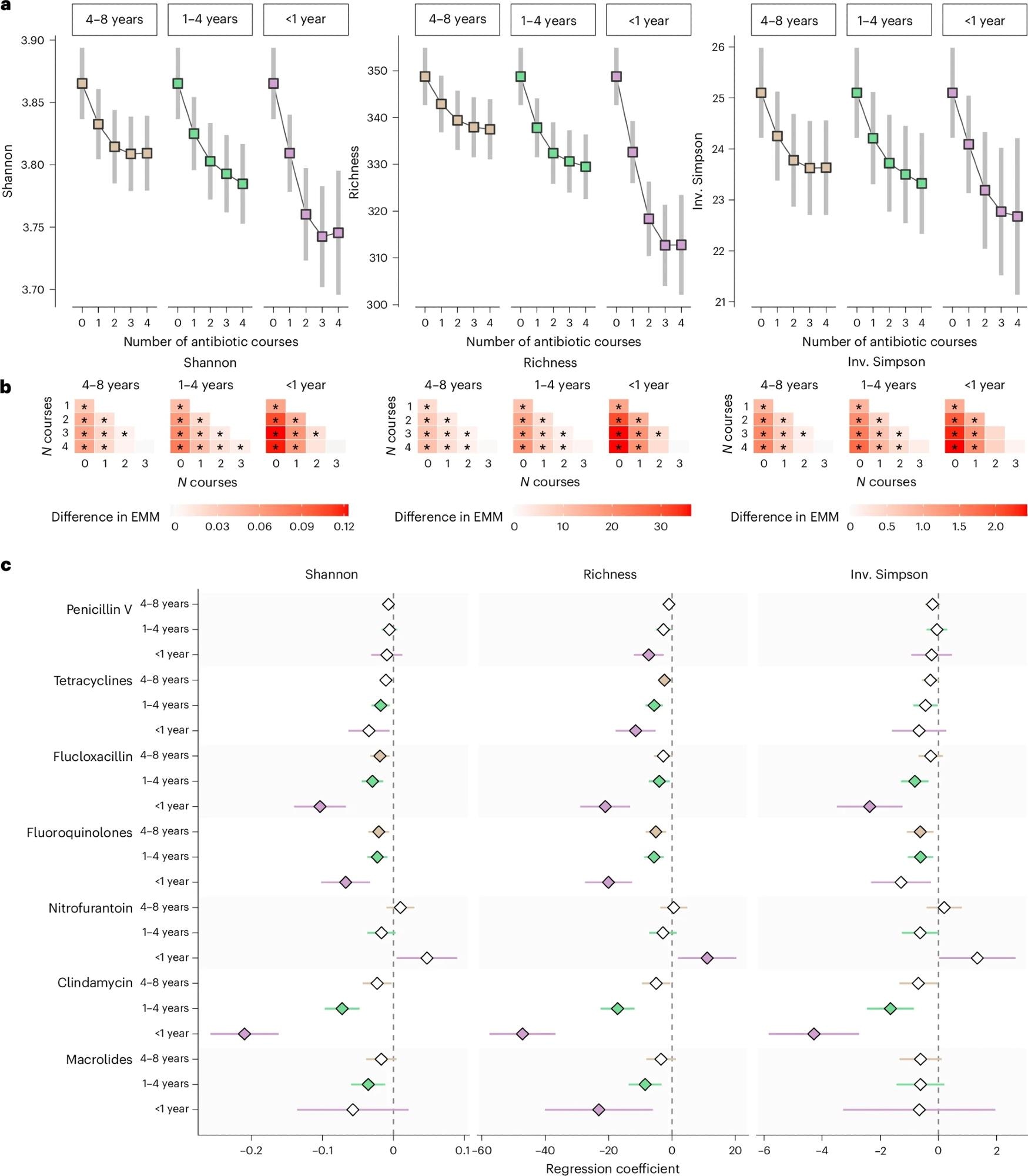
α, Μετρικές ποικιλότητας μικροβιώματος (Δείκτης Shannon, πλούτος ειδών και αντίστροφος (Inv.) Δείκτης Simpson) για κάθε πρόσθετο κύκλο οποιουδήποτε αντιβιοτικού 4-8 χρόνια, 1-4 χρόνια και <1 έτος πριν από τη δειγματοληψία κοπράνων. Ο εκτιμώμενος οριακός μέσος όρος (EMMs) της ποικιλομορφίας λήφθηκε με τη χρήση μοντέλων παλινδρόμησης, με την έκθεση σε αντιβιοτικά μοντελοποιημένα με χρήση περιορισμένων κυβικών γραμμών και προσαρμογή για ηλικία, φύλο, κάπνισμα, εκπαίδευση, χώρα γέννησης, πλάκα ανάλυσης ανά τοποθεσία, ΔΜΣ, Δείκτη Συννοσηρότητας Charlson, Πολυφαρμακία και χρήση PPIs αντιψυχωσικά (n = 14.974). Τα τετράγωνα αντιπροσωπεύουν τα EMM και εμποδίζουν τα διαστήματα εμπιστοσύνης 95%. β, Ζευγαρωμένες διαφορές στα ΕΜΜ της ποικιλότητας μικροβιώματος κατά αριθμό προηγούμενων μαθημάτων αντιβιοτικών. Τα αστέρια δείχνουν σημαντικές διαφορές (FDR < 5%). γ, οι συσχετίσεις μεταξύ της χρήσης αντιβιοτικών τα 8 χρόνια πριν από τη δειγματοληψία κοπράνων και της ποικιλότητας των ειδών μικροβιώματος του εντέρου διερευνήθηκαν χρησιμοποιώντας μοντέλα παλινδρόμησης προσαρμοσμένα για τις ίδιες συμμεταβλητές όπως παραπάνω, σε τρεις κοόρτες (SCAPIS, SIMPLER, MOS, σύνολο n = 14.974), ακολουθούμενες από μετα-αναλύσεις του συντελεστή παλινδρόμησης. Ο άξονας x και τα διαμάντια εμφανίζουν τους μετα-αναλυμένους συντελεστές παλινδρόμησης. Οι γραμμές σφαλμάτων αντιπροσωπεύουν 95% διαστήματα εμπιστοσύνης. Τα συμπληρωμένα σύμβολα υποδεικνύουν στατιστικά σημαντικές συσχετίσεις (FDR < 5%). Εμφανίζονται αντιβιοτικά με τουλάχιστον μία τέτοια συσχέτιση.

aMicrobiome diversity measures (Shannon Index, species richness and inverse (Inv.) Simpson Index) for each additional course of any antibiotic 4–8 years, 1–4 years and <1 year before stool sampling. Estimated marginal means (EMMs) of diversity were obtained using regression models, with antibiotic exposure modeled using restricted cubic lines and adjusting for age, sex, smoking, education, country of birth, panel analysis by site, BMI, Charlson Comorbidity Index, polypharmacy and use of antipsychotic PPIs (n = 14,974). Squares represent EMMs and block 95% confidence intervals. siPairwise differences in EMMs of microbiome diversity by number of previous antibiotic courses. Stars indicate significant differences (FDR < 5%). doAssociations between antibiotic use in the 8 years prior to stool sampling and gut microbiome species diversity were explored using regression models adjusted for the same covariates as above, in three cohorts (SCAPIS, SIMPLER, MOS, total n = 14,974), followed by regression coefficient meta-analyses. The x-axis and diamonds show the post-analyzed regression coefficients. Error bars represent 95% confidence intervals. Filled symbols indicate statistically significant associations (FDR < 5%). Antibiotics with at least one such association appear.

Implications for antibiotic stewardship and future research

The findings suggest that some antibiotics can have long-lasting effects on the gut microbiome, persisting for more than four years. These results support more judicious antibiotic prescribing and management strategies that minimize microbiome disruption.

However, the study remains observational and cannot prove causality. Further research is needed to understand long-term health consequences, including links to chronic disease. The findings may not generalize beyond outpatient clinics in Sweden and may underestimate overall antibiotic exposure due to a lack of hospital or international prescribing data.

Journal Reference:

  • Baldanzi, G. et al. (2026). Antibiotic use and gut microbiome composition linked from individual-level prescription data of 14,979 subjects. Nature Medicine, 1-11. DOI: 10.1038/s41591-026-04284-y, https://www.nature.com/articles/s41591-026-04284-y
Antibiotic Dose gut microbiome reshape Years
bhanuprakash.cg
healthtost
  • Website

Related Posts

Genetics play a bigger role than pregnancy in childhood obesity risk

July 1, 2026

A link between e-cigarettes and oral cancer

July 1, 2026

James Michener, My Father and Me: Finding Our Place in the World and Embracing the Mysteries of Life

June 30, 2026

Leave A Reply Cancel Reply

Don't Miss
Men's Health

Genetics play a bigger role than pregnancy in childhood obesity risk

By healthtostJuly 1, 20260

The researchers found that while maternal BMI influences birth weight, genetics accounted for most of…

Obesity may account for up to one in four cases of polypharmacy

July 1, 2026

A link between e-cigarettes and oral cancer

July 1, 2026

Why is my sinus breaking? Causes of Pelvic Floor Contractions – Vuvatech

July 1, 2026
Stay In Touch
  • Facebook
  • Twitter
  • Pinterest
  • Instagram
  • YouTube
  • Vimeo
TAGS
Baby benefits body brain cancer care Day Diet disease exercise finds Fitness food Guide health healthy heart Improve Life Loss Men mental Natural Nutrition Patients People Pregnancy research reveals risk routine sex sexual Skin Skincare study Therapy Tips Top Training Treatment ways weight women Workout
About Us
About Us

Welcome to HealthTost, your trusted source for breaking health news, expert insights, and wellness inspiration. At HealthTost, we are committed to delivering accurate, timely, and empowering information to help you make informed decisions about your health and well-being.

Latest Articles

Genetics play a bigger role than pregnancy in childhood obesity risk

July 1, 2026

Obesity may account for up to one in four cases of polypharmacy

July 1, 2026

A link between e-cigarettes and oral cancer

July 1, 2026
New Comments
    Facebook X (Twitter) Instagram Pinterest
    • About Us
    • Contact Us
    • Privacy Policy
    • Terms and Conditions
    • Disclaimer
    © 2026 HealthTost. All Rights Reserved.

    Type above and press Enter to search. Press Esc to cancel.