


You may have noticed BHT on a cereal ingredient list and wondered what it actually is. It sounds like one of those synthetic ingredients that people often worry about. But what is it really and is it something to worry about?
In short: Is BHT in grains bad for you?
BHT in cereals is not considered dangerous in the small amounts allowed by law, but it has not been proven completely safe for long-term human use either. This is one reason some people prefer to avoid it, especially when there are cereals without it.
What exactly is BHT?
BHT stands for butylated hydroxytoluene. In Europe, it is also known as E321. It is one synthetic antioxidant food additivewhich simply means it is a laboratory ingredient used to help keep certain foods stable for a longer period of time.
You will sometimes see BHT described as a preservativeand that’s not wrong, but antioxidant is the most accurate term. Its main job is to protect food from going stale too quickly. So if you spot BHT or E321 on a label, it is the same ingredient.
So what is BHT doing in your cereal?
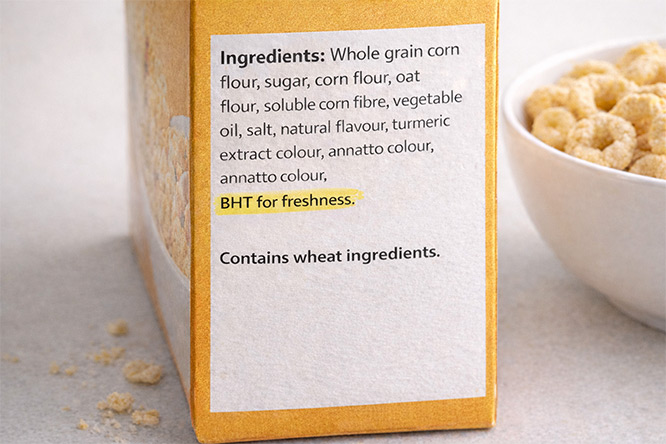
BHT is there for one main reason: freshness. It helps protect fats and oils from oxidation, which is the process that can make food go stale or rancid over time. Simply put, it helps grains stay fresher for longer.
That’s why cereal brands use it. Not because it makes the cereal healthier, but because it helps preserve it taste, color and shelf life. In some products, BHT is added to the food itself. In others, it is used on the packaging, so you may sometimes see wording like “BHT added to package for freshness” on the label.
Why don’t you see BHT in cereals in Europe?
You don’t usually see BHT in cereals in Europe because it is not allowed in breakfast cereals here. But it happens not means that BHT is banned in all foods in Europe. It is still allowed in a few other products, such as chewing gum, some spices and seasonings, and some dietary supplements.
Europe also appears to be taking a more cautious approach to BHT than countries such as the US and Canada, likely due to ongoing safety concerns from older and newer studies.
Which cereals still contain BHT?
Cereal formulations can change and ingredients often differ from country to country. So treat these as examples, not a fixed list and always check the current ingredients list on the box or on the brand’s website.
Examples of cereals that currently list BHT include:
- Kellogg’s Froot Loops
- Kellogg’s Frosted Mini-Wheats Bite Size
- Kellogg’s Extra Cinnamon Granola
- Kellogg’s Extra Granola Almond
- Kellogg’s Mini-Wheats Low Sugar (Canada)
- Post Waffle Crisp
- Post Shredded Wheat Original Big Biscuit
- Post Great Grains Crunchy Pecan
- Post raisins, dates and pecans
- Post Large Grain Banana Nut Crunchy
- Post Great Grains Cranberry Almond Crunch
Most of these examples are from the USA and Canadawhere BHT is still allowed in breakfast cereals. I also found BHT listed Cinnamon Toast Crunch it is sold by Woolworths Australia so it may still appear in the cereal there too
Should you be worried about BHT side effects?
Probably not from the occasional bowl of cereal. The biggest concern, if any, is regular exposure over timeno apparent side effects from a normal serving.
It’s also worth bearing in mind that most of the concern about BHT comes from animal studiesnot strong long-term human studies.
A human cohort study found no significant association between habitually low intake of BHT and stomach cancer, but this still does not prove that BHT is completely harmless.
Which studies have raised concerns?
The main concerns researchers come back to are the liver and reproductive health. These are the areas that official safety reviews have focused on when setting limits for BHT. Some reviews have also raised questions about the potential hormone-related effectsespecially regarding the thyroid.
What about inflammation and cancer?
Some animal studies have shown that BHT can cause inflammation and help promote tumor growth under certain laboratory conditions. That sounds alarming, but these were animal experiments, not proof that the small amounts used in grains affect humans in the same way.
So what is the logical view?
I wouldn’t panic if a cereal contained BHT, but I also wouldn’t call it completely harmless. At present, the strongest concerns come from laboratory and animal research, while good long-term human evidence is still limited.
Does BHT in Cereals Cause Cancer?
There is no good evidence that the small amounts of BHT used in cereals cause cancer in humans. A study looking at usual dietary intake of BHT found no significant association with stomach cancer. Also, anticancer services have not placed BHT in the categories used for ingredients known or likely to cause cancer in humans.
So why do people still worry about it?
Mainly because some older ones animal studies raises concerns. In some laboratory experiments, BHT appeared to help promote tumor growth under certain conditions. This is not the same as showing that eating cereal with BHT causes cancer in humans.
So where does that leave us?
At this point, I wouldn’t say that BHT in grains causes cancer. But I also wouldn’t treat it as an ingredient that’s been completely cleared without question, especially since the stronger certainty we’d want from long-term human evidence just isn’t really there.
Is BHT really safe?
BHT is still under review acceptable within applicable legal limitsbut that doesn’t mean its long-term effects on humans are entirely clear. This is the key to understanding.
Europe has set one acceptable daily intake of 0.25 mg per kg of body weight per dayand Health Canada says BHT is not harmful to human health at current exposure levels.
What does this really mean?
It means regulators do not they currently view BHT as dangerous in the small amounts that humans are typically exposed to through food. But that doesn’t mean the ingredient has been proven to be risk-free without a doubt. Limits exist for a reason.
Why do some people still feel uncertain about it?
Because we still don’t have the strong long-term human evidence that would make people feel completely reassured about regular intake.
Also the fact that The FDA is also reviewing BHT as part of the post-market evaluation of chemicals in food shows that this is still an ingredient worth watching out for.
How to Find BHT-Free Cereals
If you want to avoid BHT, there are many cereals without it. Many use mixed tocopherols Instead, which is a form of vitamin E added to help preserve freshness, simpler options like plain oats don’t need BHT at all.
Some examples include:
- Barbara’s Shredded Wheat
- Original Cheerios
- Honey Nut Cheerios
- Frosted Cheerios
- Multi Grain Cheerios
- Rice Chex
- Corn Chex
- Quaker Old Fashioned Oats
This section matters more if you live somewhere like USA, Canada or Australiawhere BHT may still occur in some grains. In Europe, it is less of a problem because BHT is not allowed in breakfast cereals. As always, ingredient lists are subject to change, so it’s worth checking the label.
Would I avoid BHT in cereal?
Personally, I would avoid BHT in cereals. It’s a synthetic additive, not something that naturally contains the grain, and with so many grains without it, I don’t see much reason to choose one that does.
For me the main issue is uncertainty. We still don’t know enough about the long-term effects of regularly consuming BHT for me to be completely comfortable with it. And when an ingredient isn’t necessary, I’d rather avoid it.
The fact that Europe does not allow BHT in breakfast cereals also gives me pause. That doesn’t prove it’s dangerous, but it does suggest that regulators have seen enough reason to be cautious.
So my advice would be simple: if you eat cereal often, choose one without BHT. There are many good options, and in my opinion, this is the best option.
