



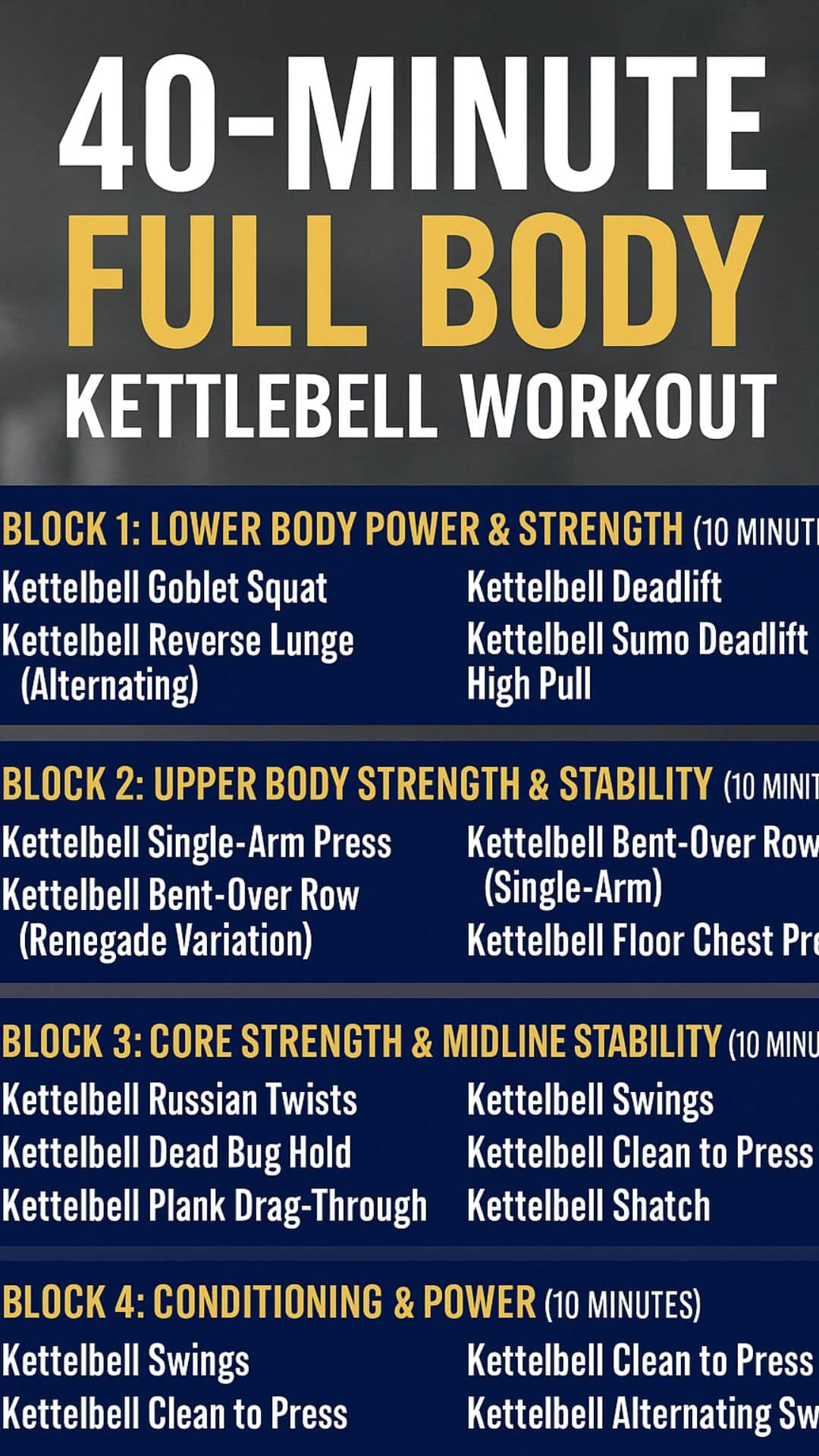
When it comes to building a strong, lean and athletic physique, few tools rival the simplicity and effectiveness of the kettlebell. Whether you’re working out at home, in a busy gym, or creating a time-efficient routine in your mornings, 40 minute full body kettlebell workout it’s one of the most effective ways to cut calories, increase strength, improve mobility, and improve cardiovascular fitness all at the same time.
This routine is designed to target every major muscle group while keeping your heart rate up—making it ideal for fat loss, muscle building, and conditioning. Below, you’ll find a complete 40-minute kettlebell workout plan, detailed exercise breakdowns, workout structure, benefits, and pro tips to maximize your results.
Why a 40 minute Full Body Kettlebell Workout Routine It’s So Effective
Kettlebell training uniquely combines strength, power, stability and conditioning. Its shifted center of mass forces your muscles to work harder, increasing total body tension and core engagement. Unlike traditional weightlifting, kettlebell movements mimic natural human patterns—hinging, squatting, pressing, pulling, and twisting—leading to improved functional strength.
Key Benefits of a 40 Minute Kettlebell Full Body Routine
- Boosts metabolism and enhances fat oxidation long after the workout is over
- Strengthens the core with every lift, swing and pressure
- Improves mobility and athleticism
- Builds lean muscle tissue throughout the upper body, legs, glutes and core
- Increases endurance with dynamic multi-joint movements
- It saves time combining strength and cardio into one powerful session
This routine is suitable for beginners to advanced lifters — you simply adjust the weight of the kettlebell to your level.
Workout Structure: How This 40-Minute Kettlebell Routine Works
The structure is designed for maximum performance:
Total time: 40 minutes
Format: 4 blocks, 10 minutes each
Work/Rest Ratio: 40 seconds work + 20 seconds rest per exercise
Equipment Required: 1–2 kettlebells (light to moderate)
Each 10-minute block targets a different part of the body while still engaging the core and conditioning system.
40 Minute Kettlebell Full Body Workout Routine
Block 1: Lower Body Strength and Power (10 minutes)
This block focuses on the hips, glutes, hamstrings and quads. These movements also get your heart rate up early in the workout.
1. Kettlebell Goblet Squat
Objectives: Quads, glutes, hamstrings, core
The cup squat is a powerful exercise for developing lower body strength while strengthening safe squat mechanics.
How to perform:
Hold the kettlebell at chest height. Sit back on your hips and lower until your thighs are parallel, then drive through your heels to stand tall.
Benefits:
Increases squat depth, builds leg strength and activates the core.
2. Kettlebell Deadlift Full body workout routine
Objectives: Legs, glutes, lower back
This hinge movement strengthens your posterior chain and prepares you for more dynamic lifts.
How to perform:
Stand with feet hip-width apart, kettlebell between your legs. Hinge the hips, keeping the back flat and lift them by driving the hips forward.
Benefits:
Builds gluteal strength, corrects hinge mechanics, reduces back strain.
3. Kettlebell Reverse Lunge (Alternating)
Objectives: Quads, glutes, hamstrings, core stability
Lunges strengthen unilateral weaknesses and improve balance.
How to perform:
Hold the kettlebell against your chest or in a standing position. Go back into a lunge, then return to standing position and switch legs.
Benefits:
It enhances the mobility, stability and symmetry of the legs.
4. Kettlebell Sumo Deadlift High Pull Full body workout routine
Objectives: Inner thighs, glutes, shoulders, traps
This hybrid exercise boosts power output and cardiovascular intensity.
How to perform:
Take a wide stance, grab the kettlebell, stand up explosively, and pull it up to chest height with your elbows up.
Benefits:
It improves conditioning while strengthening the hips and upper back.
Block 2: Upper Body Strength and Stability (10 minutes)
This block hits the shoulders, chest, back and arms. Kettlebell exercises often require more stabilization than dumbbells because of the uneven load.
1. Kettlebell Single-Arm Press
Objectives: Shoulders, triceps, upper chest
Overhead pressing with a kettlebell forces your core to stabilize and prevents asymmetry.
How to perform:
Press the kettlebell overhead while maintaining tight ribs and an engaged core.
Benefits:
It strengthens the shoulders while improving joint stability.
2. Kettlebell Bent-Over Row (Single-Arm) Full body workout routine
Objectives: Lats, rhomboids, biceps
This move combats poor posture and boosts pulling power.
How to perform:
Hinging at the hips, roll the kettlebell toward your hip while keeping your elbow tight.
Benefits:
Improves back strength, posture and grip.
3. Kettlebell Push-Ups with Row (Renegade Variation)
Objectives: Chest, triceps, core, lat
This advanced variation increases upper body tension and core engagement.
How to perform:
Place hands on kettlebell handles, perform a push-up, then row a kettlebell while stabilizing your core.
Benefits:
An upper body burner that also builds core resistance against rotation.
4. Kettlebell Floor Chest Press Full body workout routine
Objectives: Chest, triceps, shoulders
A safer alternative to bench press which reduces shoulder stress.
How to perform:
Lie on your back, press the kettlebells up with your elbows slightly bent.
Benefits:
Ideal for muscle growth and upper body hypertrophy.
Block 3: Core Strength and Midline Stability (10 minutes)
Kettlebells are incredible tools for training the core, especially through loaded carriers, counter-rotation movements, and unilateral lifts.
1. Kettlebell Russian Twists Full body workout routine
Objectives: Oblique stabilizers, deep core
Rotate with control while holding the core.
Benefits:
Improves rotational strength and tightens the midsection.
2. Kettlebell Dead Bug Hold
Objectives: Transverse abdominis, hip flexors
This slow, controlled exercise builds deep core stability.
Benefits:
Strengthens back support and improves movement patterns.
3. Kettlebell Plank Drag-Through Full body workout routine
Objectives: Abs, obliques, shoulders
Slide the kettlebell across your body, preventing hip rotation.
Benefits:
Develops anti-rotation resistance and hard core.
4. Kettlebell Windmill (Beginner or Advanced Variation)
Objectives: Reasons, shoulders, hips
This exercise enhances balance, mobility and stability of the whole body.
Benefits:
Strengthens the core while improving shoulder strength.
Block 4: Conditioning and Power (10 minutes)
This is where the heart-pounding magic happens. These explosive kettlebell moves help burn fat, boost conditioning and build athletic strength.
1. Kettlebell swings Full body workout routine
Objectives: Glutes, hamstrings, lower back, core
The swing is the king of kettlebell exercises for explosive power.
How to perform:
Lean back, drive the hips forward and let the kettlebell swing at chest height.
Benefits:
It burns more calories than almost any other strength movement.
2. Kettlebell Clean to Press Full body workout routine
Objectives: Full body
This compound movement trains the grip, hips, shoulders and core.
Benefits:
Improves strength and coordination.
3. Kettlebell Snatch
Objectives: Shoulders, hips, core
An advanced explosive move that kicks off conditioning.
Benefits:
It builds strength, improves shoulder stability and burns serious calories.
4. Alternating Kettlebell Swings Full body workout routine
Objectives: Butt, back, core
Switching hands mid-swing improves coordination and stability.
Benefits:
Improves grip strength and athletic strength.
Cool down (3–5 minutes)
Proper cooling promotes recovery and reduces pain.
Suggested moves:
- Kettlebell hip flexor stretch
- Seated hamstring stretch
- Stretching of the chest wall
- Deep breathing and spinal decompression
How often should you do this 40 minutes Full Body Kettlebell Workout Routine?
For best results:
2-3 times a week
Rotate with other strength or cardio routines for balanced development.
Best Full Body Kettlebell Workout Routine Weight to use
Choosing the right weight ensures safety and efficiency:
- Beginners: 10–20 lbs
- Intermediate: 25–35 lbs
- Advanced: 40–55+ lbs
For swings and lower body lifts, go heavier than presses and core work.
Pro tips for maximizing Full Body Kettlebell Workout Routine Results
Focus on form over speed
Kettlebell mechanics are technicians—mastering proper form prevents injury and improves results.
Engage the core at all times
Every kettlebell movement is a core movement.
Use explosive hips for power moves
Swings, cleans and grabs rely on hip movement, not arm strength.
Monitor progress weekly
Increase the weight, reps, or block the intensity to keep progressing.
Hydrate and fuel properly
Kettlebell training is intense—support performance with proper nutrition.
Who Is This Full Body Kettlebell Workout Routine Best For?
This routine is ideal for:
- Men who want lean muscle and definition
- Women looking for full body toning
- Busy professionals who need effective workouts
- Home gym users
- Athletes build strength and conditioning
Whether you’re burning fat or building strength, this 40-minute kettlebell workout delivers great results.
Build strength and conditioning all over the body in just 40 minutes of Kettlebell training Routine
The kettlebell is truly one of the most versatile pieces of training equipment. With just one weight and just 40 minutes, you can build strong legs, a stronger upper body, a sculpted core, and better cardiovascular endurance. This full-body kettlebell routine is perfect for anyone who wants maximum workout results with minimal equipment and time.
If you’re ready to improve your fitness, improve your physique, and push your performance to the next level, this workout should become a staple of your weekly routine.
