

Close Menu
Healthtost
  • News
  • Mental Health
  • Men’s Health
  • Women’s Health
  • Skin Care
  • Sexual Health
  • Pregnancy
  • Nutrition
  • Fitness
  • Recommended Essentials
What's Hot

5 Myths About Trauma and Fitness (What the Research Really Shows)

March 15, 2026

I’ll say it again: Don’t kiss the baby

March 15, 2026

March 2026 • Kath Eats

March 15, 2026
Facebook X (Twitter) Instagram
  • About Us
  • Contact Us
  • Privacy Policy
  • Terms and Conditions
  • Disclaimer
Facebook X (Twitter) Instagram
Healthtost
SUBSCRIBE
  • News

    The study highlights the benefits of specialized resource centers for autistic students

    March 15, 2026

    Selfish Chromosomes Tease Overdrive Gene to Eliminate Rival Sperm

    March 14, 2026

    App-based therapy helps men improve control of premature ejaculation

    March 14, 2026

    Scientists win prizes for discovery of genomic imprinting and tumor feeding network

    March 13, 2026

    Using blood proteins to make living brains transparent

    March 13, 2026
  • Mental Health

    How Mental Health Professionals Can Earn CE…

    March 13, 2026

    what teenage girls told us

    March 12, 2026

    The tryptophan switch? Because exercise boosts your mood

    March 8, 2026

    Are you stressed about politics? You wouldn’t expect it, and research shows that social media is largely to blame

    March 4, 2026

    Is It Sadness or Depression? Understand it…

    March 1, 2026
  • Men’s Health

    20 Minute Kettlebell HIIT Full Body Workout That Works

    March 12, 2026

    How social and environmental exposures across the lifespan affect mental health risk

    March 11, 2026

    Insurance covering male infertility procedures improves opportunities for family building

    March 10, 2026

    The fitness test of America’s most elite Citizen Search and Rescue Team

    March 10, 2026

    Love 6.0: Exploring an 82-year-old male therapist

    March 9, 2026
  • Women’s Health

    5 Myths About Trauma and Fitness (What the Research Really Shows)

    March 15, 2026

    Outpatient versus inpatient addiction treatment: How to choose the right level of care

    March 15, 2026

    Stop Making These 10 Weight Loss Mistakes

    March 14, 2026

    7 Natural Alternatives and Supplements to Ozempic, According to Doctors

    March 14, 2026

    Facts about HIV and osteoporosis

    March 13, 2026
  • Skin Care

    Your top 5 skincare questions answered

    March 14, 2026

    How to prevent UV damage and keep your skin healthy

    March 14, 2026

    The ultimate guide to transformative facials in New York

    March 12, 2026

    Is it eczema or acne? How to tell the difference

    March 12, 2026

    Shea Butter Body Wash for Dry Skin – The Natural Wash

    March 11, 2026
  • Sexual Health

    Positive porn, sedentary behavior and consensual non-monogamy — Sexual Health Alliance

    March 15, 2026

    Navigating identity and sexual health as a Vietnamese immigrant

    March 12, 2026

    Affected by lack of estrogen patch? Here are your options.

    March 9, 2026

    SRHM for International Women’s Day

    March 9, 2026

    Can an STD come back after treatment?

    March 8, 2026
  • Pregnancy

    I’ll say it again: Don’t kiss the baby

    March 15, 2026

    The baby is listening to you! Here’s why it matters

    March 13, 2026

    Gentle, supportive care for mothers, through pregnancy, labor and delivery

    March 11, 2026

    Stress and Fertility with Dr Haider Najjar

    March 10, 2026

    Budget Baby Items: The Dos and Don’ts of Buying Used

    March 8, 2026
  • Nutrition

    March 2026 • Kath Eats

    March 15, 2026

    Do pomegranates live up to their health claims?

    March 14, 2026

    Natural strategies for women to restore energy and balance hormones

    March 13, 2026

    How much sodium do you need?

    March 12, 2026

    Anorexia atypical: Eating disorders in larger bodies

    March 11, 2026
  • Fitness

    How to prevent joint pain during exercise after 50

    March 14, 2026

    What you need to know before you inject anything

    March 13, 2026

    Here’s why – Tony Gentilcore

    March 9, 2026

    10 Healthy Things to Do While Fasting

    March 9, 2026

    Over 50 and not sleeping well? These simple mobility moves can help

    March 8, 2026
  • Recommended Essentials
Healthtost
Home»Nutrition»Synchronizing your brain and body clocks
Nutrition

Synchronizing your brain and body clocks

healthtostBy healthtostMay 9, 2024No Comments5 Mins Read
Facebook Twitter Pinterest LinkedIn Tumblr Reddit WhatsApp Email
Synchronizing Your Brain And Body Clocks
Share
Facebook Twitter LinkedIn Pinterest WhatsApp Email

Exposure to bright light synchronizes the central circadian clock in our brain, while proper meal timing helps synchronize the timing of different clock genes throughout the rest of our body.

One of the most important discoveries of recent years he’s got was the discovery of “peripheral clocks”. We have known for decades about the central clock — the so-called suprachiasmatic nucleus. It sits in the middle of our brain just above where our optic nerves cross, allowing it to respond to day and night. Now we know there too is semi-autonomous clocks in almost every organ in our body. Our heart works with a clock, our lungs work with one, and so do our kidneys, for example. In fact, up to 80 percent of the genes in our liver are is expressed in a circadian rhythm.

Our entire digestive system is, very. The rate at which our stomach empties, the secretion of digestive enzymes, and the expression of transporters in our intestinal lining for the absorption of sugar and fat are cycled around the clock. The same goes for our body fat’s ability to absorb extra calories. The way we know these circles is is driven from local clocks, rather than being controlled by our brains, is that you can take surgical biopsies of fat, put them in a petri dish, and watch them continue to emit a rhythm.

All this talk about the clock isn’t just biological curiosity. Our health may depend on keeping everything in sync. “Imagine a child game on a swing.” Imagine yourself pushing, but you are distracted by what is happening around you on the playground and stop paying attention to the timing of the push. So you forget to push, or you push too early or too late. What Out of sync, the swing becomes erratic, slows down or even stops. This happens when we travel across time zones or have to work the night shift.

The “impulse” in this case is the bright marks falling on our eyes. Our circadian rhythm is meant to get a “boost” from bright light every morning at dawn, but if the sun rises at a different time or we’re exposed to bright light in the middle of the night, this can throw our cycle out of sync and out of sync. to feel inadequate. This is an example of a mismatch between the external environment and our central clock. Problems can also arise from a misalignment between the central clock in our brain and all the other organ clocks throughout our body. An extreme illustration of this is a remarkable set of experiments suggesting that even our poop can get jet lagged.

As you can see below and at 2:31 in my video How to synchronize your central circadian clock with your peripheral clocksour microbiome seems to I have its own circadian rhythm.

Even though bacteria are down where the sun don’t shine, there is a daily fluctuation in both bacterial abundance and activity in our colon, as you can see in the chart below and at 2:43 in my video. Interesting, but who cares? Everyone should.
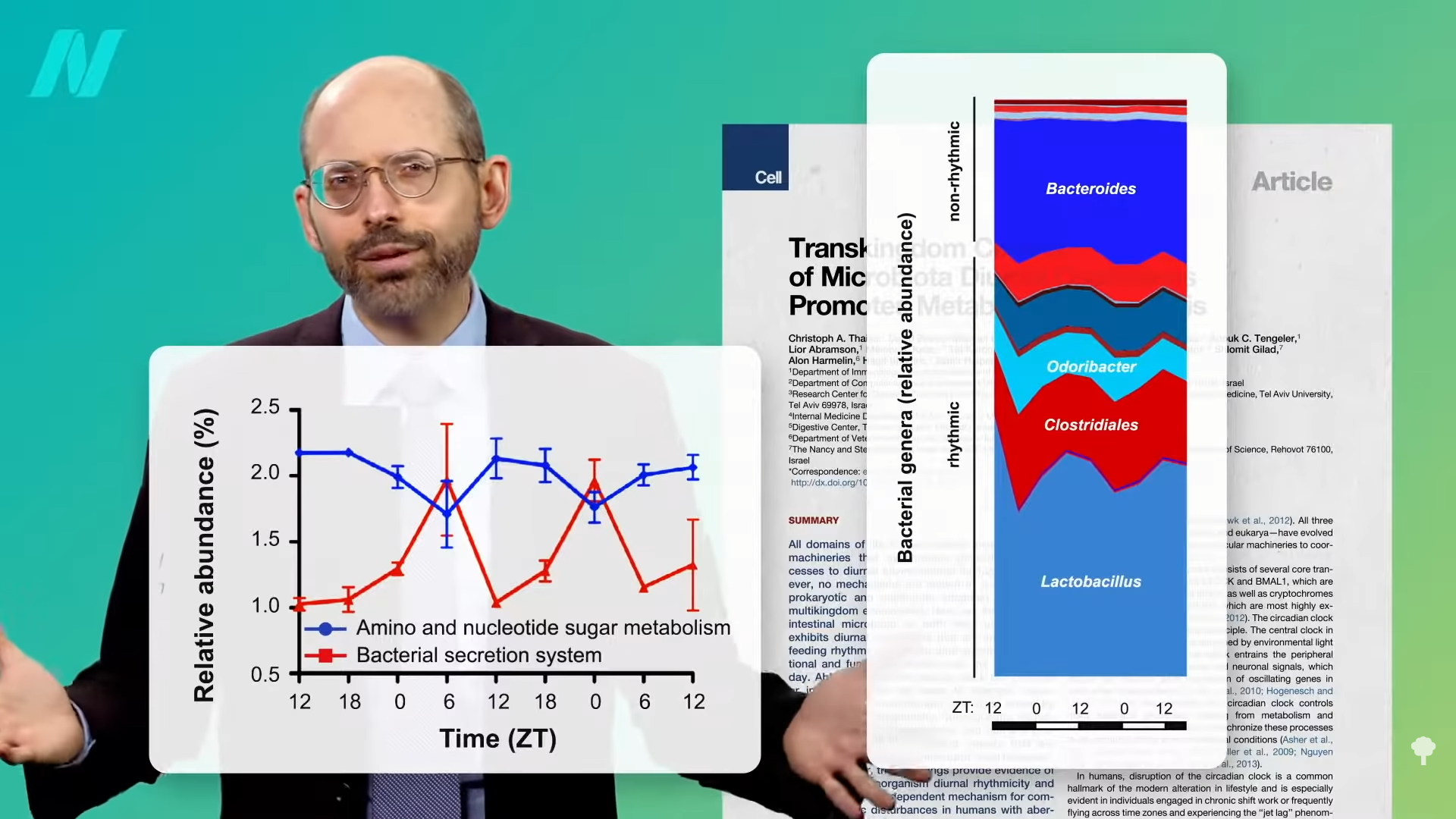
Check this out: If you put people on a plane and fly them halfway around the world, then feed their poop to mice, those mice get fatter than mice fed feces before the flight. The researchers suggest that the fattening flora was a consequence of “circadian misalignment”. Indeed, many lines of evidence now involve “chronism”—the condition in which our central and peripheral clocks drift out of sync—as game role in conditions such as premature aging and cancer, as well as fluctuates in others such as mood disorders and obesity.

Exposure to bright light is the synchronizing oscillating drive for our central clock. What leads our internal organ clocks that are not exposed to daylight? Food intake. This is why the timing of our meals can be so important. Researchers was removed all external timing cues by keeping study participants in constant dim light and found that you could effectively uncouple central from peripheral rhythms simply by varying meal times. They took blood samples every hour and biopsies of the subjects’ fat every six hours to demonstrate the resulting metabolic derangement.

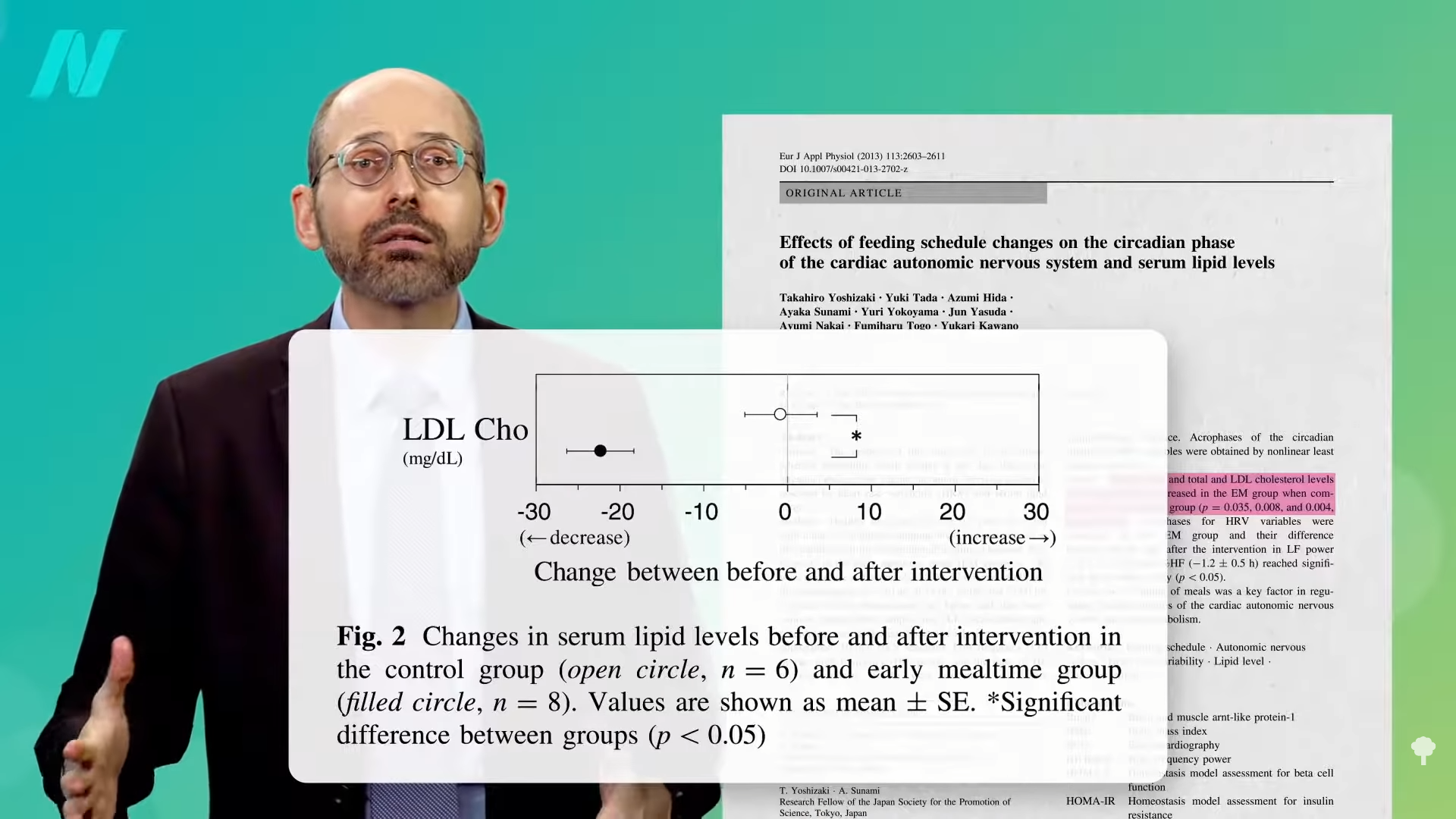
Just as morning light can help synchronize the central clock in our brains, morning meals it can help synchronize our peripheral clocks throughout the rest of our body. Skipping breakfast disrupts the normal expression and rhythm of these same clock genes, which coincides with adverse metabolic effects. Fortunately, they can be reversed. I get a group that used to skip breakfast and have them eat three meals at 8:00 a.m., 1:00 p.m. and 6:00 p.m., and their cholesterol and triglycerides improved, compared to eating meals five hours later at 1:00 p.m., 6:00 p.m., and 11:00 p.m. There is circadian rhythm in cholesterol synthesis in the body, which is also “strongly influenced by food intake.” This is demonstrated by the 95 percent drop in cholesterol production in response to a day of fasting. That is why a shift in meal times of just a few hours can results in a 20-point drop in LDL cholesterol thanks to eating meals earlier, as you can see below and at 5:00 video.
If exposure to light and meal times help to synchronize everything, what happens when circumstances prevent us from following a normal cycle of the day? We will learn inside The metabolic damage of night shifts and irregular meals. If you’re just getting into the series, be sure to check out the related posts below.

body brain clocks Synchronizing
bhanuprakash.cg
healthtost
  • Website

Related Posts

March 2026 • Kath Eats

March 15, 2026

Do pomegranates live up to their health claims?

March 14, 2026

Natural strategies for women to restore energy and balance hormones

March 13, 2026

Leave A Reply Cancel Reply

Don't Miss
Women's Health

5 Myths About Trauma and Fitness (What the Research Really Shows)

By healthtostMarch 15, 20260

Trauma can profoundly affect people’s psychological well-being. This is not controversial. But when we move…

I’ll say it again: Don’t kiss the baby

March 15, 2026

March 2026 • Kath Eats

March 15, 2026

The study highlights the benefits of specialized resource centers for autistic students

March 15, 2026
Stay In Touch
  • Facebook
  • Twitter
  • Pinterest
  • Instagram
  • YouTube
  • Vimeo
TAGS
Baby benefits body brain cancer care Day Diet disease exercise Fitness food Guide health healthy heart Improve Life Loss Men mental Natural Nutrition Patients People Pregnancy protein research reveals risk routine sex sexual Skin Skincare study Therapy Tips Top Training Treatment ways weight women Workout
About Us
About Us

Welcome to HealthTost, your trusted source for breaking health news, expert insights, and wellness inspiration. At HealthTost, we are committed to delivering accurate, timely, and empowering information to help you make informed decisions about your health and well-being.

Latest Articles

5 Myths About Trauma and Fitness (What the Research Really Shows)

March 15, 2026

I’ll say it again: Don’t kiss the baby

March 15, 2026

March 2026 • Kath Eats

March 15, 2026
New Comments
    Facebook X (Twitter) Instagram Pinterest
    • About Us
    • Contact Us
    • Privacy Policy
    • Terms and Conditions
    • Disclaimer
    © 2026 HealthTost. All Rights Reserved.

    Type above and press Enter to search. Press Esc to cancel.