

Close Menu
Healthtost
  • News
  • Mental Health
  • Men’s Health
  • Women’s Health
  • Skin Care
  • Sexual Health
  • Pregnancy
  • Nutrition
  • Fitness
  • Recommended Essentials
What's Hot

Study links gut microbiome imbalance to worsening kidney disease

March 20, 2026

The Nitty Gritty About Prostate Cancer and Screening

March 20, 2026

What is rosemary extract for hair?

March 20, 2026
Facebook X (Twitter) Instagram
  • About Us
  • Contact Us
  • Privacy Policy
  • Terms and Conditions
  • Disclaimer
Facebook X (Twitter) Instagram
Healthtost
SUBSCRIBE
  • News

    Study links gut microbiome imbalance to worsening kidney disease

    March 20, 2026

    Genetic risk for Alzheimer’s disease may be modified by higher meat intake

    March 19, 2026

    Siemens Healthineers Launches Brain Health Research Portfolio With First Biomarker Tests Now Available

    March 19, 2026

    The snail-derived compound prevents blood clots while maintaining normal bleeding

    March 18, 2026

    Sartorius launches next-generation platform to boost efficiency in cell therapy production

    March 18, 2026
  • Mental Health

    Anxiety and ADHD can overlap—here’s how to untangle these widespread mental health disorders

    March 16, 2026

    How Mental Health Professionals Can Earn CE…

    March 13, 2026

    what teenage girls told us

    March 12, 2026

    The tryptophan switch? Because exercise boosts your mood

    March 8, 2026

    Are you stressed about politics? You wouldn’t expect it, and research shows that social media is largely to blame

    March 4, 2026
  • Men’s Health

    The Nitty Gritty About Prostate Cancer and Screening

    March 20, 2026

    Low testosterone almost broke me

    March 19, 2026

    How a dose of antibiotic can reshape your gut microbiome for years

    March 18, 2026

    Dr. Michelle Quist Ryder on Social Connection, Elements of Belonging, and Loneliness on Vacation

    March 17, 2026

    6 Lifesaving Skills Every Man Should Know

    March 17, 2026
  • Women’s Health

    What is rosemary extract for hair?

    March 20, 2026

    Eliminate Your Daily Stimulant Fix! Here’s how to eat for sustained energy throughout the day

    March 19, 2026

    How Becoming a Faster Trainer Changed My Life (and 4x My Gross Income) – Sarah Fit

    March 18, 2026

    When ‘Affordable’ Means Risk: What Disastrous Health Plans Can Mean for Black Women

    March 18, 2026

    49 Years of Women’s Power

    March 17, 2026
  • Skin Care

    Facials Los Angeles: The Best Event-Ready Treatments to Book

    March 19, 2026

    Winter skincare essentials – The natural wash

    March 18, 2026

    Before Tropic had awards, an extensive range of products or millions of C – Tropic Skincare

    March 18, 2026

    How long does Jeuveau last? Comparison of results with Botox

    March 17, 2026

    Your top 5 skincare questions answered

    March 14, 2026
  • Sexual Health

    Queer Muslims find community through Ramadan

    March 17, 2026

    The law and self-administered abortion during COVID19 and beyond < SRHM

    March 16, 2026

    Can you get an STD from a sex toy?

    March 16, 2026

    Positive porn, sedentary behavior and consensual non-monogamy — Sexual Health Alliance

    March 15, 2026

    Navigating identity and sexual health as a Vietnamese immigrant

    March 12, 2026
  • Pregnancy

    Is stress in the third trimester affecting your baby?

    March 20, 2026

    Cattle Reproductive Tissue Supplement Guide – Pink Stork

    March 19, 2026

    Choosing the best online prenatal fitness instructor course

    March 17, 2026

    I’ll say it again: Don’t kiss the baby

    March 15, 2026

    The baby is listening to you! Here’s why it matters

    March 13, 2026
  • Nutrition

    Easy St. Patrick’s Day Cupcakes with Green Frosting and Rainbow Candy

    March 19, 2026

    Why GLP-1s change your relationship with food

    March 15, 2026

    March 2026 • Kath Eats

    March 15, 2026

    Do pomegranates live up to their health claims?

    March 14, 2026

    Natural strategies for women to restore energy and balance hormones

    March 13, 2026
  • Fitness

    Disney Fantasy Cruise Nassau and Lookout Cay

    March 19, 2026

    How Comparison Fuels Anxiety (and How to Break the Cycle)

    March 18, 2026

    The 5 Best Hobbies That Double as Therapy After 50

    March 17, 2026

    What is BHT in Cereals? Is it bad for you?

    March 17, 2026

    How to build a simple home gym that supports long-term healthy living

    March 15, 2026
  • Recommended Essentials
Healthtost
Home»News»Mediterranean and MIND diets boost memory retention in middle age
News

Mediterranean and MIND diets boost memory retention in middle age

healthtostBy healthtostFebruary 6, 2024No Comments4 Mins Read
Facebook Twitter Pinterest LinkedIn Tumblr Reddit WhatsApp Email
Mediterranean And Mind Diets Boost Memory Retention In Middle Age
Share
Facebook Twitter LinkedIn Pinterest WhatsApp Email

A study published in the journal Alzheimer’s Research & Treatment describes that the Mediterranean and MIND diets could effectively preserve episodic and visuospatial working memory in middle age.

Study: Dietary patterns and cognitive performance in a UK twin women’s registry (TwinsUK). Image credit: DiViArt / Shutterstock

Record

Age-related cognitive decline is a public health concern as it can affect morbidity and mortality. Although most people experience cognitive decline in middle age, the rate of cognitive decline can vary greatly among individuals depending on their cardiovascular health and lifestyle behaviors. A faster-than-usual rate of cognitive decline with age may be a risk factor for Alzheimer’s disease.

Nutrient-rich dietary patterns, such as the Mediterranean (MED) and the Mediterranean Dietary Approach to Stop Hypertension Intervention for Neurodegenerative Delay (MIND) diets, are known to have neuroprotective and cognitive abilities. In this context, evidence suggests that the MED diet can improve cognitive functions by positively affecting the gut microbiota.

In this study, scientists investigated the impact of the MED and MIND diets on cognitive function and 10-year change in cognitive performance in cognitively healthy female twins.

Study design

The study analyzed data obtained from the UK Adult Twin Registry that enrolled healthy female twins between 1992 and 2004. A total of 509 twins who had complete baseline data on diet and cognitive performance between 1998 and 2000 were included in the analysis. of twins, 34% were monozygotic (genetically identical) and 66% were dizygotic (50% identical genes).

Baseline dietary intake was assessed using a food frequency questionnaire. Dietary intake data were used to calculate diet scores for the MED and MIND dietary patterns. A higher nutritional score is indicative of higher adherence to the respective diets.

Participants’ cognitive performance was assessed at baseline and after ten years (2008 – 2010). Six types of cognitive functions were examined, including reaction speed, spatial working memory, episodic memory, visual episodic memory, decision time, and visuospatial working memory.

Fecal samples were collected from the participants at the 10-year follow-up to analyze the gut microbiota.
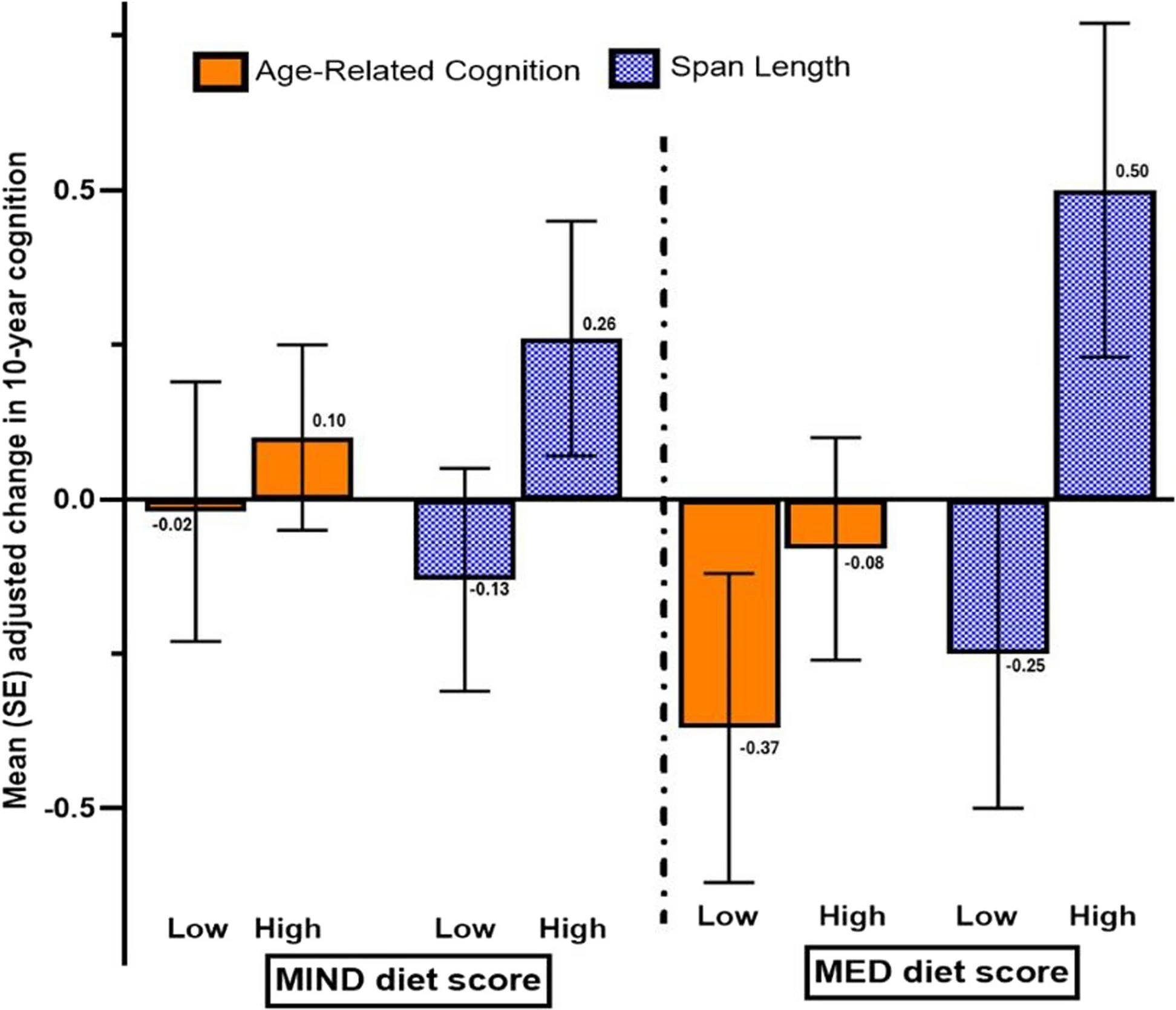
Change in adjusted mean (SE).  Age-related cognitive ability and span length over 10 years in MZ twins discordant for MIND and MED diet scoreChange in adjusted mean (SE). Age-related cognitive ability and span length over 10 years in MZ twins discordant for MIND and MED diet score

Important observations

Assessment of the effect of dietary patterns on baseline cognitive performance revealed no significant correlation between MED diet scores and cognitive test scores. For the MIND diet, each 1-point increase in diet score was found to be associated with faster reaction time and better visual episodic memory after adjusting for demographic, health, and lifestyle confounders.

Evaluation of the effect of dietary patterns on cognitive performance over a 10-year follow-up revealed that increasing adherence to the MED or MIND diet was associated with improved episodic memory.

Assessment of the effect of dietary patterns on 10-year change in cognitive performance in discordant monozygotic twin pairs revealed that the monozygotic twin with a high diet score has less decline in global cognitive ability overall. However, this difference was not statistically significant.

Within each monozygotic pair, the twin with high MED or MIND diet scores showed greater preservation of visuospatial working memory. This observation was significant for the MED diet. No significant effect of MED or MIND diet was observed on 10-year change in other cognitive performance in discordant monozygotic twins.

Regarding the relationship between dietary patterns and gut microbiota, the findings revealed that high adherence to the MIND diet at baseline was associated with higher abundance Ruminococcaceae UCG-010 (short-chain fatty acid-producing bacteria) and lower abundance Dorea at 10-year follow-up. This association became non-significant after adjustment for dietary fiber intake.

Further analysis revealed that greater abundance Ruminococcaceae UCG-010 is associated with lower decline in global cognition and improved spatial working memory at 10-year follow-up.

Importance of study

The study finds that both the MED and MIND diets could effectively preserve episodic and visuospatial working memory in middle age. These neuroprotective effects could be attributed to the high dietary fiber content and increased abundance of short-chain fatty acid-producing bacteria in the gut.

As the scientists report, the possible influence of unidentified genetic factors on the study results in the entire study population cannot be ruled out, as the same pattern of cognitive improvement has not been found in monozygotic twins.

Future studies should include longer follow-up with repeated cognitive assessments to understand the impact of nutrition on cognitive performance in older age.

age Boost diets Mediterranean memory middle mind retention
bhanuprakash.cg
healthtost
  • Website

Related Posts

Study links gut microbiome imbalance to worsening kidney disease

March 20, 2026

Genetic risk for Alzheimer’s disease may be modified by higher meat intake

March 19, 2026

Siemens Healthineers Launches Brain Health Research Portfolio With First Biomarker Tests Now Available

March 19, 2026

Leave A Reply Cancel Reply

Don't Miss
News

Study links gut microbiome imbalance to worsening kidney disease

By healthtostMarch 20, 20260

Researchers at the UC Davis School of Medicine have revealed how an imbalanced gut microbiome…

The Nitty Gritty About Prostate Cancer and Screening

March 20, 2026

What is rosemary extract for hair?

March 20, 2026

Is stress in the third trimester affecting your baby?

March 20, 2026
Stay In Touch
  • Facebook
  • Twitter
  • Pinterest
  • Instagram
  • YouTube
  • Vimeo
TAGS
Baby benefits body brain cancer care Day Diet disease exercise Fitness food Guide health healthy heart Improve Life Loss Men mental Natural Nutrition Patients People Pregnancy protein research reveals risk routine sex sexual Skin Skincare study Therapy Tips Top Training Treatment ways weight women Workout
About Us
About Us

Welcome to HealthTost, your trusted source for breaking health news, expert insights, and wellness inspiration. At HealthTost, we are committed to delivering accurate, timely, and empowering information to help you make informed decisions about your health and well-being.

Latest Articles

Study links gut microbiome imbalance to worsening kidney disease

March 20, 2026

The Nitty Gritty About Prostate Cancer and Screening

March 20, 2026

What is rosemary extract for hair?

March 20, 2026
New Comments
    Facebook X (Twitter) Instagram Pinterest
    • About Us
    • Contact Us
    • Privacy Policy
    • Terms and Conditions
    • Disclaimer
    © 2026 HealthTost. All Rights Reserved.

    Type above and press Enter to search. Press Esc to cancel.