


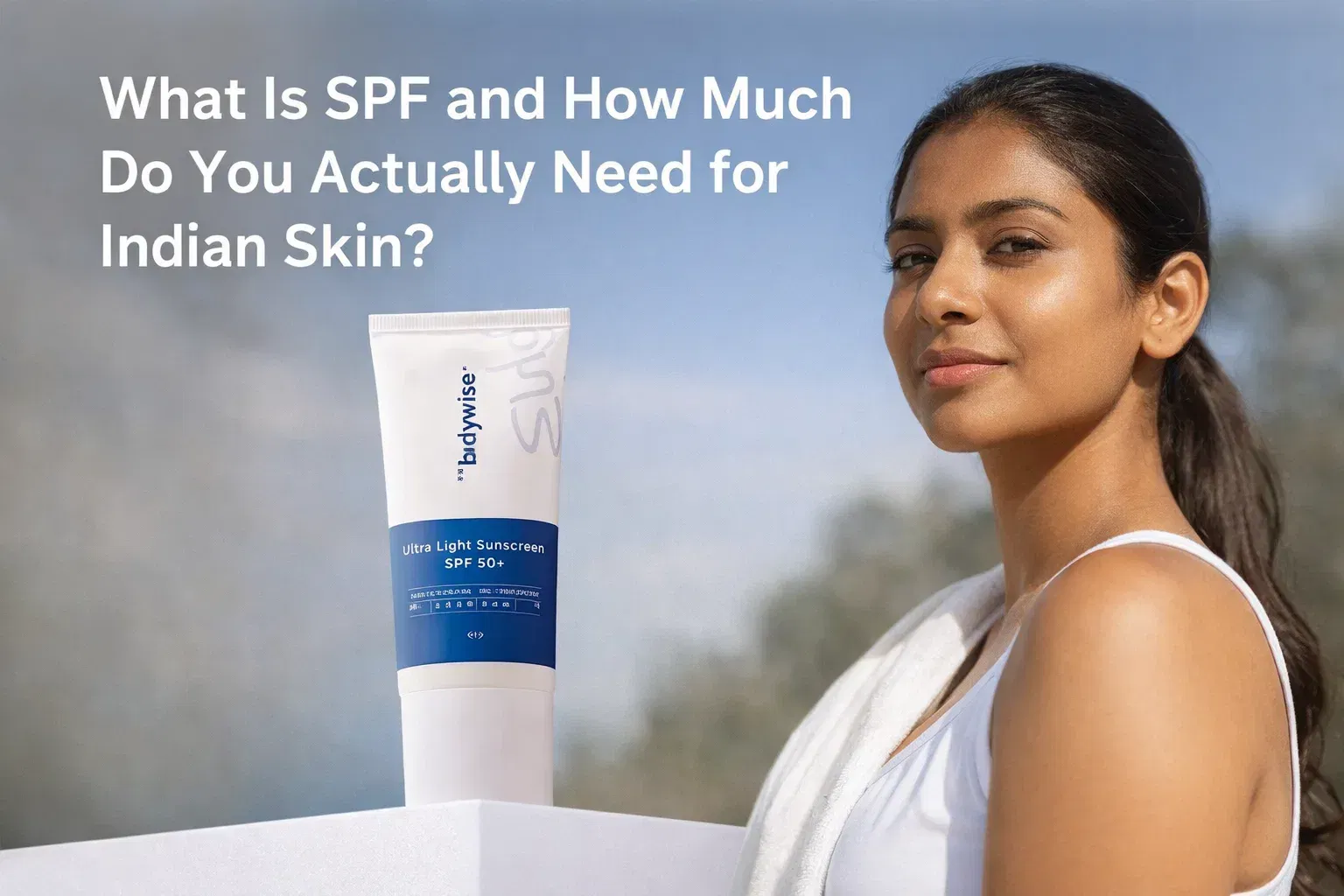
If you’ve ever stood in a skincare aisle looking at SPF 15, SPF 30, and SPF 50 wondering what the difference really is—you’re not alone. The number on the bottle sounds clear. Is not.
Find out what SPF actually means, why Indian skin has specific needs, and how to stop guessing.
What does SPF actually mean?
SPF stands for Sun Protection Factor. It measures how well a sunscreen protects your skin from UVB rays – the rays responsible for sunburn and contributing to skin cancer.
But the number doesn’t work the way most people think. SPF 30 does not mean double the protection of SPF 15.
Here’s the actual math:
- SPF 15 blocks about 93% of UVB rays
- SPF 30 blocks about 97% of UVB rays
- SPF 50 blocks about 98% of UVB rays
The difference between SPF 30 and SPF 50 is about 1% more UVB blocked. Small gap – but important for prolonged sun exposure, which is the daily reality in India.
Does melanin give Indian skin natural SPF?
Yes – but much less than people assume.
Melanin, the pigment that gives Indian skin its tone, offers some basic UV protection. Dermatologists estimate this to be roughly equivalent to SPF 2–4 naturally. This is not enough for a country where UVI levels regularly reach 8-11 (very high to extreme) in most cities.
The myth that “darker skin doesn’t need sunscreen” is why many Indian women experience hyperpigmentation, uneven skin tone and premature aging sooner than they expect.
How much SPF do you really need?
The honest answer depends on your day, not just your skin tone.
For mostly indoor days (with windows): SPF 30 is a reasonable minimum. UVA rays – the aging rays – penetrate the glass. Even if you never go outside, your skin is exposed.
For daily commuting or outdoor exposure of less than 30 minutes: SPF 30–50.
For extended outdoor time – travel, sports, movement in open vehicles: SPF 50 minimum, reapplied every 2 hours.
Dermatologists in India widely recommend SPF 50 as an everyday standard, not a special occasion product. The margin of extra protection it offers above SPF 30 is worth it given the Indian UV intensity.
Be Bodywise- Telehealth Platform for Women’s Health and Wellness
Here is a list of all our products at Be Bodywise. Happy shopping! Get free online advice from our team of women’s health and wellness doctors and choose from a variety of products to suit your skincare, hair and nutritional needs.

What is In Vivo vs In Vitro SPF Testing?
This is important to understand – not all SPF claims are created equal.
In vitro tests measures SPF in a laboratory environment, on a glass plate. It is standard, but less accurate.
In Vivo Tests measures SPF directly on human skin. It is the gold standard because it reflects actual performance – how the sunscreen actually protects you when you wear it.
When choosing a sunscreen, look for one that has been tested In Vivo. It is an important sign of clinical rigor.
What is a PA rating and does it matter?
SPF only measures UVB protection. The PA rating – the plus signs you see (+, ++, +++, ++++) – measures UVA protection.
UVA rays are responsible for skin aging, dark spots and pigmentation. They penetrate deeper and don’t cause a visible sunburn, so people often ignore them. It shouldn’t.
For Indian skin prone to hyperpigmentation: PA++++ is the goal. This represents the maximum UVA protection currently rated.
How much sunscreen should you really be wearing?
Most people apply 20-25% of the recommended amount and wonder why they tan despite using SPF 50.
The standard guideline is the two finger rule for the face: press the sunscreen along your index and middle finger – this is about the right amount for the face and neck.
For SPF to work as advertised, you need to apply the right amount. Applying too little is equivalent to using a lower SPF.
How to choose the right SPF for Indian skin
- Look for SPF 50 with PA++++ — this is the practical daily standard for Indian UV levels
- Tested on Vivo it is more reliable than In Vitro alone
- Check for no hormone disruptor claims — some chemical sunscreens have raised safety concerns; certified testing addresses this issue
- No fragrance, no alcohol — cause irritation under sun exposure
- Non-foodborne — particularly important for acne-prone skin
For daily face use, a lightweight SPF 50+ that’s In Vivo tested and certified free of harmful endocrine disruptors is worth considering. Be Bodywise’s Ultra Light Sunscreen SPF50+ meets In Vivo and In Vitro testing standards, is fragrance-free and designed with Korean anti-acne technology – making it suitable for acne-prone and sensitive skin. Compare test certifications and formulation before choosing.
FAQ
Q: Is SPF 50 enough for Indian summer?
Yes, SPF 50 with PA++++ is the right standard for the Indian climate – as long as you apply enough and reapply every 2 hours during outdoor activity.
Q: Does SPF in foundation or BB cream count?
Only if applied in the right amount, which most people don’t do with makeup. Treat SPF in foundation as a bonus, not as primary protection.
Q: Do I need sunscreen in winter or on cloudy days?
Yes. UVA rays pass through clouds and are present all year round. Cloud cover reduces UV radiation by about 20% – not enough to skip SPF.
Q: Can I skip moisturizer if my sunscreen is moisturizing?
If the sunscreen is moisturizing enough for your skin type, yes. Check the ingredient list for humectants like hyaluronic acid or glycerin.
Q: How soon before going out should I apply sunscreen?
Chemical sunscreens take about 20-30 minutes to bind to the skin. Mineral sunscreens work immediately. Apply accordingly.
Q: Does sunscreen run out?
Yes. Most sunscreens have a shelf life of 12-24 months after opening. Expired sunscreen degrades and offers reduced protection.

If you’re exploring SPF options suitable for Indian skin, there are dermatologist-tested formulations made specifically for the Indian climate and skin tones bebodywise.com.
