

Close Menu
Healthtost
  • News
  • Mental Health
  • Men’s Health
  • Women’s Health
  • Skin Care
  • Sexual Health
  • Pregnancy
  • Nutrition
  • Fitness
  • Recommended Essentials
What's Hot

The FDA-cleared ADHD device is not effective in reducing symptoms

January 16, 2026

Escape Gym Groundhog Day: Why your workout takes seasons

January 16, 2026

Your ultimate guide to climax and orgasm control

January 16, 2026
Facebook X (Twitter) Instagram
  • About Us
  • Contact Us
  • Privacy Policy
  • Terms and Conditions
  • Disclaimer
Facebook X (Twitter) Instagram
Healthtost
SUBSCRIBE
  • News

    The FDA-cleared ADHD device is not effective in reducing symptoms

    January 16, 2026

    Incretin-based diabetes drugs show possible protective effects against dementia

    January 16, 2026

    Does night work increase the risk of osteoporosis?

    January 15, 2026

    Scientists uncover promising therapeutic target for autoimmune disease that affects the brain

    January 15, 2026

    Long-term singles experience a sharper decline in life satisfaction and well-being

    January 14, 2026
  • Mental Health

    How to apply for a fully funded PhD in the UK

    January 8, 2026

    9 Secrets on How to Stop Procrastinating

    January 6, 2026

    Setting boundaries for self-care in 2026

    January 4, 2026

    In a world of digital money, what is the proper etiquette for splitting the bill with friends?

    January 1, 2026

    Rest is essential during the holidays, but it can mean getting active, not crashing on the couch

    December 26, 2025
  • Men’s Health

    Escape Gym Groundhog Day: Why your workout takes seasons

    January 16, 2026

    What is Blue Collar Guilt?

    January 14, 2026

    Glucose stability in diabetes is enhanced by natural daylight

    January 10, 2026

    I reconcile my father’s anger and mine: some hills don’t deserve to die

    January 10, 2026

    How to get enough sunlight in winter

    January 9, 2026
  • Women’s Health

    What really works? – Vuvatech

    January 16, 2026

    What is mental wellness and how does it differ from mental health?

    January 14, 2026

    Beyond weight loss: How GLP-1 ‘miracle drugs’ are revolutionizing whole-body health

    January 14, 2026

    8 Simple Food Swaps to Improve Your Health

    January 13, 2026

    Ways Omega-3s Benefit Women Specifically

    January 13, 2026
  • Skin Care

    An OUMERE Scientific and Regul – OUMERE

    January 16, 2026

    Collagen Induction Treatments in Rittenhouse Square

    January 15, 2026

    🥜⚠️ Why nut allergies are on the rise—and what it means for its future

    January 14, 2026

    Postnatal massage: Benefits, timing and what to book

    January 13, 2026

    Prepare your lips for the cold with TNW Lip Balm – The Natural Wash

    January 12, 2026
  • Sexual Health

    Your ultimate guide to climax and orgasm control

    January 16, 2026

    Stillbirths may be more common in US than previously known—Study

    January 14, 2026

    COVID-19 heightens vulnerabilities for women asylum seekers and refugee women in South Africa < SRHM

    January 14, 2026

    What does an unclear test result mean?

    January 13, 2026

    Relationship diversity, conflict, and why it matters for sex counselor certification — Sexual Health Alliance

    January 12, 2026
  • Pregnancy

    Weighing in: How GLP-1s fit into your pregnancy plans

    January 15, 2026

    5 foods, 4 habits, 3 reminders

    January 14, 2026

    I’m pregnant… Now what? 13 Things You Should Do Right Now

    January 14, 2026

    Which vitamins and minerals are important to consume during pregnancy?

    January 12, 2026

    Supporting emotional development in our children and ourselves – Podcast Ep 194

    January 11, 2026
  • Nutrition

    Sliced ​​meatballs | The Nutritionist Reviews

    January 16, 2026

    5-ingredient skillet dinner recipe

    January 15, 2026

    Family sheet-Gnocchi pan with vegetables and chicken sausage (30 minutes!)

    January 15, 2026

    3 Easy, Nutritious Salads – JSHealth

    January 13, 2026

    What to Eat During Weeks 2-4 on GLP-1: Simple Protein Plan | glp-1, weight loss, medical weight loss and more

    January 13, 2026
  • Fitness

    Not sure your multivitamin is working? 3 ways the signal could be missing

    January 16, 2026

    Barbell RDL: Proper Form & Benefits

    January 15, 2026

    Lazy high protein dinners that I make when I don’t feel like cooking

    January 15, 2026

    Behavioral health 101: What it means and why it matters

    January 14, 2026

    Snack smarter this New Year: 5 healthy low-calorie options

    January 13, 2026
  • Recommended Essentials
Healthtost
Home»News»Gut bacteria have been found to produce serotonin and enhance intestinal motility
News

Gut bacteria have been found to produce serotonin and enhance intestinal motility

healthtostBy healthtostOctober 22, 2025No Comments6 Mins Read
Facebook Twitter Pinterest LinkedIn Tumblr Reddit WhatsApp Email
Gut Bacteria Have Been Found To Produce Serotonin And Enhance
Share
Facebook Twitter LinkedIn Pinterest WhatsApp Email

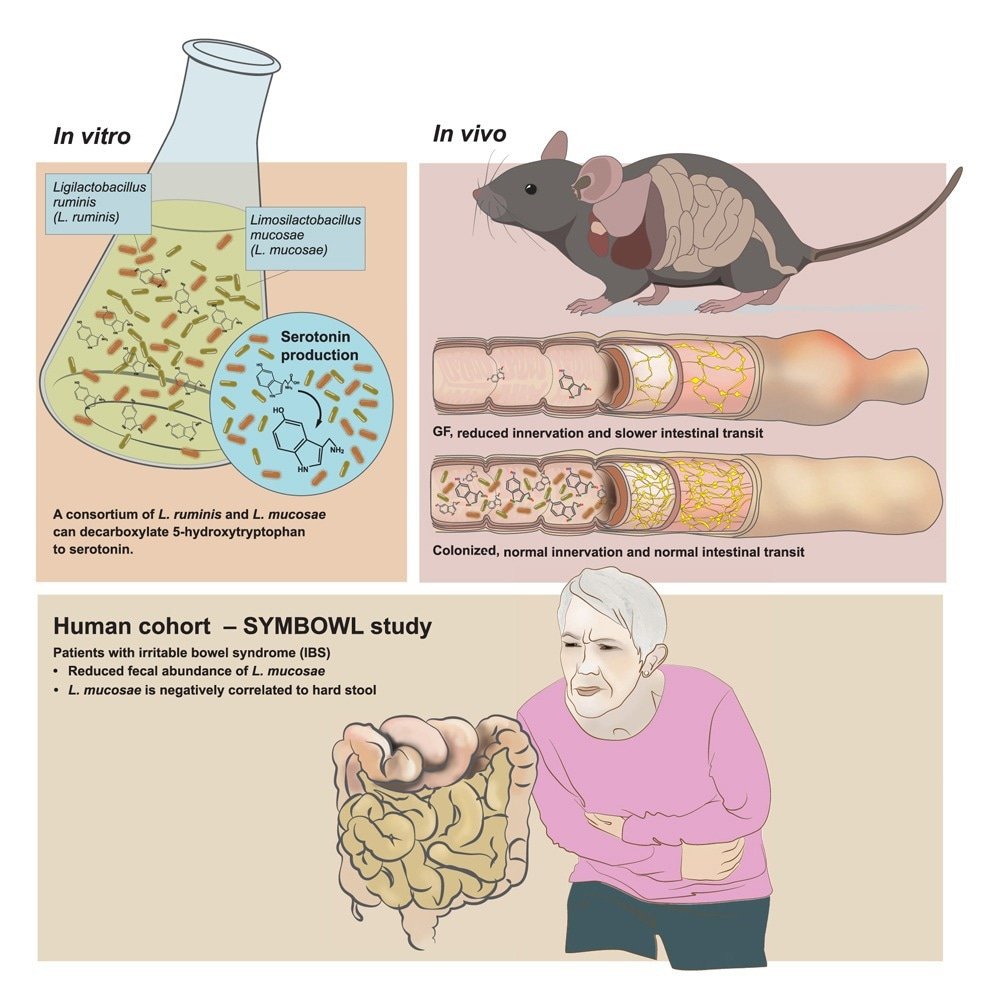
Scientists have discovered two human gut microbes that produce serotonin, revealing how microbial chemistry can shape gut motility and nerve connectivity and opening up new possibilities for treating gut disorders like IBS.

Study: Identification of human gut bacteria that produce bioactive serotonin and promote colonic innervation.

In a recent study published in the journal Cell referencesresearchers identified human intestinal substances that decarboxylate 5-hydroxytryptophan (5-HTP) to produce serotonin.

Serotonin is an important signaling molecule in the gut, mediating gastrointestinal functions such as vasodilation, visceral sensitivity, and peristalsis. Abnormal serotonin signaling is involved IBS pathogenesis. The gut accounts for about 95% of the body’s serotonin pool. Mammalian enterochromaffin cells produce serotonin from tryptophan (Trp).

Studies have shown that the gut microbiota up-regulates the host’s production of serotonin Tph1 expression. Disrupting the gut microbiota with the use of antibiotics has been shown to shrink the colon Tph1 expression and serotonin levels. While serotonin has been detected in culture media of facultative anaerobes, incl Escherichia colithere is no evidence for microbial production of serotonin in the gut. However, in this study, microbial serotonin was derived from decarboxylation of 5-HTP and not from hydroxylation of Trp to 5-HTP.

The study and findings

The present study identified human gut bacteria that produce serotonin. First, the researchers compared serum and fecal serotonin levels Tph1– incomplete (Tph1-/-) and wild type (Tph1+/+) raised conventionally (CONV-R) and germ-free (GF) mice. Both serum and faecal serotonin levels were lower Tph1-/- relative to Tph1+/+ CONV-R mice. Tph1+/+ GF mice had lower serotonin levels than Tph1+/+ CONV-R mice.

While serum serotonin levels were not different from each other Tph1–/- CONV-R and GF mice, fecal serotonin levels were higher in Tph1–/- CONV-R mice than media GF counterparts. Further, Tph1–/- GF mice were conventionalized with caecal contents from Tph1+/+ CONV-R mice. This significantly increased faecal serotonin levels in conventional mice compared to Tph1–/- GF mice, indicating that the gut microbiota produces serotonin.

Microbial feces from six individuals were then cultured anaerobically and serotonin was quantified. Serotonin was produced in the growth medium, reaching maximum levels within the first 12 hours of inoculation. In addition, the researchers isolated bacteria from the feces of healthy people to identify the serotonin-producing strains. Several consortia containing at least one metabolizable species Trp were isolated and cultured.

Only two consortia (Ls and h1L12h) synthesized detectable serotonin. Genomic analysis identified two species in Ls and seven in h1L12h. Limosilactobacillus mucosae and Ligilatobacillus ruminis were present in both Ls and h1L12h. Other consortia lacked one or both species. The team then investigated whether these two species produced serotonin in monocultures. These species were isolated as pure cultures in nutrient-rich broth.

However, no serotonin production was detected under aerobic or anaerobic conditions, suggesting that interactions between the two species may be required for serotonin synthesis. Consistent with this, serotonin and tryptamine production occurred in the co-isolated community and not in monocultures or simple cocultures in vitroalthough the reconstituted pair increased fecal serotonin in vivo. The study further confirmed that the L. mucosae strain encoded a tryptophan decarboxylase gene, which was cloned and functionally validated as capable of producing tryptamine from Trp and serotonin from 5-HTP.

Further experiments revealed that the two co-isolated lactobacilli produced tryptamine and serotonin in vitro by its decarboxylation Trp and 5-hydroxytryptophan (5-HTP), respectively. Serotonin was not produced by Trp; 5-HTP was required. It was decarboxylated in vitro in microbial communities rather than monocultures.

The group was then colonized Tph1–/- GF mice with Ls, which increased faecal levels of tryptamine and serotonin and serotonin immunoreactivity in colonic tissue, but did not change serum serotonin levels, indicating a local rather than a systemic effect.

Monocolonization with L. mucosae or L. ruminis did not increase faecal serotonin, but colonization of reconstituted Ls increased faecal serotonin levels. Further, the researchers assessed whether Ls colonization affects colonic innervation and stained proximal colonic sections from GF and Ls-colonization Tph1-/- mice with Tuj1, a pan-neural marker. This showed an increased Tuj1-immunoreactive area in the Ls group relative to GF controls and increased serotonin immunoreactivity within the isolated myenteric plexus.

Further, the colonic myenteric plexus of the enteric nervous system was isolated and stained to visualize serotonin immunoreactive areas. This showed increased serotonin immunoreactivity in the myenteric plexus of Ls colonized Tph1-/- mice. The reconstituted Ls also increased the area of ​​serotonin in the myenteric plexus, whereas the single strains did not. Next, the team investigated whether Ls colonization affects gut transit time.

Wild type GF Mice showed slower transit than wild-types CONV-R mice. However, wild-type Ls colonization GF mice normalized transit time to that of the wild type CONV-R mice. Colonization significantly increased faecal serotonin levels, which were positively correlated with intestinal transit rate. This association was significant overall and in women, but not in men, when analyzed separately. Notably, Ls colonization was not increased Tph1 expression in the proximal colon, suggesting Ls as a source of serotonin, and Mao expression was not reduced.

The researchers then determined the abundance of feces L. ruminis and L. mucosaefecal and serum serotonin levels, total oral transit time, and stool composition and form in 147 IBS patients and 27 healthy controls. They found no significant differences in serum and fecal serotonin levels between groups. IBS patients showed significantly lower abundance only L. mucosae rather than controls. Besides, L. mucosae abundance was negatively associated with hard stools IBS patients, reflecting a weak correlation (Spearman ρ ≈ -0.23, FDR = 0.044) according to the paper’s reported effect size.

conclusions

Overall, the findings showed that members of the human gut microbiota produce serotonin in cultures and in vivo. Co-isolated man L. ruminis and L. mucosae strains produce serotonin from 5-HTP in vitro and regulate intestinal serotonin levels, intestinal transit time, and enteric innervation in vivo. These results were obtained in germ-free mice. The mechanisms of microbial regulation of serotonin and the clinical implications in humans remain to be determined.

Restrictions: The mechanistic regulators of microbial serotonin synthesis have not been resolved. Effects were demonstrated in germ-free mice, but human serotonin levels did not differ by IBS situation. The study reports industry relations and a patent application.

bacteria enhance gut intestinal motility Produce serotonin
bhanuprakash.cg
healthtost
  • Website

Related Posts

The FDA-cleared ADHD device is not effective in reducing symptoms

January 16, 2026

Incretin-based diabetes drugs show possible protective effects against dementia

January 16, 2026

Does night work increase the risk of osteoporosis?

January 15, 2026

Leave A Reply Cancel Reply

Don't Miss
News

The FDA-cleared ADHD device is not effective in reducing symptoms

By healthtostJanuary 16, 20260

A large multicenter clinical trial led by King’s College London with 150 children and adolescents…

Escape Gym Groundhog Day: Why your workout takes seasons

January 16, 2026

Your ultimate guide to climax and orgasm control

January 16, 2026

Sliced ​​meatballs | The Nutritionist Reviews

January 16, 2026
Stay In Touch
  • Facebook
  • Twitter
  • Pinterest
  • Instagram
  • YouTube
  • Vimeo
TAGS
Baby benefits body brain cancer care Day Diet disease exercise finds Fitness food Guide health healthy heart Improve Life Loss Men mental Natural Nutrition Patients People Pregnancy protein research reveals risk routine sex sexual Skin study Therapy Tips Top Training Treatment ways weight women Workout
About Us
About Us

Welcome to HealthTost, your trusted source for breaking health news, expert insights, and wellness inspiration. At HealthTost, we are committed to delivering accurate, timely, and empowering information to help you make informed decisions about your health and well-being.

Latest Articles

The FDA-cleared ADHD device is not effective in reducing symptoms

January 16, 2026

Escape Gym Groundhog Day: Why your workout takes seasons

January 16, 2026

Your ultimate guide to climax and orgasm control

January 16, 2026
New Comments
    Facebook X (Twitter) Instagram Pinterest
    • About Us
    • Contact Us
    • Privacy Policy
    • Terms and Conditions
    • Disclaimer
    © 2026 HealthTost. All Rights Reserved.

    Type above and press Enter to search. Press Esc to cancel.