

Close Menu
Healthtost
  • News
  • Mental Health
  • Men’s Health
  • Women’s Health
  • Skin Care
  • Sexual Health
  • Pregnancy
  • Nutrition
  • Fitness
  • Recommended Essentials
What's Hot

A Hike Leader’s Must-Have Kit

April 30, 2026

Sapio Sciences brings Claude Cowork to the lab

April 30, 2026

3 Day Home Workout Plan: Build Muscle and Burn Fat

April 30, 2026
Facebook X (Twitter) Instagram
  • About Us
  • Contact Us
  • Privacy Policy
  • Terms and Conditions
  • Disclaimer
Facebook X (Twitter) Instagram
Healthtost
SUBSCRIBE
  • News

    Sapio Sciences brings Claude Cowork to the lab

    April 30, 2026

    Research shows women are confused about when to start mammograms

    April 29, 2026

    Scientists are reengineering CAR-T cells to fight more than just cancer

    April 29, 2026

    New blood-based method detects testicular cancer missed by standard tests

    April 28, 2026

    Detailed images reveal DNA repair mechanism in cancer-related proteins

    April 28, 2026
  • Mental Health

    What animal studies teach us about toxic work environments

    April 27, 2026

    I hate hope: How to manage hope when you have treatment-resistant bipolar disorder

    April 19, 2026

    Rose Byrne is raw, magnetic and unfiltered as a woman in crisis

    April 18, 2026

    Can a single mother change her child’s surname in India?

    April 16, 2026

    Is it anxiety or OCD? 2 psychology experts explain the difference

    April 14, 2026
  • Men’s Health

    3 Day Home Workout Plan: Build Muscle and Burn Fat

    April 30, 2026

    GLP-1 drugs promise broader health benefits, but experts advise caution on use

    April 28, 2026

    Trauma patients recover faster when medical teams know each other well, new study finds

    April 28, 2026

    I did red light therapy for 3 months so I shouldn’t have

    April 27, 2026

    Sex Secrets for Men Over 40: Surviving Male Menopause

    April 27, 2026
  • Women’s Health

    Are you a fungus fanatic? We unpack the nutritional trend of mushroom mania

    April 29, 2026

    What the Patients’ Bill of Rights Could Mean for Black Women

    April 29, 2026

    Navigating sexual health during and after cancer

    April 28, 2026

    Do tampons break the hymen? Facts, Myths and What You Need to Know – Vuvatech

    April 27, 2026

    Why 24-hour gut support is essential in a probiotic | The Wellness Blog

    April 27, 2026
  • Skin Care

    Face Peeling Mask Guide: Shine Without Irritation

    April 28, 2026

    Is your moisturizing face mist really drying out your skin?

    April 28, 2026

    Uses and Benefits of TNW Natural Aloe Vera Face Gel – The Natural Wash

    April 27, 2026

    Our strongest retina serum yet – Tropic Skincare

    April 27, 2026

    What it is and how to do it right – Lifeline Skin Care

    April 21, 2026
  • Sexual Health

    Judicial Restrictions on Abortion COVID-19 < SRHM

    April 30, 2026

    Can herpes affect fertility?

    April 29, 2026

    The Importance of Personalized Care in Medication Assisted Therapy (MAT) Programs I Novus

    April 28, 2026

    Your favorite mold is lying to you (a little) — Sexual Health Alliance

    April 28, 2026

    How accurate are herpes blood tests?

    April 22, 2026
  • Pregnancy

    Comprehensive yoga for pregnancy, birth and beyond

    April 29, 2026

    Midwifery and Life – The postnatal health check New mums don’t know they can ask for

    April 28, 2026

    Epidural and unmedicated delivery with two different deliveries

    April 26, 2026

    Researchers identify new genetic links to Hyperemesis Gravidarum

    April 25, 2026

    Loss of Appetite During Pregnancy: A Third Trimester Guide

    April 24, 2026
  • Nutrition

    I answer the most HOT Questions about Fatty Liver

    April 29, 2026

    Why You’re Not Losing Weight After 35 (Even When You Eat Less)

    April 28, 2026

    Where to eat in London

    April 27, 2026

    Dr. Will Cole on Why Hire FDN Professionals

    April 26, 2026

    Doing the work in the face of fear

    April 25, 2026
  • Fitness

    A Hike Leader’s Must-Have Kit

    April 30, 2026

    Menopausal Hair Loss Solutions: 10 Expert Tips

    April 29, 2026

    Identity Inversion: Part 1 – Ben Greenfield Life

    April 29, 2026

    How to improve accessibility in your gym

    April 28, 2026

    Can a 10-minute workout really change your health?

    April 27, 2026
  • Recommended Essentials
Healthtost
Home»Mental Health»New hope for fast-acting depression treatment
Mental Health

New hope for fast-acting depression treatment

healthtostBy healthtostOctober 29, 2024No Comments6 Mins Read
Facebook Twitter Pinterest LinkedIn Tumblr Reddit WhatsApp Email
New Hope For Fast Acting Depression Treatment
Share
Facebook Twitter LinkedIn Pinterest WhatsApp Email

October 24, 2024
• Research Highlights

Depression symptoms can be difficult to manage, especially for people with treatment-resistant depression, a persistent and severe form of the disorder. Fortunately, new treatments are emerging for such difficult conditions. One of these is the drug ketamine, which numerous NIMH-funded studies have shown to have real action and lasting effects in people with mood disorders such as depression.

Realization: Jennifer Fontan.

The discovery of ketamine was a game-changer for people with severe depression, who often need rapid relief from life-threatening symptoms. While most antidepressants take weeks or months to work, ketamine works within hours to significantly reduce symptoms of depression in people for whom other treatments have not worked.

Despite ketamine’s effectiveness as an antidepressant, serious concerns limit its use, including problematic side effects and a high risk of misuse. To address these concerns, the National Institutes of Health (NIH) is investing in finding drugs that capitalize on ketamine’s therapeutic effects while avoiding its negatives.

What did the researchers look at in the study?

New research funded through NIH Blueprint Neurotherapeutics Network for Small Molecules Program tested a new drug related to ketamine known as RR– HNK. RR-HNK is a metabolite or byproduct, of ketamine that remains as the body breaks it down. RR-HNK showed antidepressant effects in preclinical animal studies but it had not yet been tested on humans.

The study involved a broad collaboration of researchers in the intramural programs of the NIH’s National Institute of Mental Health, the National Center for Advancing Translational Sciences, and the National Institute on Aging. Duke University and the University of Maryland School of Medicine. and other national and international bodies.

What did the researchers do in the study?

This study looked at safety, tolerability, pharmacokinetics (how the drug moves through the body) and pharmacodynamics (how the drug affects the body) RR-HNK for the first time in humans.

Participants were healthy adults between 18-65 years of age. A total of 74 people participated in three randomized trials: 55 received RR-HNK and 19 received an inactive placebo. Both the drug and the placebo were given intravenously, with participants and researchers unaware of which group the participants belonged to.

  • In Trial 1, participants received one of six dose levels RR-HNK only once.
  • In Trial 2, participants received one of two dose levels RR-HNK four times in 2 weeks.
  • In Trial 3, participants received a single dose RR-HNK, and their cerebrospinal fluid (a fluid that surrounds the brain and spinal cord) was collected.

The primary goal of the study was to determine whether the drug is safe by first testing it in healthy adults without a diagnosed mental health condition. Throughout the study, the researchers watched closely for adverse effects, such as negative side effects. The comprehensive safety profile included physical examinations. lab results; vital signs; electrocardiograms of cardiac activity. and assessments of mood, suicidal risk, and dissociative and depressive symptoms. In addition, participants were asked to inform study staff if they experienced any concerns or side effects at any point.

The researchers also collected blood and urine samples from all participants before, during and after taking the drug. These samples and the cerebrospinal fluid collected in Trial 3 were used to test whether the drug entered the body and brain.

As a final exploratory step, the researchers used brain imaging to examine the participants’ gamma oscillations (a type of brain wave) before and after taking the drug. This measure of the brain’s response to stimuli is one of the few available biomarkers of a drug’s effects on the brain.

What did the study find?

RR-HNK has proven to be extremely safe, with no serious side effects and only mild side effects that resolve quickly without care. Participants also reported no symptoms of depression or dissociation. The positive safety profile was maintained at all doses tested and after multiple doses. Together, the results show it RR-HNK is safe and tolerable, with limited potential for abuse or misuse.

The cerebrospinal fluid confirmed it RR-HNK entered the brain and remained at detectable levels several hours after administration. The results further showed a dose-dependent response to the drug, meaning that at higher levels RR-HNK, the amount of the substance in the body also increased at the same rate. A predictable relationship between the amount of RR-HNK is given and the amount of RR-HNK in the bloodstream is important to the drug’s clinical effectiveness, allowing doctors and researchers to precisely calibrate doses to a person’s specific level and type of symptoms.
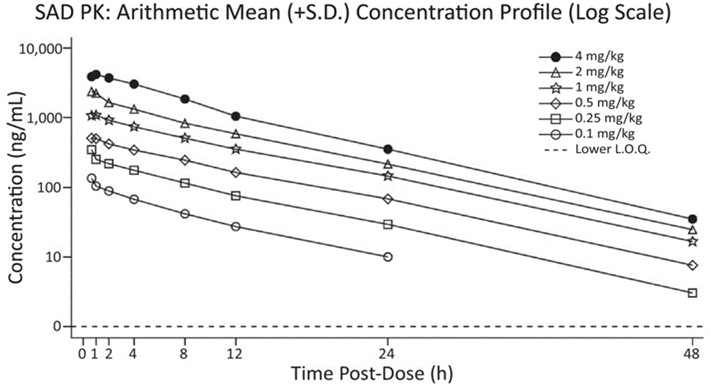
Plasma concentration-time profiles for the six dose levels of RR-HNK tested in Trial 1.

RR-HNK plasma concentration-time profiles from Trial 1. Reprinted from “A Phase 1 Assessment of the Safety, Tolerability, Pharmacokinetics and Pharmacodynamics of (2R,6R)-Hydroxynorketamine in Healthy Volunteers,” by SM Raja et al. , 2024, Clinical Pharmacology & Therapeutics, 116(5), pp. 1314–1324 (https://www.doi.org/10.1002/cpt.3391). Copyright 2024 by the authors.

In the brain activity test, some participants who received low to moderate doses RR-HNK, but not those given high doses or the placebo, showed an increase in the power of gamma oscillations. Preliminary evidence that RR-HNK causing a change in brain activity strengthens the case for its use as an antidepressant and provides a clinical biomarker to measure if it works in future research. However, there was a lot of variability in the results, and given the small number of participants, the researchers caution against drawing firm conclusions from these findings.

What do the results mean?

This study offers critical insight into its safety, tolerability, and effects RR-HNK in a diverse population of healthy adults. Findings from this early-stage study show that the ketamine metabolite does not cause the negative side effects of ketamine and is safe for use in humans. The results also help define dosing parameters for its use in future research and therapy.

These data, particularly a strong safety profile, support progress to the next phase of research aimed at developing new treatments for people with difficult-to-treat mental disorders. Despite the small size of each trial, making some of the results difficult to interpret, the findings hold promise for the future of mental health treatment. This study is a critical early step in NIMH’s mission to improve the treatment of mental illness through research, setting the stage for clinical trials testing whether RR-HNK effectively treats depression and other disorders.

Reference

Raja, SM, Guptill, JT, Mack, M., Peterson, M., Byard, S., Twieg, R., Jordan, L., Rich, N., Castledine, R., Bourne, S., Wilmshurst, M., Oxendine, S., Avula, SGC, Zuleta, H., Quigley, P., Lawson, S., McQuaker, SJ, Ahmadkhaniha, R., Appelbaum, LG … & Thomas, CJ (2024). Phase 1 evaluation of the safety, tolerability, pharmacokinetics and pharmacodynamics of (2R,6R)-hydroxynorketamine in healthy volunteers. Clinical Pharmacology & Therapeutics, 116(5), 1314–1324. https://www.doi.org/10.1002/cpt.3391

Grants

R01MH107615 , ZIAMH002857 , ZIATR000042 , ZIAAG000297

Clinical trial

NCT04711005

depression fastacting hope Treatment
bhanuprakash.cg
healthtost
  • Website

Related Posts

What animal studies teach us about toxic work environments

April 27, 2026

I hate hope: How to manage hope when you have treatment-resistant bipolar disorder

April 19, 2026

Calm & Correct: The 4-in-1 color correcting treatment

April 19, 2026

Leave A Reply Cancel Reply

Don't Miss
Fitness

A Hike Leader’s Must-Have Kit

By healthtostApril 30, 20260

After leading a few group hikes, I’ve learned that the difference between an enjoyable…

Sapio Sciences brings Claude Cowork to the lab

April 30, 2026

3 Day Home Workout Plan: Build Muscle and Burn Fat

April 30, 2026

Judicial Restrictions on Abortion COVID-19 < SRHM

April 30, 2026
Stay In Touch
  • Facebook
  • Twitter
  • Pinterest
  • Instagram
  • YouTube
  • Vimeo
TAGS
Baby benefits body brain cancer care Day Diet disease exercise finds Fitness food Guide health healthy heart Improve Life Loss Men mental Natural Nutrition Patients Pregnancy protein research reveals risk routine sex sexual Skin Skincare study Therapy Tips Top Training Treatment ways weight women Workout
About Us
About Us

Welcome to HealthTost, your trusted source for breaking health news, expert insights, and wellness inspiration. At HealthTost, we are committed to delivering accurate, timely, and empowering information to help you make informed decisions about your health and well-being.

Latest Articles

A Hike Leader’s Must-Have Kit

April 30, 2026

Sapio Sciences brings Claude Cowork to the lab

April 30, 2026

3 Day Home Workout Plan: Build Muscle and Burn Fat

April 30, 2026
New Comments
    Facebook X (Twitter) Instagram Pinterest
    • About Us
    • Contact Us
    • Privacy Policy
    • Terms and Conditions
    • Disclaimer
    © 2026 HealthTost. All Rights Reserved.

    Type above and press Enter to search. Press Esc to cancel.