


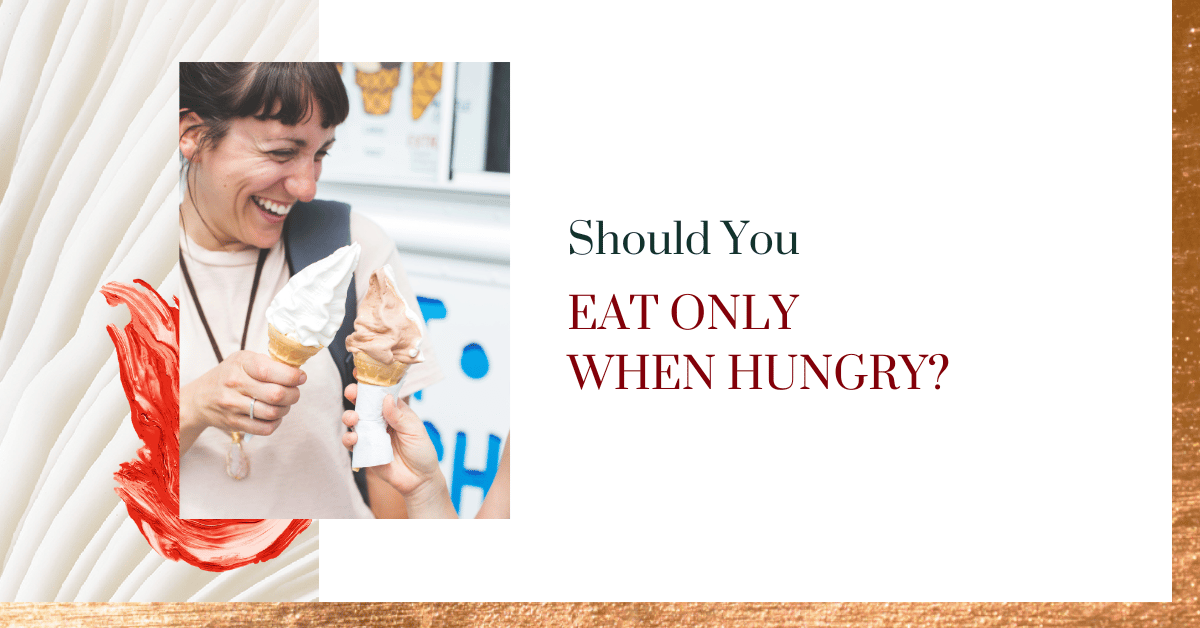
One of the common questions people have as they begin their intuitive eating journey and become more attuned to their hunger cues is whether they should eat only when they are hungry. (Spoiler alert: the answer is no!).
Read on to find out why there are many reasons you might eat other than hunger, and why it’s not just okay – it’s normal.
What messages have you received about only eating when you’re hungry?
Most of us have received messages telling us to distinguish between eating Hunger and eating for boredom, or other feelings. The latter is usually punished as an “invalid” reason for eating.
Food culture has taught that “healthy eating” means “eat only when you’re hungry.” This is also a message that can inadvertently come across when people learn about intuitive eating.
In response to a food craving or desire, you may have been told – through a nutrition plan, a health professional or even a dietitian – that you should:
- “Wait 20 minutes to see if you’re really hungry.”
- “Eat something else (usually something like an apple or carrot) and see if you still crave the food.”
- “Find something else to do if you’re bored of being distracted.”
When I first worked as a dietitian, I recommended many of these same things to my patients and clients.
But over the years I’ve come to realize that this line of thinking – that we HAVE to be physically hungry to eat anything – is unhelpful at best and harmful at worst. It tends to put us in a restrictive mindset, which often leads to later overeating. This brings us to…
Is it okay to eat when you’re not hungry?
Absolutely! Food serves many purposes beyond just being a source of fuel and nutrients. There are many reasons why you might want to eat, even when you’re not physically hungry.
Food is a source of joy, pleasure, culture and memory.
In many cultures, food is a love language, connecting family members, friends, and even generations. Can you think of a dish that makes you happier when you’re having a rough day? Or a dish you associate with a family member or memory? For me, it’s the chocolate chip cookies I used to make with my mom and boxed macaroni and cheese that always provide comfort.
Food also reflects history and culture and is a bond that connects people and places. The way a dish is prepared historically can tell you about the socio-agricultural history of its place of origin.
Eating can be a coping mechanism.
Sometimes food can be the only thing that can calm or comfort us when we are stressed, sad or lonely. In these situations, we rely on food as a coping mechanism, and that’s okay.
Coping mechanisms are developed for a reason, to help us through a difficult time. Depriving yourself of this coping tool (i.e. food) is not helpful, especially if you have no other ways to deal with that stressor or emotion.
Intuitive eating also involves knowing the brain.
Intuitive eating involves using your body’s cues and your brain’s insights to decide what, when and how much to eat.
For example, your work schedule may mean that your only chance to eat is early in the morning before work. Otherwise, you won’t have a chance to eat until noon. Although you may not feel as hungry this early in the morning, it is still important to eat something to provide your body with energy and prevent excessive hunger at midday.
There are also times when your hunger cues can be masked by stress, anxiety, caffeine intake, and even exercise. Many people do not feel hungry when they are busy, stressed, have just exercised, or consumed a lot of caffeine.
But just because you don’t feel hungry at those times doesn’t mean you don’t need to eat: your body still needs energy and fuel. This is where your brain’s knowledge comes in, to alert you that it’s been X hours since you last ate, or to remind you that you still need to eat even if you don’t feel hungry.
What about highly processed foods?
You may have heard or read about “ultra-processed foods”, how they are designed to be super-tasty or super-tasty, and how they are marketed to be super-appealing.
It may seem like these foods are meant to “seduce” our body’s internal hunger system, but to our bodies, these are still just foods that have flavors and textures and provide some combination of nutrients.
Try to approach these foods the same way you would any other food: be mindful and watch your body as you eat them. What do you notice about taste, flavor, satisfaction, fullness?
You may notice once you start eating that the food may not taste as good at the moment, even though it looked really appealing before. This may be because the branding or marketing of the food makes it look appealing, but it’s actually not what your body wants right now.
There’s a difference between “forcing” yourself not to eat highly processed foods (which can trigger the restriction-binge cycle) and compassionately giving yourself permission to eat them while noticing how they affect you.
Sometimes highly processed or packaged foods seem very appealing because we have labeled them as “bad” and think of them as something we shouldn’t eat. This type of mental limitation puts us in a scarcity mindset.
This mindset can lead us to overeat and feel “out of control” when we have access to limited or off-limits food. As you work to give yourself unconditional permission to eat, you may notice that this appeal diminishes over time, and eventually, these highly processed foods will become like any other food to you.
What are some reasons to eat other than hunger?
Below are some situations in which you may want to eat even when you don’t feel physically hungry. Are you related to any of them?
- When you are physically full, but not mentally satisfied with what you already ate.
- When you have a craving for food.
- When you’ve just worked out.
- When you see someone else eating and their food (and their eating experience) seems really appealing.
- When food is part of an experience (for example, popcorn at the movies or cake at a birthday party).
- When you notice that you are stressed or anxious and you haven’t eaten in the last 3-4 hours.
- When you try a food for the first time (for example, while traveling to a new city or visiting a new restaurant).
- When a food has a special meaning to you (for example, a certain food that you always eat on a special occasion or when you visit your parents).
- When you know you’re going somewhere where you won’t be able to eat for several hours.
- When you are stressed and you feel that a certain food would help you feel safe or calm you down.
- When food looks really delicious right now!
Do you have other motivations for eating other than hunger? Comment below!
A few things to keep in mind about hunger and food
Remember that ideally, you want to try to eat whenever you’re hungry, not only only when you’re hungry!
Regardless of the situation, motivation or food, can you be present in everything you experience without worrying too much about what or why or how much you are eating?
If discomfort arises as you give yourself permission to eat out of hunger, sit with that discomfort. Explore where it might be coming from. This can be a great opportunity to better understand your relationship with food. A dietitian who specializes in intuitive eating can also be supportive.
Looking for more support?
My team and I offer one-on-one virtual coaching and can help you break out of the all-or-nothing mindset, find the gray area and come to terms with food and your body – check it out nutrition guidance packages to learn more.
You can also see mine Unapologetic Eating 101 Coursean online, self-paced intuitive eating and body image program to break free from dieting and make peace with food and your body.
Author biography
This blog post was written and edited by Thanh Thanh Nguyen, a nutritionist at Teachers College, Columbia University.
The post was edited and reviewed by Alissa Rumsey, MS, RD, CSCS, registered dietitian and certified intuitive nutrition consultant. She specializes in inclusive weight care, intuitive eating, body image therapy, mindfulness, self-compassion, and healing from chronic dieting, disordered eating, and eating disorders. Alissa holds a BA in Nutrition and Exercise Science, and a MA in Health Communications, and is also an NSCA Certified Strength and Conditioning Specialist.
